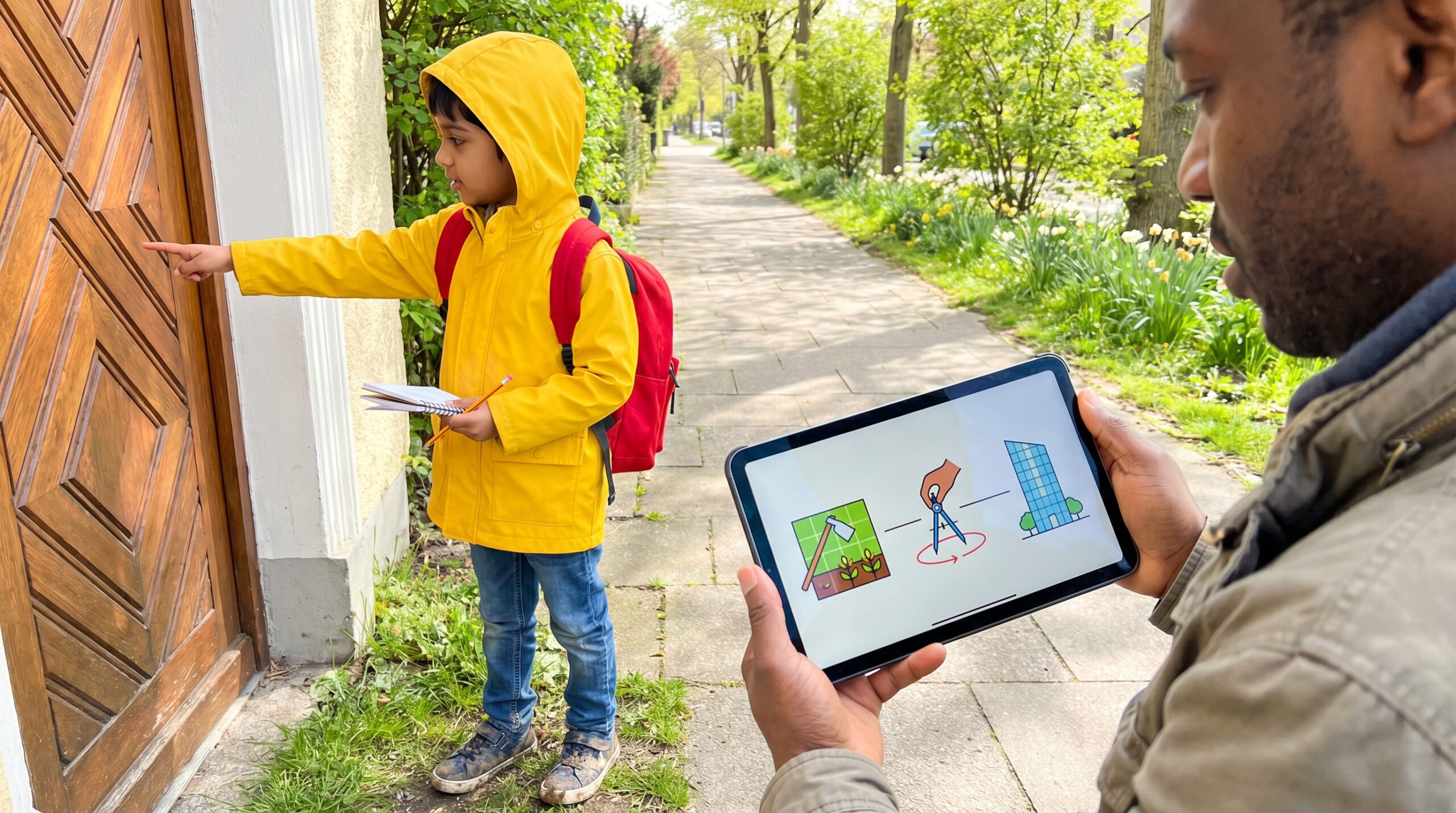
Rectangle for kids starts with things children see every day. For example, a door, a tablet screen, or a book cover all show the shape. Say the name aloud and the rectangle becomes friendly and familiar.
What is a rectangle?
A rectangle is a quadrilateral with four right angles (90°) and opposite sides that are equal and parallel. In short, each interior angle measures 90 degrees, reinforcing its definition as a fundamental geometric shape. According to Math Open Reference, this basic structure is essential for understanding their characteristics.
Quick properties to notice
- The diagonals are equal in length and bisect each other, which is an important property for geometric proofs and understanding the symmetry of rectangles, as noted by Math Open Reference.
- Lines of symmetry run through the center, so the shape looks balanced.
- A rectangle is a special parallelogram. Also, a square is a special type of rectangle where all four sides are of equal length, highlighting the relationship between these two shapes according to SplashLearn.
Rectangle for kids: simple formulas
Try two short, useful formulas. First, the area of a rectangle is calculated by multiplying its length by its width, so area = length × width. This provides a practical application of rectangles, which is important for educational purposes, as discussed on SplashLearn. Next, the perimeter of a rectangle is calculated by adding twice the length and twice the width: Perimeter = 2 × (Length + Width). Understanding how to calculate the perimeter is crucial for various real-world applications involving rectangles.
For example, a book cover 20 cm by 12 cm has area 240 cm squared. Likewise, the same book has perimeter 64 cm. Measuring like this helps ideas stick.
Everyday rectangles to spot
Rectangles appear everywhere. Look for doors, windows, A4 paper, license plates, and screens. Bricks and pavement slabs also show rectangles in rows.
Try a spring walk and ask your child to find and count rectangles. It turns a short walk into joyful discovery.
Hands-on ideas that feel like play
- Scavenger hunt: make a checklist of five rectangles to spot.
- Measure and compare: measure length and width of three finds. Then compute area and perimeter together.
- Rectangle collage: cut recycled boxes and label sides to practice vocabulary.
- Grid puzzle: draw a 3 by 3 grid and count all rectangles. Use the counting formula for a grid: rectangles = m(m+1)n(n+1)/4.
A quick math moment works well. For a 3 by 2 grid the formula gives 3×4×2×3 divided by 4, which equals 18 rectangles. For older kids try a 4 by 5 grid. It is a neat combinatorics trick.
Euclid called a rectangle a quadrilateral with four right angles. Also, the word comes from Latin rectangulus, straight and angle. Ancient surveyors used right angle tricks to mark rectangular fields after the Nile flooded. That practical past helps explain why rectangles are so common today.
Read or listen to a story about Rectangle now: For 3-5 year olds, For 3-5 year olds, For 6-8 year olds, For 8-10 year olds, and For 10-12 year olds.
Final thought
Rectangles are simple, useful, and full of learning moments. Small hunts turn into big discoveries. Try a tiny measuring activity and watch curiosity grow.
Want more? Explore related Storypie ideas and stories to keep the learning playful and bright.