Sunlight for kids lights imagination and sparks simple questions that grow into wonder. For example, sunlight feels warm on the cheek. Also, it brightens a page and a morning mood.
Sunlight for kids: What sunlight is
Sunlight is electromagnetic radiation from the Sun. Inside the Sun, nuclear fusion turns hydrogen into helium and releases huge energy. Then that energy travels through space as waves and as tiny packets called photons. Light moves very fast. At about 299,792 kilometers per second, sunlight takes roughly 8 minutes and 20 seconds to reach Earth, covering a distance of approximately 93 million miles according to the American Museum of Natural History.
Sunlight and life
Sunlight comes in a spectrum: ultraviolet, visible, and infrared. Visible light runs roughly 380 to 740 nanometers. Our eyes use that band to see color. For example, Rayleigh scattering sends short blue waves across the sky. So the sky looks blue. Later, when sunlight travels farther through air, sunsets glow red and orange.
Sunlight plays a starring role in nature. Photosynthesis converts light into food and oxygen. Thus plants, algae, and some bacteria support whole food chains. Also, UVB helps people make vitamin D; in fact, nearly 50% of daytime UVB radiation—responsible for sunburn and vitamin D synthesis—is received between 10 a.m. and 4 p.m., when the sun’s rays are strongest, as noted by the U.S. Environmental Protection Agency. Finally, sunlight helps set sleep cycles and lifts moods.
Why sunlight matters and safety tips
Sunlight nourishes gardens and bodies. However, it can harm skin and eyes in strong doses. Therefore families benefit from simple safety steps. Use these friendly tips to enjoy sunlight safely.
- Use broad spectrum sunscreen and reapply after swimming.
- Wear sunglasses that block UV and a wide brim hat on bright days.
- Avoid direct sun during peak midday hours when UV is highest; remember that approximately 1,361 watts per square meter (W/m²) of solar energy hits the top of Earth’s atmosphere, reducing to about 1,000 W/m² under clear-sky conditions according to SolarScope.
- Never let children look directly at the Sun or through magnifiers without proper filters.
Hands on mini activities
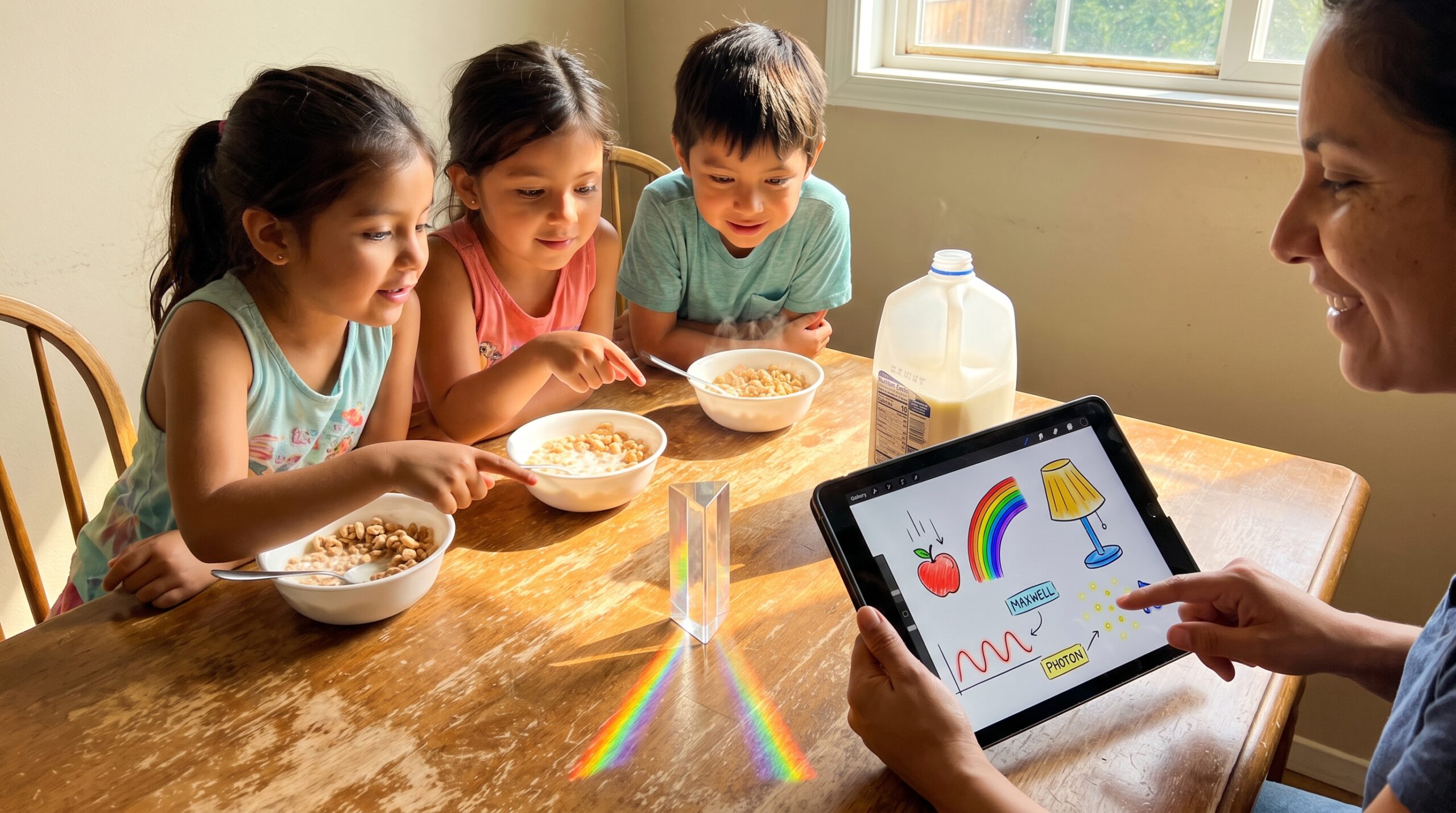
Sunlight invites playful experiments that are short and safe. For example, try a prism rainbow. Hold a glass prism or spray a fine mist to split sunlight and watch a rainbow appear. Also, mark a toy’s shadow every 30 minutes to learn about the Sun’s angle and time of day. Next, make a pinhole camera to project the Sun safely. Finally, on warm days try a small solar oven to melt chocolate with adult supervision.
Read or listen to a story about Sunlight now: For 3-5 year olds, For 3-5 year olds, For 6-8 year olds, For 8-10 year olds, and For 10-12 year olds.
Final thought
Sunlight for kids is science you can feel and taste in a ripe tomato. Encourage curiosity with short experiments and cozy stories. Try a Storypie sunlight story at breakfast to spark a five minute science chat and a bright, wonder filled start to the day.