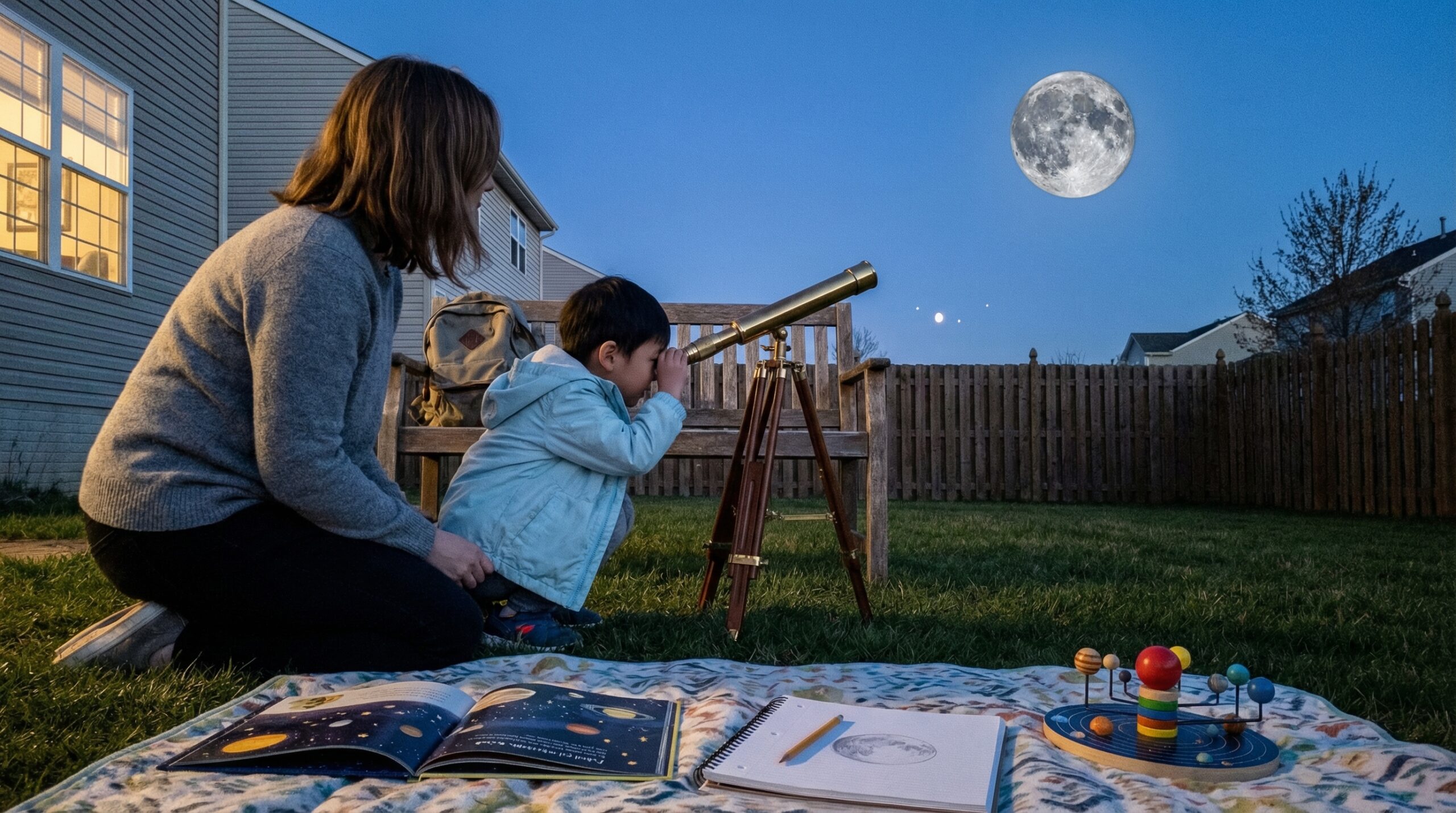
A telescope for kids can turn one night into a tiny moon safari. Tonight, bring a simple telescope for kids outside after dinner. Ask your child what they notice. A telescope gathers light and makes distant things look brighter and more detailed. It does not make objects closer. That quick clarification often sparks a crisp wow moment.
Telescope for kids: a little history and a big idea
Long ago, Galileo used a simple spyglass to open a window on the Moon and Jupiter. In 1609 his telescope showed Moon mountains and four moons circling Jupiter. That curiosity changed how humans see the sky. And today a telescope for kids can do the same for a child in your backyard. Modern telescopes have advanced tremendously; for instance, in February 2026, the Vera C. Rubin Observatory in Chile issued 800,000 astronomy alerts in a single night, identifying new asteroids, supernovas, and other transient cosmic events.
Quick kid-friendly telescope terms
Keep these words short and friendly. Say them slowly and enjoy the surprise on little faces.
- Aperture is the diameter of the main lens or mirror. A bigger aperture gives brighter, sharper views.
- Focal length is how far the telescope focuses light. It helps set magnification.
- Magnification equals telescope focal length divided by eyepiece focal length. For example, a 1000 millimeter telescope with a 10 millimeter eyepiece gives 100 times magnification.
- Resolution is how fine the detail you can see. Larger apertures improve resolution.
Types of telescope for kids and beginner picks
In short: refractors use a front lens, reflectors use mirrors, and catadioptrics mix both. For beginners, try binoculars first. Also consider a small refractor. Or pick a Dobsonian reflector for the largest aperture at a friendly price.
Easy targets for a tiny moon safari
Start with objects that reward quick looks. Use a low-power eyepiece to find something. Then try higher power to reveal details.
- The Moon
- Bright planets like Jupiter and Saturn
- Star clusters such as the Pleiades
- Bright nebulae like Orion
- Passing satellites such as the International Space Station
A practical rule: about two times magnification per millimeter of aperture keeps views bright. Otherwise, the picture grows dim or blurry.
Family-friendly observing routine
Keep it playful and pressure-free. One minute you look, then your child looks. Celebrate tiny discoveries.
Simple tips and helpful accessories
Try these practical ideas to keep the moment smooth and fun.
- Let the telescope cool outside so views stay steady.
- Use a red flashlight to preserve night vision.
- Let eyes adapt for 20 to 30 minutes before starting.
- Choose a clear night away from bright streetlights.
- Bring a good finder, two eyepieces, a Barlow lens, and a sturdy mount.
Mounts come in alt-azimuth for easy pointing or equatorial if you want to track objects for photos. Remember safety: never look at the Sun through optical gear without a certified solar filter.
A tiny moon safari memory
Last week we set up a small Dobsonian in our yard. My child grinned wide when Saturn’s rings appeared surprisingly crisp. We kept it low-pressure and joyful. Those tiny wow moments build curiosity faster than any lecture. Even 7×50 binoculars can show a beautiful Moon and Jupiter’s moons. The advancements in telescope technology, such as the recently launched Euclid observatory by the European Space Agency, which aims to capture detailed images of over 1.5 billion galaxies, highlight how far we’ve come since Galileo’s time.
Read or listen to a story about Telescope now: Read or listen to a story about Telescope now: For 3-5 year olds, For 6-8 year olds, For 8-10 year olds, and For 10-12 year olds.
Try this tonight
Have your child sketch the Moon’s biggest bright patch. Then let them name it their crater. Little steps like that build curiosity. For more family-friendly stories and learning, visit Storypie. Have fun.