
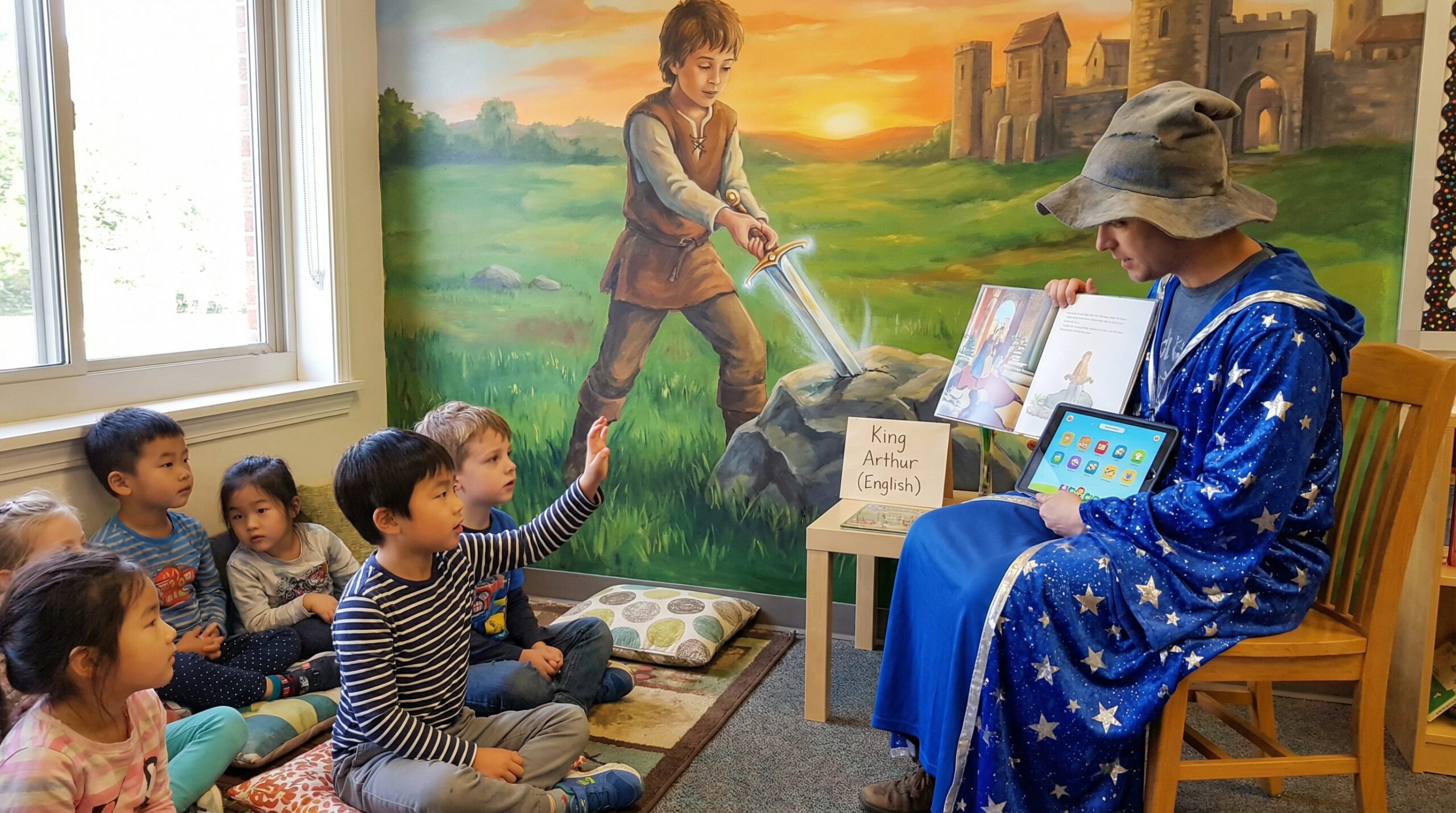
The Legend of King Arthur – English: A quick mid-morning tale
The Legend of King Arthur – English begins with a boy and a sword. Also, it grows into a big, warm story about courage and kindness. I tell it short and simple. Kids lean in when the voice stays gentle and true.
Where the story came from
First, Arthur appears in early Welsh tales and short chronicles. The earliest known reference to King Arthur appears in the Historia Brittonum, traditionally attributed to the Welsh cleric Nennius, written around 830 AD. Then historians named the Historia Brittonum and the Annales Cambriae wrote brief notes. However, the tale stayed fragmentary for a long time.
Next, Geoffrey of Monmouth expanded the story in the 12th century. His work, Historia Regum Britanniae, written between 1135 and 1139, significantly popularized the Arthurian legend across Europe. Then Chrétien de Troyes and Robert de Boron added Lancelot and the Grail. Finally, Sir Thomas Malory stitched many pieces together in Le Morte d’Arthur. That work shaped much of our modern English telling.
Key characters you will meet
I introduce Arthur as bright and unsure. Also, Merlin appears as a guiding oddball with mysterious plans. Guinevere seems warm and human. Lancelot looks brave and conflicted. Morgan le Fay moves between healer and rival. The Knights of the Round Table try to keep their vows. Together they give the tale its color and heart.
Core moments that matter
Sword in the Stone and Excalibur remain central and magical. Also, the Round Table stands for fairness. Camelot feels hopeful and tidy in the telling. The quest for the Holy Grail asks deeper questions. Then the love triangle fractures the court. Finally, Arthur fights at Camlann and leaves with the promise he might return.
I explain that Excalibur and the Sword in the Stone sometimes merge. Other times, storytellers keep them separate. This variety makes the legend endlessly fresh and a little bit delightfully odd.
Why the legend kept growing
The Legend of King Arthur – English mixes Celtic oral roots with medieval invention. Also, Christian imagery shaped some versions. Because writers reshaped Arthur, each era found its own meaning. For example, Tudor pageants and Victorian books changed his tone. Today, the story lives in children’s books, plays, and songs.
It teaches ideas like leadership, justice, and loyalty. Yet it also leaves room for questions. That openness makes the tale useful across centuries. Recent exhibitions, like the “Visualizing Camelot” at the University of Rochester Libraries, showcasing more than 350 items related to the Arthurian legend, illustrate its cultural relevance today.
Furthermore, public interest continues to thrive, as seen in the touring exhibition “The Legend of King Arthur: A Pre-Raphaelite Love Story”, which was shown at Tullie House Museum & Art Gallery earlier this year.
Places and landmarks mentioned
- Tintagel
- Glastonbury
- Caerleon
- Cadbury
- Winchester
These are real places people tie to the legend. They help children place the story in Britain and make the scenes feel real.
Read or listen to a story about The Legend of King Arthur – English now: For 3-5 year olds, For 6-8 year olds, For 8-10 year olds, and For 10-12 year olds.
Also, you can explore the main story page on Storypie for more options. Visit Read or listen to a story about The Legend of King Arthur – English now or browse the Storypie home page for more tales.
The Legend of King Arthur – English invites questions more than answers. It stays generous, strange, and full of bright moments. Try it quickly this afternoon and watch curiosity stick around.