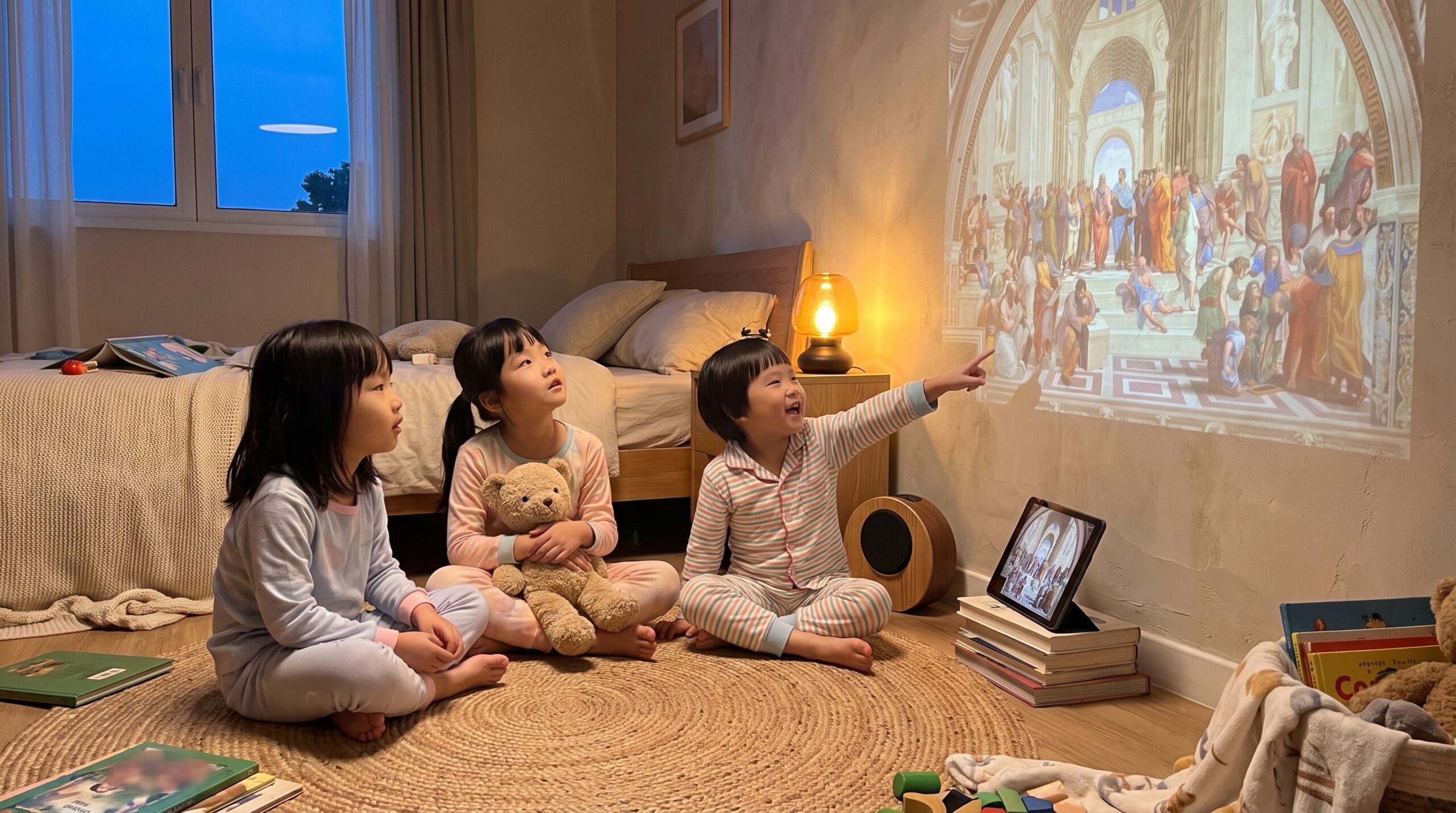
Welcome to The School of Athens painting
The School of Athens painting is Raphael’s grand fresco in the Vatican. It dates from about 1509 to 1511, marking it as a significant work of the High Renaissance period. Parents and teachers often mention its friendly crowd of thinkers. In fact, the scene looks like a lively meeting of ideas.
Where and when Raphael painted it
Raphael painted The School of Athens painting for the Stanza della Segnatura, located in the Apostolic Palace in Vatican City. He worked in buon fresco, which means he painted on wet plaster. As a result, the pigments fused with the wall and stayed bright for centuries. The dimensions of the fresco are approximately 500 cm in height by 770 cm in width (about 200 inches × 300 inches), emphasizing its grandeur and impact.
Who appears in the scene
Plato and Aristotle stand at the center. Plato points upward, and Aristotle gestures toward the earth. Those two poses are a clear, small story in one glance. Around them, Raphael placed Socrates, Pythagoras, Diogenes, Heraclitus, and Euclid or Archimedes with a compass. There are a total of 21 figures depicted in The School of Athens, though only a portion have been confidently identified, adding a playful mystery to the scene. Scholars still debate some identifications, which enriches the dialogue surrounding the artwork.
Design, perspective, and scale
Raphael used single point linear perspective. The vanishing point sits between Plato and Aristotle. The background shows grand, coffered architecture. Raphael borrowed ideas from Roman models and Bramante. The fresco stretches roughly five by seven meters, so seeing it on a small screen cannot show the full scale. The size helps the scene feel like a public square of ideas.
Why it mattered then and now
The School of Athens painting formed part of a room that celebrated branches of knowledge. The Stanza pairs philosophy with theology, poetry, and law. Together the frescoes create a painted library that invites conversation. Since the 16th century, artists and scholars have admired Raphael’s balance of classical learning and portraiture.
Simple viewing notes
- Look for gestures and groupings of figures.
- Notice the compass and geometric tools.
- See how faces may echo Raphael’s contemporaries.
Also use a high quality reproduction to catch small details. For images, the Vatican’s online photos show close views and colors clearly.
Read or listen to a story about The School of Athens now: Read or listen to a story about The School of Athens now: For 3-5 year olds, For 6-8 year olds, For 8-10 year olds, and For 10-12 year olds.
Finally, if you want more child-friendly art content, visit Storypie for more gentle guides and stories.
Tip: Ask one open question tonight to spark curiosity and wonder.