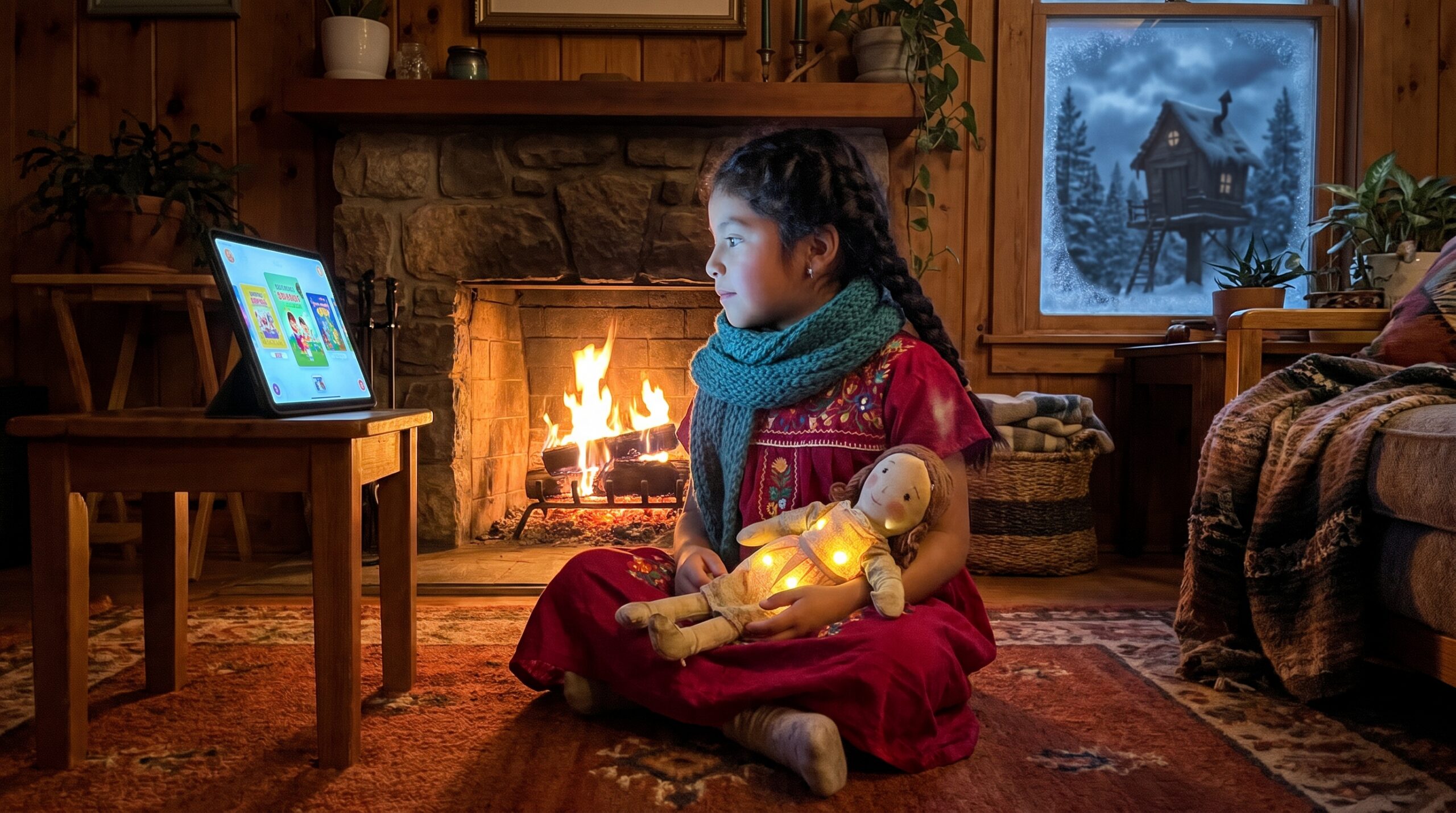
I love curling up in November with the Vasilisa the Beautiful story. It feels cozy and brave at once. Open Storypie for a five minute family ritual that sparks wonder and courage.
What happens in the Vasilisa the Beautiful story
Vasilisa becomes an orphan at the age of **eight** when her mother dies, giving her a magic doll that serves as a source of strength throughout her journey. The tiny carved or cloth doll acts as a motanka type helper. It is a maternal talisman and a visible sign of inner strength.
Then Vasilisa is sent to Baba Yaga. She finds a hut that stands on chicken legs. This striking image always captures kids. Baba Yaga sets impossible tasks. Often the doll helps Vasilisa sort seeds, clean floors, and find a light to take home. Sometimes the tale ends with light banishing the oppressors. In some versions, the narrative ends with the **death of the stepmother and stepsisters**, after which Vasilisa lives peacefully with her father—this lack of a wedding ending is noted as unusual for tales featuring a grown heroine. Sometimes Vasilisa goes on to the tsar’s court. In every version she gains freedom, wisdom, or a safer life. The tale “Vasilisa the Beautiful” (Василиса Прекрасная) was collected by Alexander Afanasyev and first published in **1862** in his collection *Narodnye russkie skazki*, and it is classified in the East Slavic Folktale Classification (SUS) as type **480B*** and in the international Aarne–Thompson–Uther (ATU) Index as type **AT 480B***.
Why Vasilisa the Beautiful still matters
The story quiets fear and makes courage practical. The doll stands for care that lasts. Baba Yaga is not only a villain. She is a boundary keeper who tests worth and resourcefulness. A 2025 scholarly article identifies Vasilisa the Beautiful as one of **three central archetypes of active heroines** in Russian folklore—specifically, she represents the “Wise Maiden/Enchantress” archetype—based on analysis of Afanasyev’s collections.
Also the tale contains darker elements in some versions. For preschool listeners I soften those parts. I keep the focus on courage and cleverness. That ambiguity makes the story rich to talk about with kids. It sparks empathy and problem solving in playful ways.
Quick ways to share Vasilisa tonight
- Ask one open question after the last page: “What would you do if you found Baba Yaga’s hut?”
- Point out the doll as a symbol of love or a habit that helps.
- Turn Vasilisa’s tasks into a tiny household game: sort socks, pour seeds, or tidy a corner.
Read or listen to a story about Vasilisa the Beautiful now: For 3-5 year olds, For 6-8 year olds, For 8-10 year olds, and For 10-12 year olds.
A tiny closing ritual
After listening, ask “What would you do?” Then pick one tiny task together and celebrate the attempt. It turns a story into a habit of courage. It makes your child feel utterly heroic, truly small but mighty.
Open Storypie or get the app to add this tale to your family routine. Open Storypie.