Water cycle for kids begins with a single droplet. I kneel by a sparkling puddle and imagine that tiny voice. It says, “I was a puddle, then I rose, I became a cloud, and I fell again.” That simple story makes the cycle feel friendly.
How the water cycle for kids works
The water cycle moves water between air, land, and oceans. First, the Sun warms water. Then water evaporates into vapor. Also, plants give water to the air by transpiration. Next, vapor cools and gathers into clouds. This is condensation. When droplets grow heavy, they fall as precipitation. In fact, approximately 5,000 billion gallons of water fall as precipitation each day in the lower 48 states of the U.S.
Precipitation can be rain, snow, sleet, or hail. Some water runs off into rivers. Some soaks into the ground and becomes groundwater. Some pools in lakes and oceans. Meanwhile, ice and glaciers can keep water for years. In contrast, a water molecule stays in the atmosphere about eight to ten days. The atmosphere contains about 3,094 cubic miles (12,900 cubic kilometers) of water, which is approximately 0.001% of the Earth’s total water volume.
A tiny history of the water cycle
Science grew from watching and measuring. For example, Bernard Palissy in the 1500s said rain feeds springs. Then Pierre Perrault in the 1600s measured rain and river flow. He showed that precipitation can explain river water. These stories show science as a careful, step-by-step detective job.
Explore the water cycle with your child
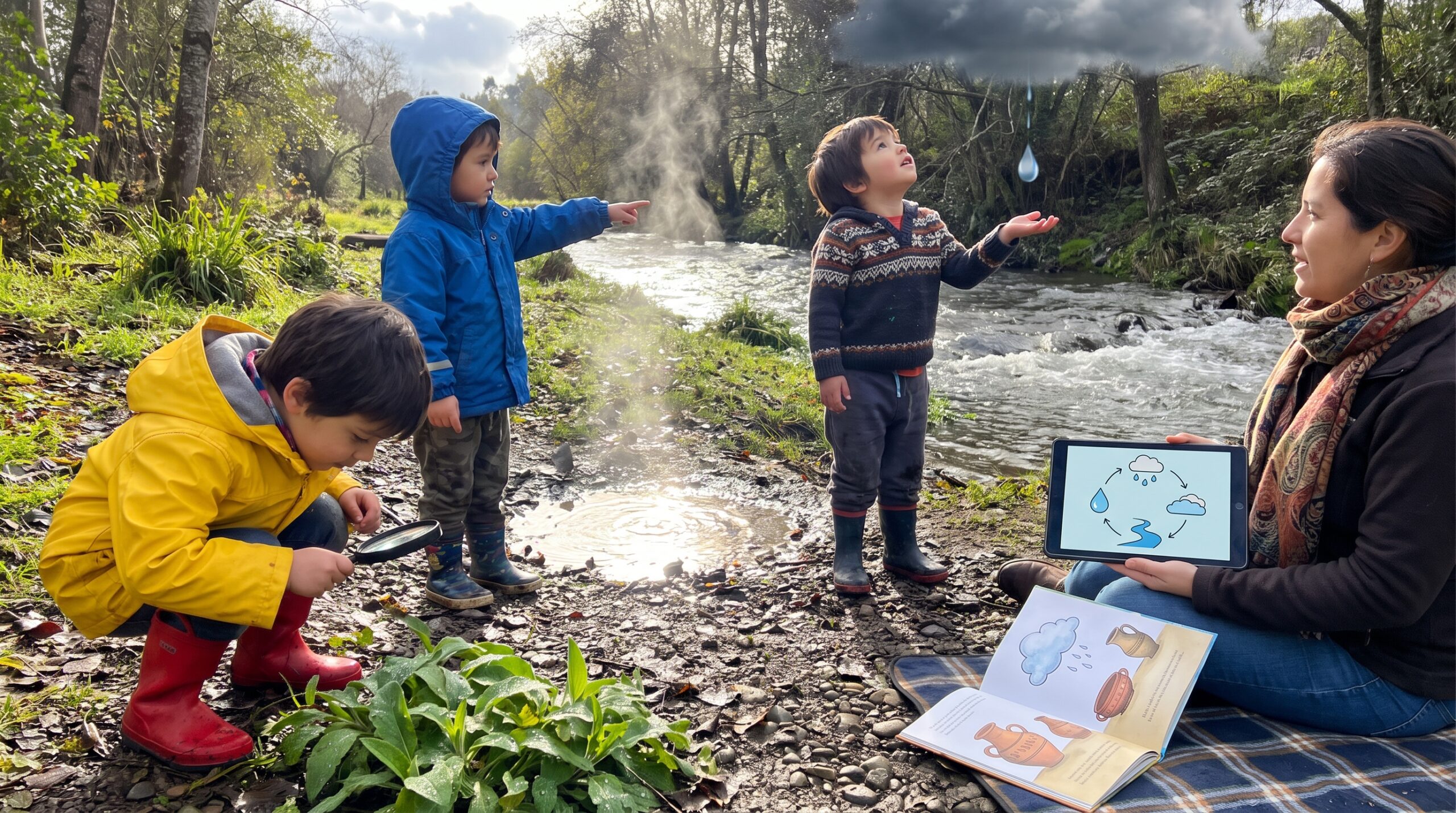
On a walk, be tiny detectives. Spot evaporation, condensation, precipitation, or collection. Try short, joyful demos at home. For example:
- Make a rain gauge from a jar.
- Tape a bag of water to a sunny window to watch evaporation and condensation.
- See condensation on a cold can.
Always supervise demos that use heat. Keep experiments short so curiosity wins. Also, point out steam on a sidewalk or fog rising from a river. Those are condensation and evaporation in motion.
Why the water cycle matters
The water cycle supports all life. It shapes weather and climate. Also, it supplies freshwater for drinking, farming, and industry. However, people change the cycle. Deforestation, concrete, pollution, and climate change alter water flow and water quality. Teaching kids respect for water is a small, mighty step. Globally, about 70 percent of terrestrial evaporation returns as precipitation over land, while only about 17 percent of evapotranspired moisture over oceans rains back on land.
Short glossary for curious kids
- Evaporation: water becomes vapor.
- Condensation: vapor makes clouds.
- Precipitation: water falls from clouds.
- Transpiration: plants release water to the air.
- Runoff: water traveling over land.
- Infiltration: water soaking into soil.
- Aquifer: underground water storage.
At Storypie we tell the water cycle’s journey, from droplet to cloud to river. We mix history and simple science for curious kids and families. For gentle stories that match age and attention span, try our tailored reads.
Read or listen to a story about Water Cycle now: For 3-5 year olds, For 6-8 year olds, For 8-10 year olds, and For 10-12 year olds.
For more about the concept and stories, visit our concept page: Read or listen to a story about Water Cycle now. Or gently explore the app at Storypie.