Why I tell a water cycle story at bedtime
I tell a water cycle story for kids when the last light fades. I use first person so children hold the science. First, keep lines short and sing-song. Then, add a clear problem and a small triumph. That helps curiosity stick and makes the tale cozy.
What the water cycle is
The water cycle moves water on, above, and below Earth’s surface. The Sun is the engine, so water warms and rises. Next, vapor travels on air and wind to new places. There is no fixed start or end. Instead, water moves among oceans, glaciers, lakes, rivers, soil, and the sky. In fact, mountains contribute between 55% and 60% of global annual freshwater flows, serving as essential ‘water towers’ for roughly 2 billion people.
Water cycle story for kids: main stages
Evaporation and transpiration: I warm and I vaporize. Liquid water becomes vapor from oceans, lakes, and plants. Then condensation: I cool and gather into clouds, clinging to tiny dust bits. Next precipitation: I fall as rain, snow, sleet, or hail depending on the air. Finally collection: I join rivers, soak into soil, become groundwater, or return to the ocean. Runoff runs fast after storms. Infiltration moves slowly underground into aquifers. Understanding these processes is more important than ever, as global rivers experienced their lowest flow levels in 33 years in 2023, highlighting the critical state of our water resources.
Quick facts kids can remember
About 97.5 percent of Earth’s water is saltwater in oceans. Only about 2.5 percent is freshwater. Most freshwater is frozen or deep underground. The atmosphere holds a tiny share, but it moves fast. In fact, water stays in the air for only days. Meanwhile, deep groundwater and ice can lock water away for decades to millennia. Alarmingly, the world is losing 324 billion cubic meters of freshwater every year, which is equivalent to the water needs of 280 million people annually.
Why the water cycle matters and what you can see
The water cycle gives us drinking water, weather, and steady beats for ecosystems. Also, plants breathe out vapor through transpiration. Because condensation releases heat, it helps shape weather. Humans change the cycle when we build cities, dam rivers, pump groundwater, or pollute streams. That changes when and where water falls. For instance, in 2023, the Amazon’s Rio Negro River reached its lowest water levels in a century, with water surfaces reduced to 68.1% of the maximum observed during the previous year. This illustrates how climate factors can lead to extreme fluctuations in water levels, affecting ecosystems.
Simple experiments and a kid action
Try a tiny experiment tonight to show evaporation and condensation. First, put a little water in a clear sealable bag. Then tape it to a sunny window and watch. Or fill a jar with hot water and hold a plate of ice above it to see steam turn into drops. Always supervise with hot water.
Use these keywords with your child: evaporation, condensation, precipitation, transpiration, groundwater, aquifer, runoff, watershed. For preschoolers, say rain, cloud, puddle, and sun. For older kids, add the scientific words and link to classroom standards.
Read or listen to a story about Water Cycle now: For 3-5 year olds, For 6-8 year olds, For 8-10 year olds, and For 10-12 year olds. Also visit Read or listen to a story about Water Cycle now for full concept pages and audio.
Try it tonight
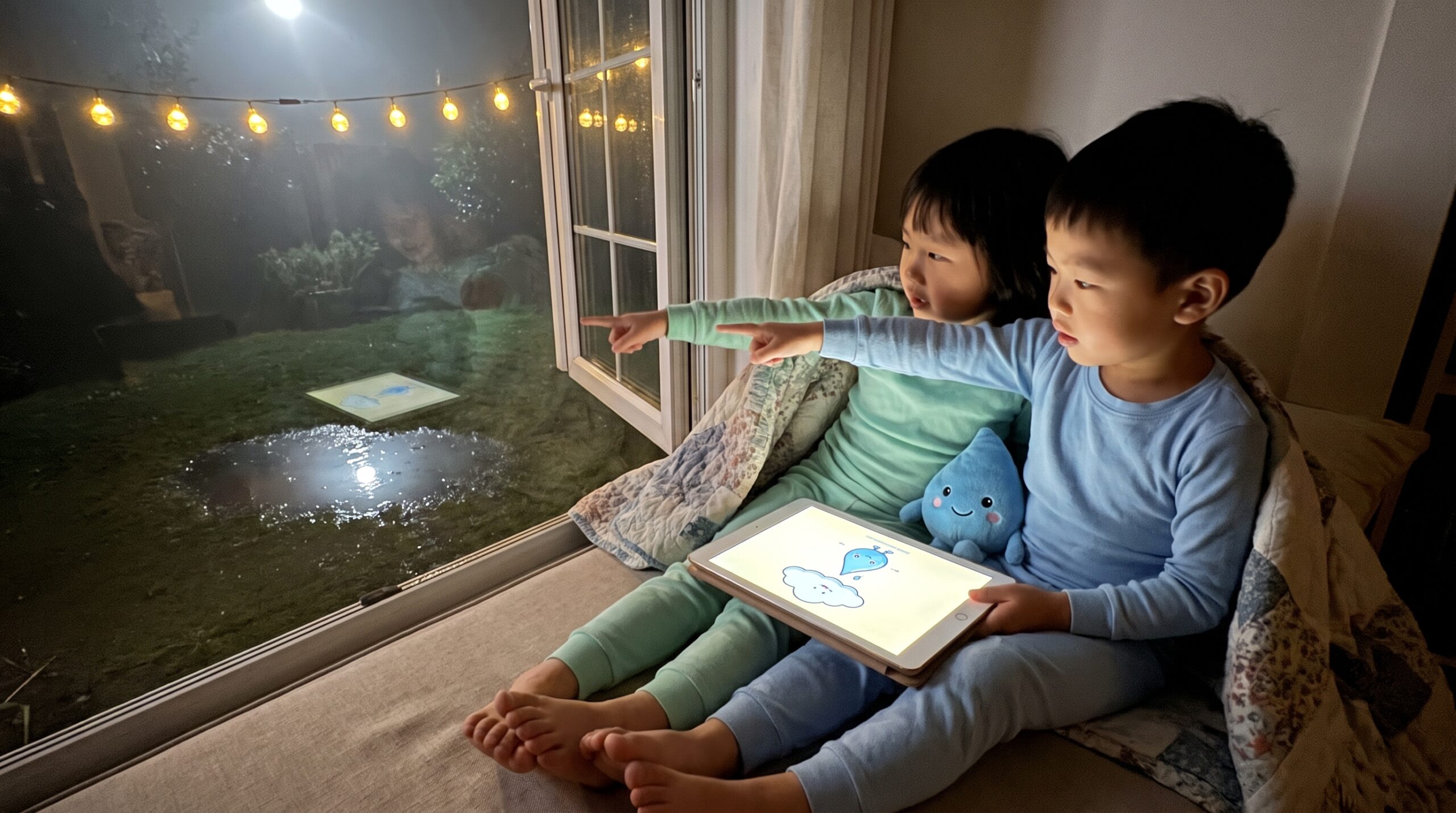
Turn the journey into a short audio tale. Follow a droplet from puddle to cloud and back. Play it tonight to spark your child’s curiosity. Then invite your child to say, “I was a droplet who…” and listen. The best learning happens when kids get to be the narrator.
For more family-friendly stories and audio prompts, gently explore Storypie. Enjoy this small, magical science moment together.