English

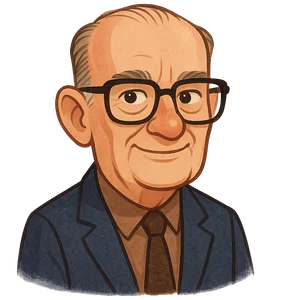
Arthur C. Clarke
A British science fiction writer, futurist, and inventor…
Reads at Grades 6–8 Listens at Grades 4–8
Print & create
Answer keys·No prep·Free with an account
28 worksheets · answer keys · full story · quiz · Ages 10-12 · CEFR B2
Plus adds 244,000+ more stories in 27 languages, audio for every one, and printables for all of them.
Just want Arthur C. Clarke?
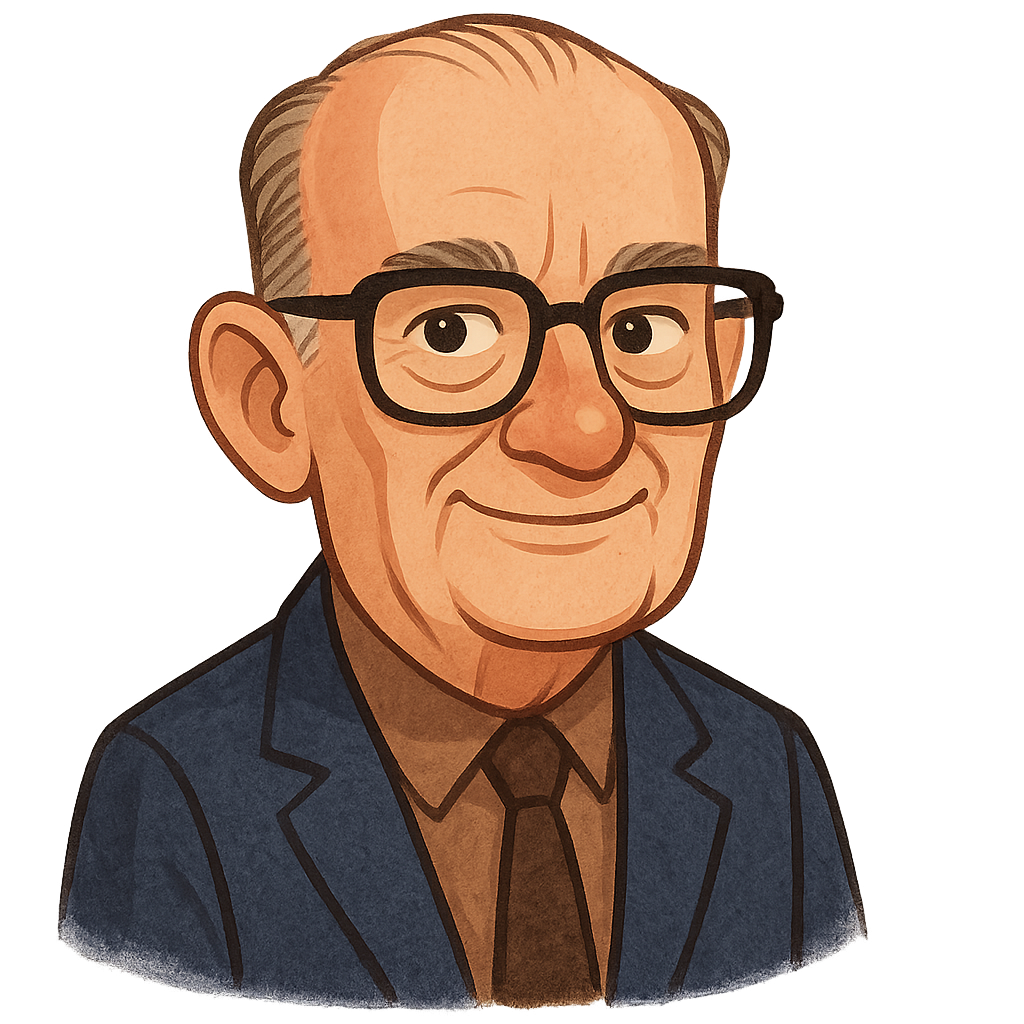
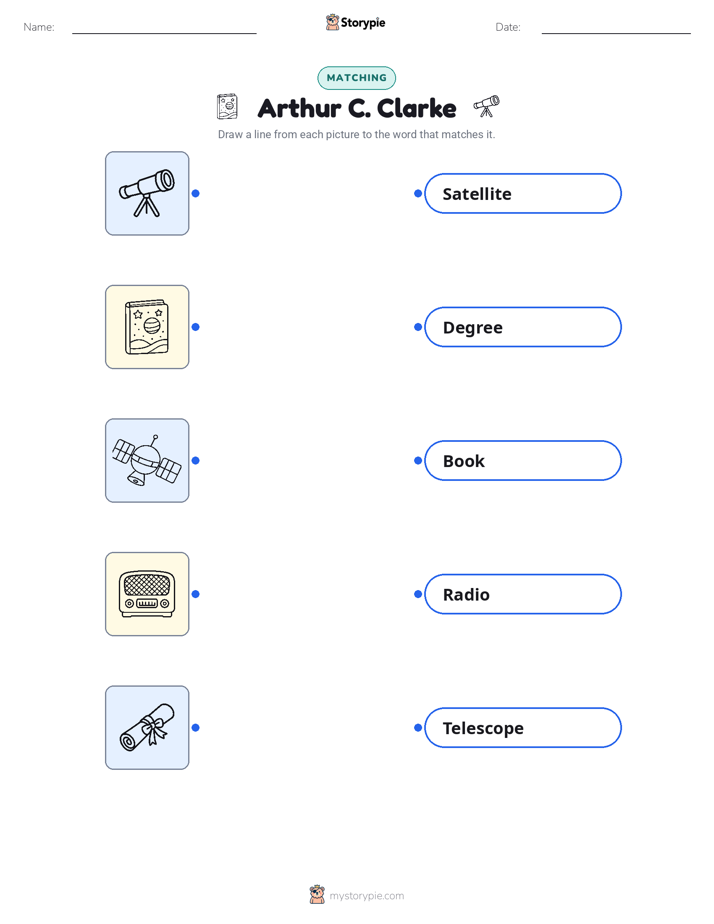
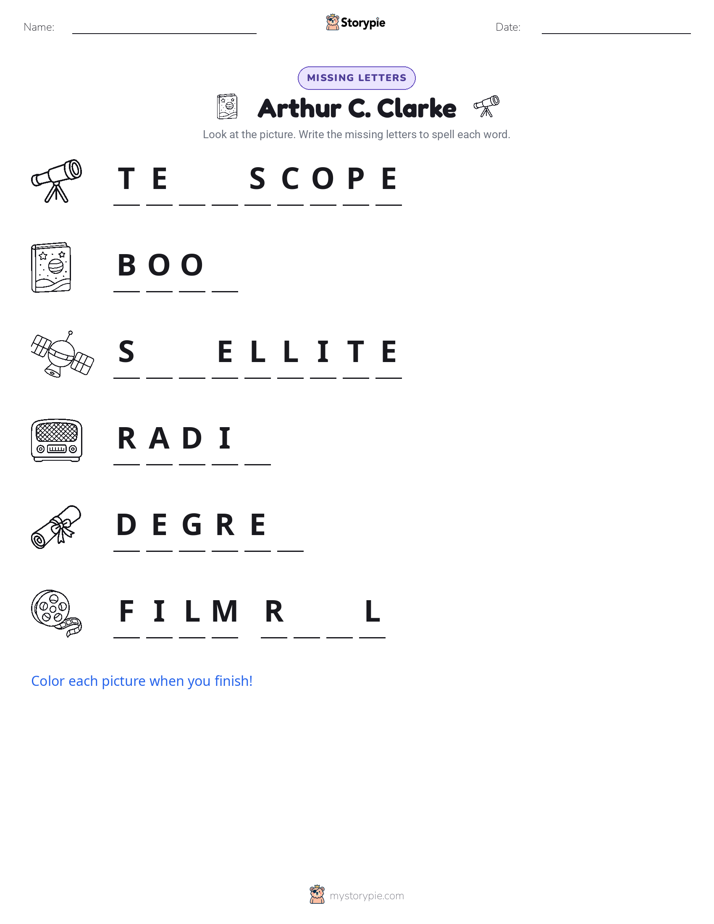
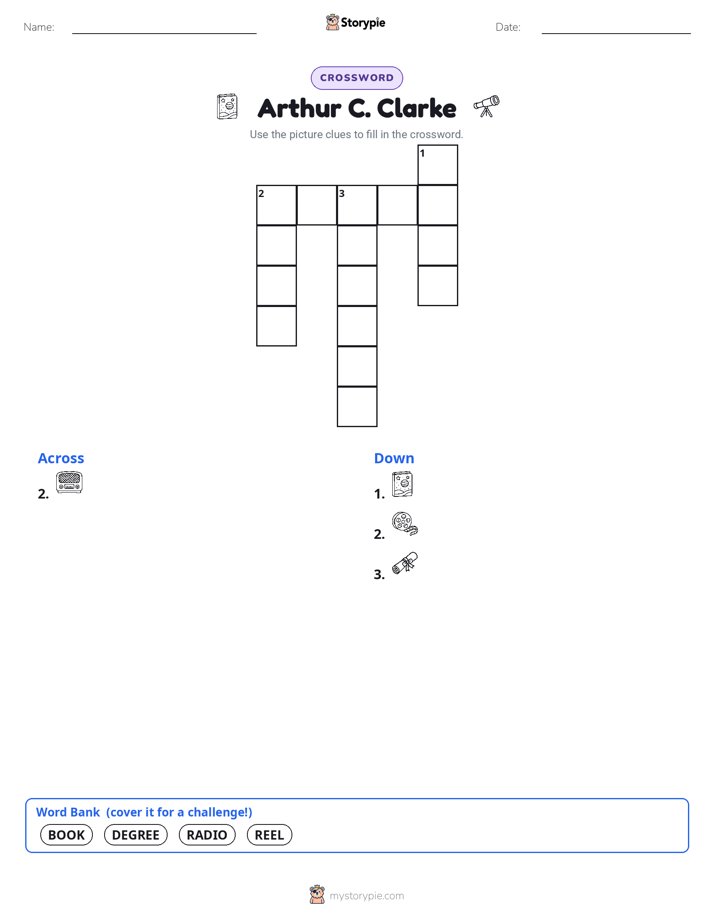
Hello, my name is Arthur C. Clarke, and I spent my life looking toward the future. I was born on December 16th, 1917, in the small seaside town of Minehead, England. Growing up on my family's farm, the world around me was quiet and rural, but my mind was always soaring among the stars. At night, I would gaze up at the vast, dark sky and feel a deep sense of wonder. I was so fascinated that I decided I needed a better view. Using cardboard tubes and lenses I had collected, I built my very own telescope. It wasn't as powerful as the ones in observatories, but it was mine, and it brought the moon and stars a little closer. My imagination was also fueled by something else: American science fiction magazines. They were filled with incredible stories of space travel, alien worlds, and futuristic technologies. Reading them, I began to believe that traveling to space wasn't just a fantasy; it was a future that humanity could actually build.
As a young man, my dreams of space became more serious. In the 1930s, I moved to London to be closer to others who shared my passion. There, I joined the British Interplanetary Society, a group of enthusiasts and thinkers who were all dedicated to the idea of space exploration. It was an exciting time, meeting people who didn't think my ideas were just daydreams. However, the world was soon caught up in World War II. From 1941 to 1946, I served in the Royal Air Force as a radar specialist. Radar was a new and vital technology that used radio waves to detect objects from a distance. My job was to help create an early-warning system that could guide pilots. Working with this technology gave me a powerful idea. In 1945, while still in the service, I wrote a scientific article. In it, I proposed that three satellites could be placed in a special orbit high above the Earth. This orbit, which we now call a 'geostationary' orbit, would allow the satellites to match the Earth's rotation, so they would appear to stay in the same spot in the sky. From there, they could bounce television and radio signals all around the globe, connecting the entire planet.
Arthur C. Clarke: A Visionary of the Future
Hello, my name is Arthur C. Clarke, and I spent my life looking toward the future. I was born on December 16th, 1917, in the small seaside town of Minehead, England. Growing up on my family's farm, the world around me was quiet and rural, but my mind was always soaring among the stars. At night, I would gaze up at the vast, dark sky and feel a deep sense of wonder. I was so fascinated that I decided I needed a better view. Using cardboard tubes and lenses I had collected, I built my very own telescope. It wasn't as powerful as the ones in observatories, but it was mine, and it brought the moon and stars a little closer. My imagination was also fueled by something else: American science fiction magazines. They were filled with incredible stories of space travel, alien worlds, and futuristic technologies. Reading them, I began to believe that traveling to space wasn't just a fantasy; it was a future that humanity could actually build.
As a young man, my dreams of space became more serious. In the 1930s, I moved to London to be closer to others who shared my passion. There, I joined the British Interplanetary Society, a group of enthusiasts and thinkers who were all dedicated to the idea of space exploration. It was an exciting time, meeting people who didn't think my ideas were just daydreams. However, the world was soon caught up in World War II. From 1941 to 1946, I served in the Royal Air Force as a radar specialist. Radar was a new and vital technology that used radio waves to detect objects from a distance. My job was to help create an early-warning system that could guide pilots. Working with this technology gave me a powerful idea. In 1945, while still in the service, I wrote a scientific article. In it, I proposed that three satellites could be placed in a special orbit high above the Earth. This orbit, which we now call a 'geostationary' orbit, would allow the satellites to match the Earth's rotation, so they would appear to stay in the same spot in the sky. From there, they could bounce television and radio signals all around the globe, connecting the entire planet.
After the war ended, I was determined to continue my education and my writing. In 1948, I earned a degree in both physics and mathematics from King's College London. This scientific knowledge gave my science fiction stories a strong foundation in reality. I began to write novels that explored humanity's future and our place in the universe. One of my most famous books was 'Childhood's End,' which imagined what might happen if humanity encountered a far more advanced alien civilization. My work caught the attention of a brilliant film director named Stanley Kubrick. Together, we collaborated on a project that would become one of the most famous science fiction films of all time: '2001: A Space Odyssey,' which was released in 1968. The film explored themes of technology, evolution, and artificial intelligence. Through my writing, I also developed what people now call 'Clarke's Three Laws.' The third law is perhaps the most famous: 'Any sufficiently advanced technology is indistinguishable from magic.' I wanted people to understand that future inventions might seem as impossible to us now as a smartphone would have seemed to someone from the Middle Ages.
In 1956, my life took a new and exciting turn. I decided to move away from England to the beautiful island of Ceylon, which is now known as Sri Lanka. The warm climate and stunning natural beauty were a perfect fit for me. I developed a new passion there: scuba diving. Exploring the coral reefs and the vibrant world beneath the ocean's surface felt just as thrilling as exploring outer space. It was like visiting another planet right here on Earth. The underwater world inspired my writing in new ways, and I continued to produce books and articles from my tropical home. Life presented challenges as well. Later in life, I began to experience the effects of post-polio syndrome, which was related to a childhood illness. It made it difficult for me to walk, and I eventually used a wheelchair. But even with these physical limitations, my mind remained as active and curious as ever. I continued to write, to speak about science and the future, and to look up at the stars with that same sense of wonder I had as a boy.
Looking back on my life, I feel an immense sense of fulfillment. The idea I proposed in that article back in 1945—the concept of a global network of communication satellites—became a reality. Today, the world is connected by television, phone calls, and the internet, all thanks to satellites in that special geostationary orbit I described. I lived to be 90 years old, passing away in 2008, and I was able to witness many of the futures I had only dreamed about. My greatest hope was always that humanity would use its incredible technology not for conflict, but for exploration, knowledge, and peace. I am remembered as a writer and a thinker, someone who dreamed about tomorrow and whose ideas helped shape the world we live in today.
Wow facts
About
A British science fiction writer, futurist, and inventor, most famous for co-writing the screenplay for the 1968 film '2001: A Space Odyssey' and for proposing the concept of geostationary communication satellites.
Take a Quiz
Question 1 of 5
What is the main idea of this story about my life?
Explore next






Want to do even more?
Go beyond exploring. Unlock tools that turn every story into real learning.

Storypie Plus for families
Full stories, quizzes, and printables. Nights and car rides, sorted.
- Unlimited audio stories
- Create Mode: your child stars in the story
- Offline downloads
- Printable worksheets & coloring pages

Why Storypie for Schools
Students engaged. Prep in seconds. Evenings back to you.
- Worksheets & Quizzes
- Classroom Management
- Formative Assessment
- Custom Curriculum & Lesson Plans
- 27 Languages

Why Storypie for Homeschool
Curriculum done. They'll ask for more. Hours back in your day.
- Worksheet Generator
- First-Person Audio Stories
- Built-in Comprehension Quizzes
- Custom Curriculum & Lesson Plans
- Print & Go Activities