English

B.F. Skinner
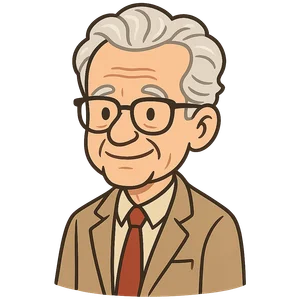
Burrhus Frederic Skinner was an American psychologist, behaviorist, author, inventor, and social philosopher.
Reads at Grades 6–8 Listens at Grades 4–8
 Screen-free speaker. Built for your kids.
No card, no commitment. One email when there is real news, and one click to stop.
Print & create
Answer keys·No prep·Free with an account
28 worksheets · answer keys · full story · quiz · Ages 10-12 · CEFR B2
Plus adds 102,000+ more stories in 27 languages, audio for every one, and printables for all of them.
Just want B.F. Skinner?
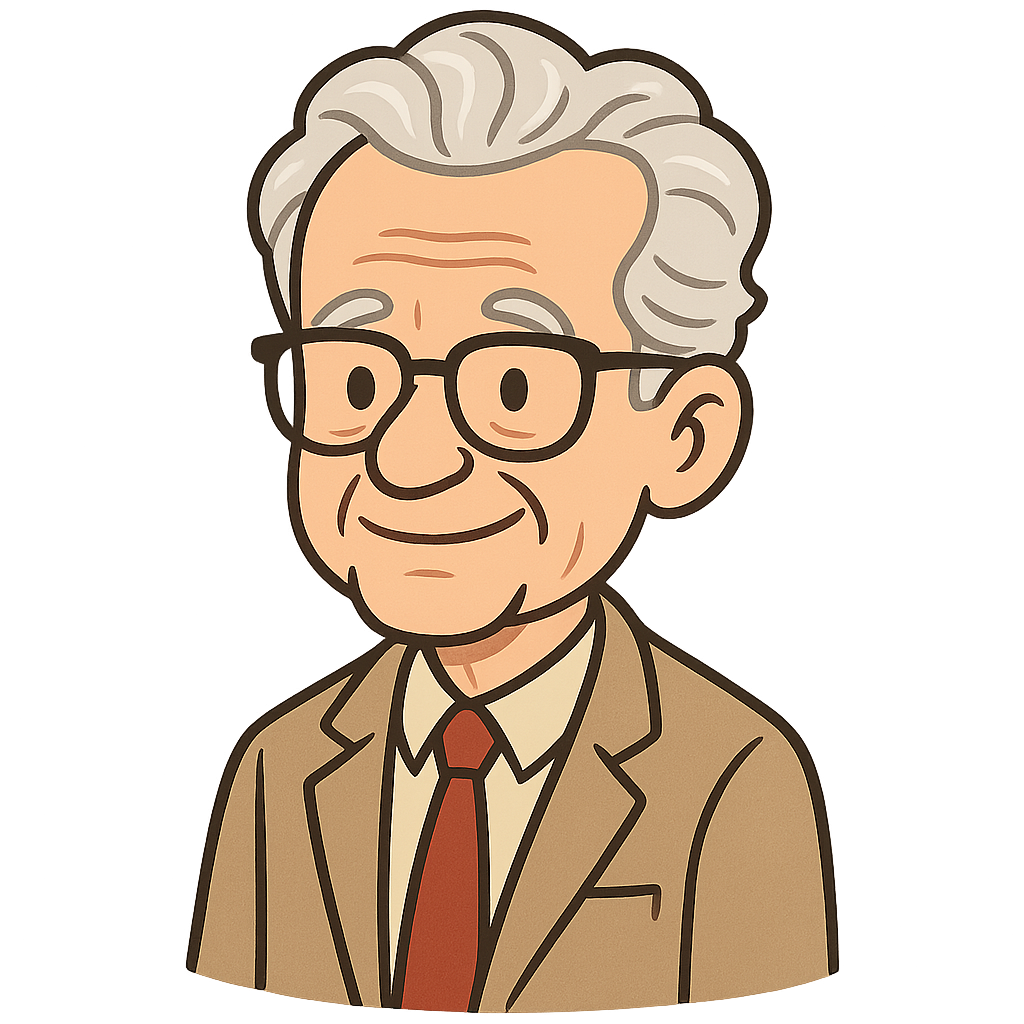
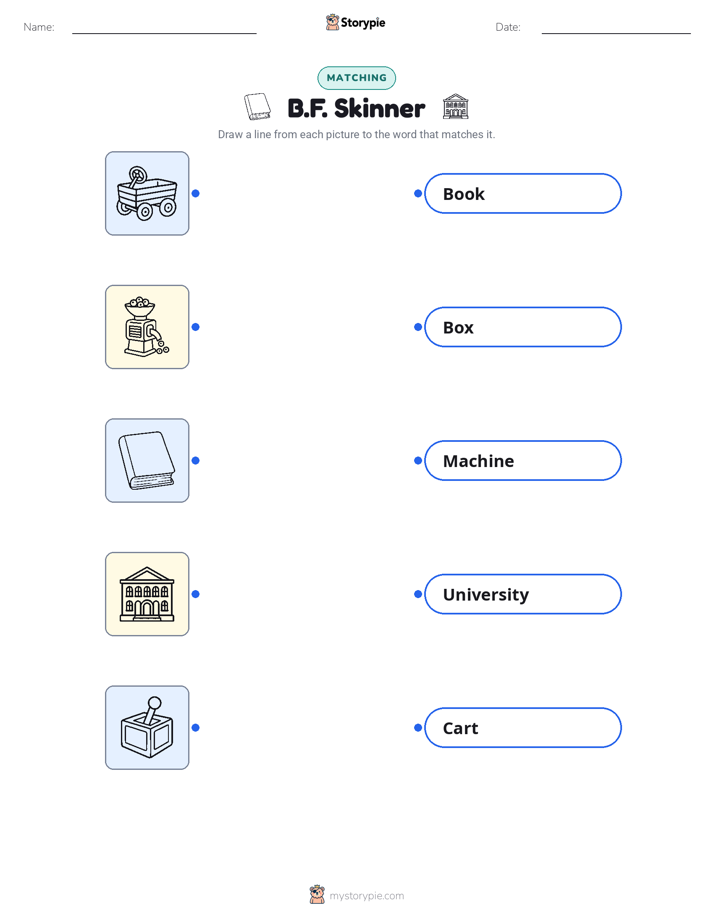
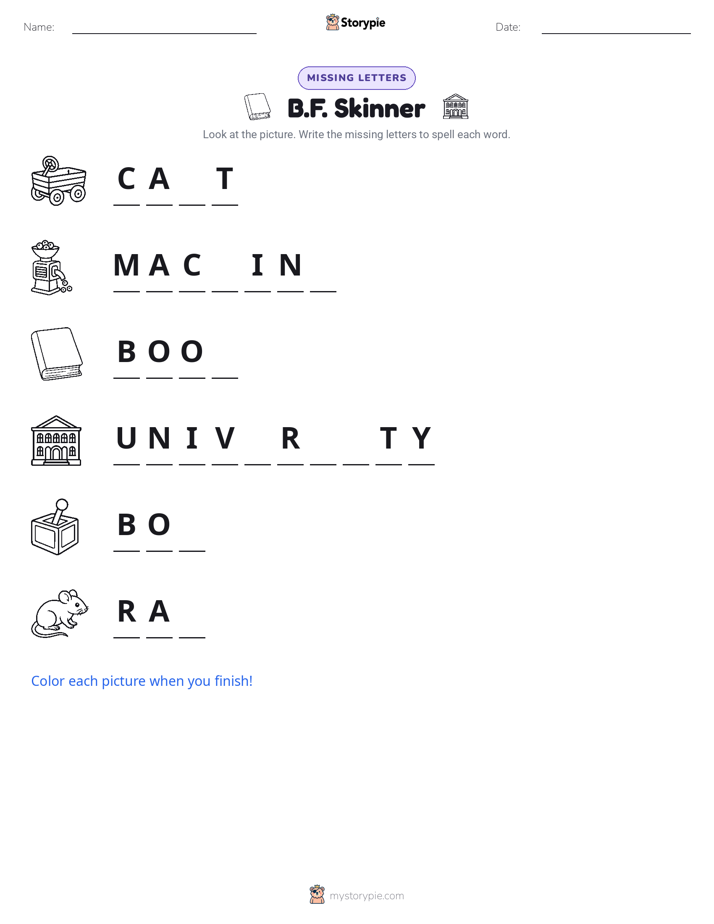
Hello! My name is Burrhus Frederic Skinner, but you can call me B.F. I was born on March 20th, 1904, in the small town of Susquehanna, Pennsylvania. Growing up, I was not like other kids who played with store-bought toys; I was an inventor, always busy building things. My mind was constantly at work, figuring out how things could be improved or created from scratch. I once built a cart with reverse steering, which meant you had to turn the wheel left to make the cart go right. I also designed a machine to help with chores, a clever device that could separate ripe elderberries from the unripe ones. After graduating from Hamilton College in 1926, I believed my future was in writing. I wanted to become a novelist, but I soon discovered that my true passion wasn't just telling stories about what people do, but understanding the reasons behind their actions.
My fascination with human and animal actions led me to pursue a new path. In 1928, I enrolled at Harvard University to study psychology. The world of psychology was exciting at that time, and I was introduced to a new field called 'behaviorism' through the work of scientists like John B. Watson and Ivan Pavlov. Their core idea was that to truly understand a person or an animal, you should focus on their observable behavior and the environment that influences it, rather than trying to guess what was happening inside their mind. This approach made perfect sense to me. It felt scientific and methodical, like a chemist studying chemicals in a lab. I dedicated myself to my studies and research, and by 1931, I had earned my Ph.D. I was eager to begin my own experiments to uncover the fundamental principles of how we learn and behave.
B.F. Skinner: The Science of Behavior
Hello! My name is Burrhus Frederic Skinner, but you can call me B.F. I was born on March 20th, 1904, in the small town of Susquehanna, Pennsylvania. Growing up, I was not like other kids who played with store-bought toys; I was an inventor, always busy building things. My mind was constantly at work, figuring out how things could be improved or created from scratch. I once built a cart with reverse steering, which meant you had to turn the wheel left to make the cart go right. I also designed a machine to help with chores, a clever device that could separate ripe elderberries from the unripe ones. After graduating from Hamilton College in 1926, I believed my future was in writing. I wanted to become a novelist, but I soon discovered that my true passion wasn't just telling stories about what people do, but understanding the reasons behind their actions.
My fascination with human and animal actions led me to pursue a new path. In 1928, I enrolled at Harvard University to study psychology. The world of psychology was exciting at that time, and I was introduced to a new field called 'behaviorism' through the work of scientists like John B. Watson and Ivan Pavlov. Their core idea was that to truly understand a person or an animal, you should focus on their observable behavior and the environment that influences it, rather than trying to guess what was happening inside their mind. This approach made perfect sense to me. It felt scientific and methodical, like a chemist studying chemicals in a lab. I dedicated myself to my studies and research, and by 1931, I had earned my Ph.D. I was eager to begin my own experiments to uncover the fundamental principles of how we learn and behave.
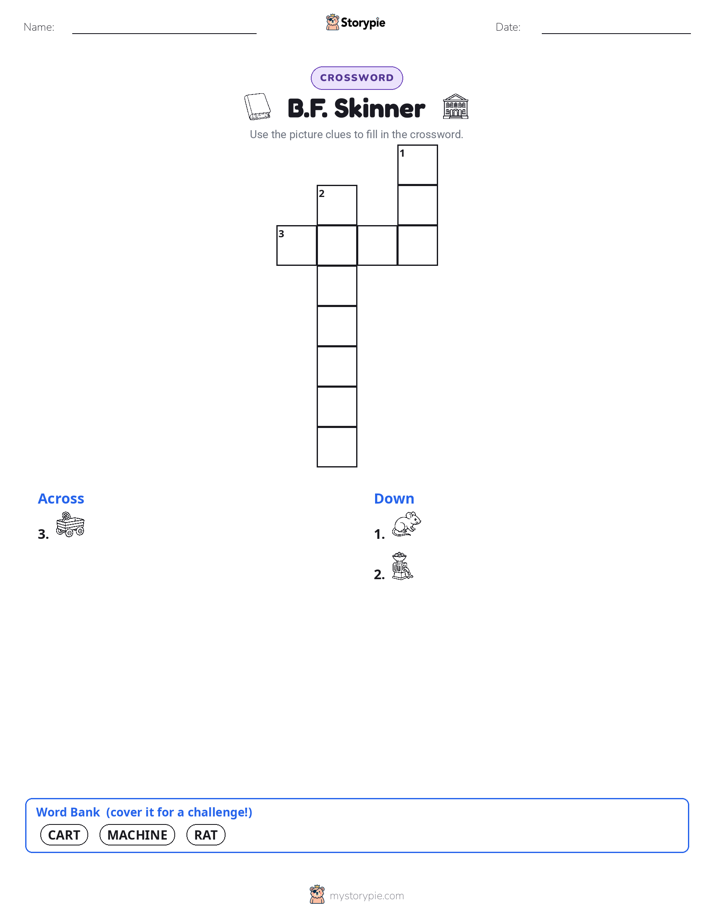
To conduct my research properly, I needed a controlled environment where I could observe an animal's behavior without any outside distractions. So, I invented one. It was a simple box, but it was designed for a specific purpose. Inside, an animal, such as a rat or a pigeon, could press a lever or peck a small disk to receive a food reward. This invention became known as the 'Skinner Box,' though I preferred its official name, the operant conditioning chamber. Through my work with this chamber, I discovered a powerful principle I called 'operant conditioning.' I found that I could shape an animal's behavior by providing a positive consequence, or 'reinforcement,' immediately after it performed a desired action. During World War II, I applied this principle to 'Project Pigeon,' where I trained pigeons to guide missiles. While the project was never used by the military, it proved how effective these learning principles could be. I began sharing my findings as a teacher, first at the University of Minnesota in 1936 and then at Indiana University in 1945.
In 1948, I accepted a position as a professor back at Harvard University. That same year, I published a book that shared my vision for a better world, titled Walden Two. It was a novel about a fictional community built entirely on my principles of positive reinforcement. My goal was not to control people, but to design an environment where good behavior was naturally encouraged, leading to a happier and more productive society. I continued to explore how these ideas applied to complex human actions, including language. In my 1957 book, Verbal Behavior, I argued that even our thoughts and feelings are forms of behavior that are shaped by our experiences and their consequences. This comprehensive view of behavior, which included internal events, became known as 'radical behaviorism.' It became my life's work to develop this science and share its potential with the world.
I lived to be 86 years old, and I remained dedicated to writing and research until the very end of my life. Some of my ideas were considered controversial, but their influence on psychology and education has been significant. The principles of reinforcement that I studied are now widely used in many helpful ways. Teachers apply them in classrooms to encourage positive learning habits, therapists use them to help people build better routines and overcome fears, and animal trainers use them to teach everything from simple commands to complex jobs. My greatest hope was always that by understanding the causes of our actions, we could build a kinder and more effective world for everyone.
Wow facts
About
Burrhus Frederic Skinner was an American psychologist, behaviorist, author, inventor, and social philosopher. He was a leading figure in the school of psychology known as behaviorism, and developed the theory of operant conditioning.
Take a Quiz
Question 1 of 5
In the story, Skinner uses the term 'reinforcement.' What does this term mean in the context of his experiments?
Explore next






Want to do even more?
Go beyond exploring. Unlock tools that turn every story into real learning.

Storypie Plus for families
Full stories, quizzes, and printables. Nights and car rides, sorted.
- Unlimited audio stories
- Create Mode: your child stars in the story
- Offline downloads
- Printable worksheets & coloring pages

Why Storypie for Schools
Students engaged. Prep in seconds. Evenings back to you.
- Worksheets & Quizzes
- Classroom Management
- Formative Assessment
- Custom Curriculum & Lesson Plans
- 27 Languages

Why Storypie for Homeschool
Curriculum done. They'll ask for more. Hours back in your day.
- Worksheet Generator
- First-Person Audio Stories
- Built-in Comprehension Quizzes
- Custom Curriculum & Lesson Plans
- Print & Go Activities