English

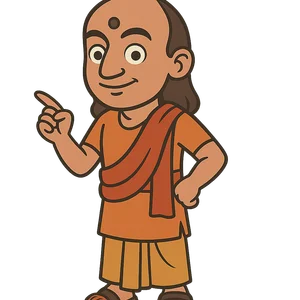
Brahmagupta
Brahmagupta was an influential Indian mathematician and astronomer who established key rules for computing…
Reads at Grades 3–5 Listens at Grades 1–5
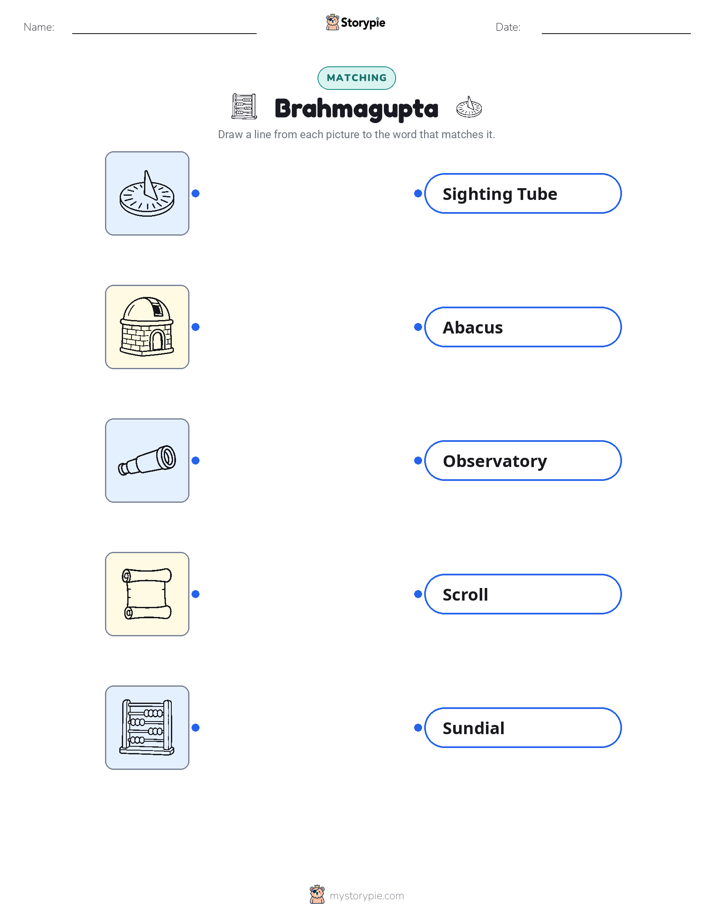
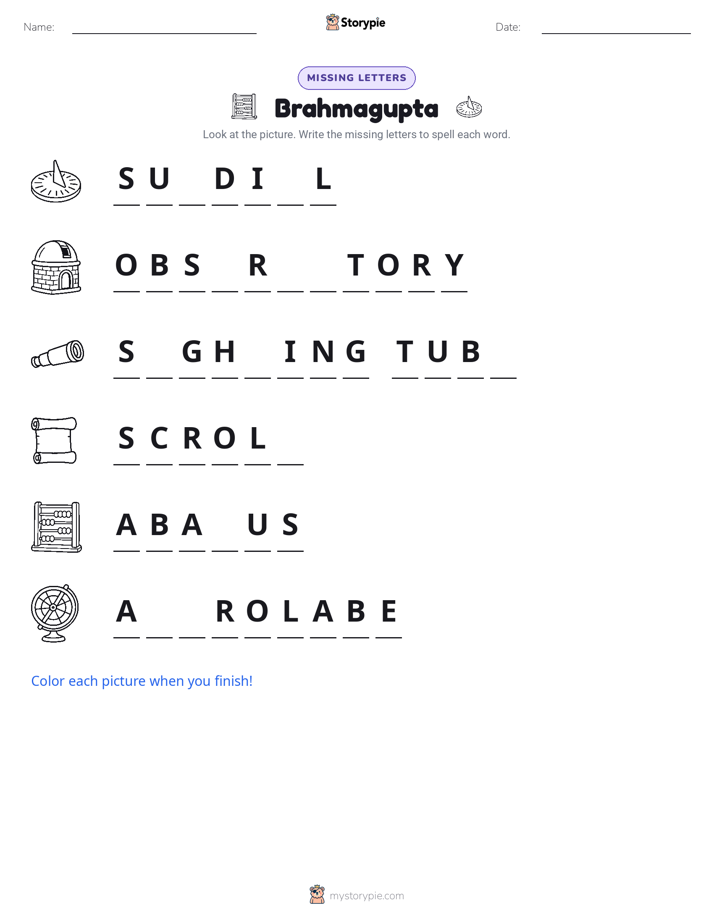
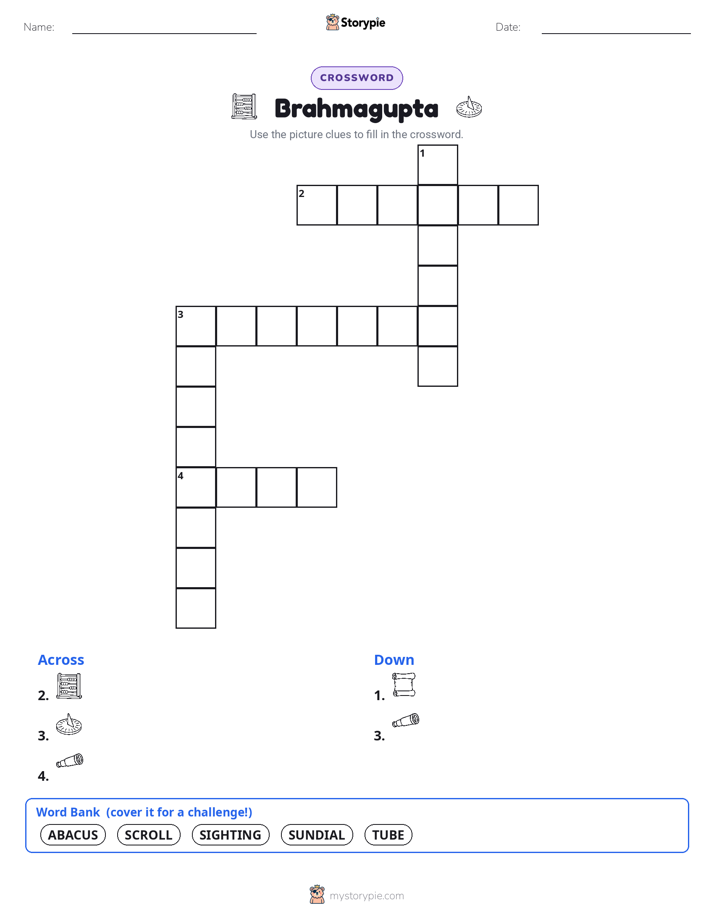
Print & create
Answer keys·No prep·Free with an account
28 worksheets · answer keys · full story · quiz · Ages 8-10 · CEFR B1
Plus adds 164,000+ more stories in 27 languages, audio for every one, and printables for all of them.
Just want Brahmagupta?
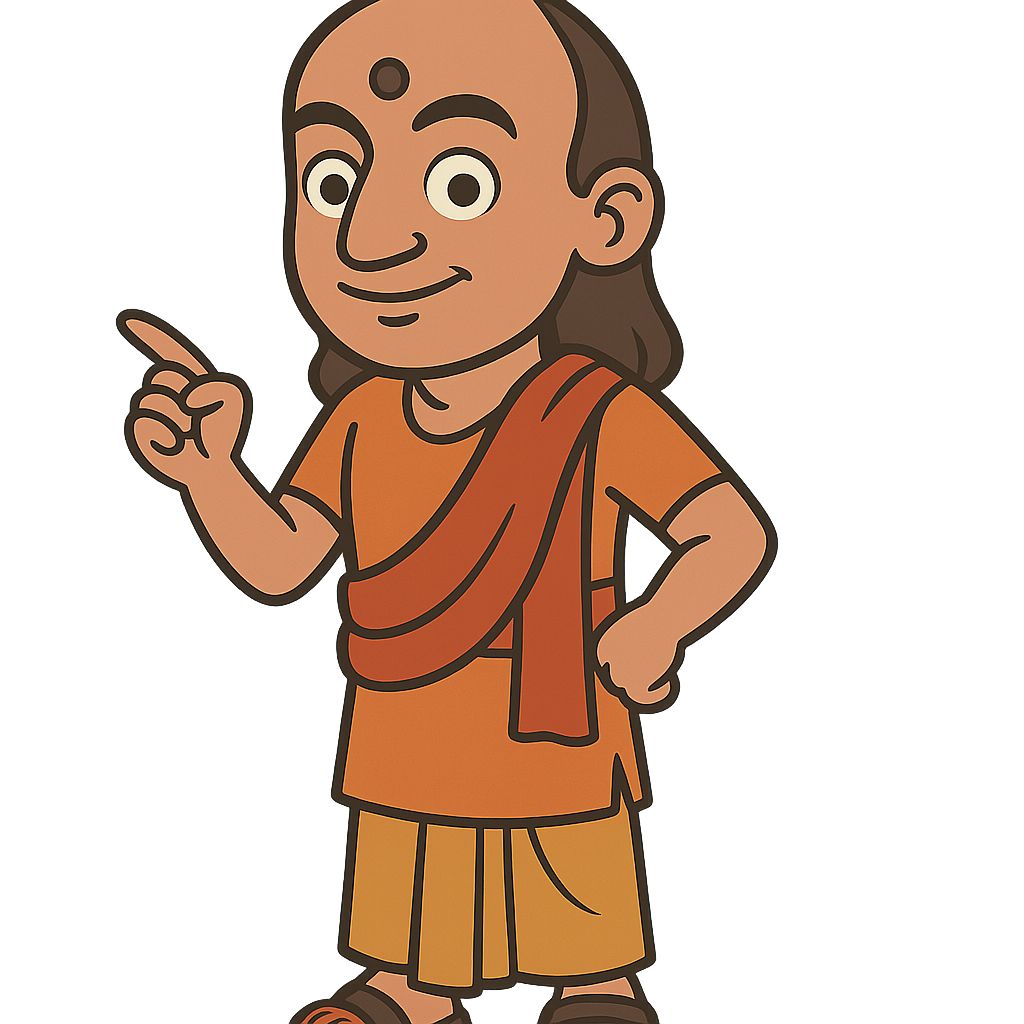
Hello! My name is Brahmagupta, and I would like to tell you my story. I was a mathematician and an astronomer who lived many centuries ago in ancient India. My life began in the year 598 in a city called Bhinmal. From a very young age, I was filled with wonder. I would lie outside at night, my eyes fixed on the twinkling stars, trying to map their journeys across the dark sky. During the day, my mind was captivated by numbers. They were not just for counting; they were a secret language I wanted to understand. I saw patterns everywhere and felt a deep desire to solve the puzzles they presented. This childhood curiosity for the stars above and the numbers here on Earth guided my entire life's work and led me to some very important discoveries.
Imagine a world without calculators or computers. That was the world I lived in during the 7th century. Every calculation had to be done by hand and in our minds, which made mathematics a great challenge. This is why I spent so much of my time thinking about how to make numbers easier to understand. My most important work was with a very special number: zero. Before my time, people sometimes used a symbol as a placeholder, but they did not have clear rules for it. I was one of the very first to define zero as a number and create rules for how to use it. I wrote that adding zero to any number leaves it unchanged. Subtracting zero from a number also leaves it unchanged. And a very important rule: multiplying any number by zero always results in zero. I did not stop there. I also wanted to explain numbers that were less than zero. I came up with a simple way to think about them. I called positive numbers 'fortunes,' which is like treasure or money you own. I called negative numbers 'debts,' which is like money you owe to someone. This idea of 'fortunes' and 'debts' helped people understand how these numbers related to each other and how they could be used in real-life problems.
Brahmagupta: The Man Who Gave Rules to Zero
Hello! My name is Brahmagupta, and I would like to tell you my story. I was a mathematician and an astronomer who lived many centuries ago in ancient India. My life began in the year 598 in a city called Bhinmal. From a very young age, I was filled with wonder. I would lie outside at night, my eyes fixed on the twinkling stars, trying to map their journeys across the dark sky. During the day, my mind was captivated by numbers. They were not just for counting; they were a secret language I wanted to understand. I saw patterns everywhere and felt a deep desire to solve the puzzles they presented. This childhood curiosity for the stars above and the numbers here on Earth guided my entire life's work and led me to some very important discoveries.
Imagine a world without calculators or computers. That was the world I lived in during the 7th century. Every calculation had to be done by hand and in our minds, which made mathematics a great challenge. This is why I spent so much of my time thinking about how to make numbers easier to understand. My most important work was with a very special number: zero. Before my time, people sometimes used a symbol as a placeholder, but they did not have clear rules for it. I was one of the very first to define zero as a number and create rules for how to use it. I wrote that adding zero to any number leaves it unchanged. Subtracting zero from a number also leaves it unchanged. And a very important rule: multiplying any number by zero always results in zero. I did not stop there. I also wanted to explain numbers that were less than zero. I came up with a simple way to think about them. I called positive numbers 'fortunes,' which is like treasure or money you own. I called negative numbers 'debts,' which is like money you owe to someone. This idea of 'fortunes' and 'debts' helped people understand how these numbers related to each other and how they could be used in real-life problems.
By the time I was 30 years old, I had spent years studying and forming my own ideas. In the year 628, I compiled all this knowledge into my most famous work, a book called the Brāhmasphuṭasiddhānta. This title is very meaningful; it translates to 'The Corrected Treatise of Brahma.' My goal was to take the existing knowledge of my time, find the mistakes, and present a more accurate and complete system. This book was my life's work up to that point. It contained my groundbreaking rules for operating with the number zero, and I carefully explained my concepts of 'fortunes' and 'debts.' The book was more than just mathematics, though. I did much of my work in the city of Ujjain, home to an important astronomical observatory. I included many chapters on astronomy, detailing my observations of the planets and stars. I explained methods to calculate their movements, predict their positions, and even understand solar and lunar eclipses. The Brāhmasphuṭasiddhānta was a comprehensive text for any scholar who wanted to understand the universe through the language of mathematics.
My curiosity did not fade as I grew older. The world of numbers and the universe of stars were endless sources of wonder for me, and I continued to learn and write throughout my life. Many years after my first great book, I wrote another important text. In the year 665, I completed my second major work, which I called the Khaṇḍakhādyaka. This book was focused on astronomy. I designed it to be a more practical and easy-to-use guide for fellow astronomers. It contained tables and simpler methods to help them make their calculations more quickly and accurately. I wanted to share my knowledge in a way that would help others in their own studies of the heavens.
My journey of discovery continued for many years. I lived a full life dedicated to numbers and stars until the year 668. I lived to be 70 years old. After my time on Earth, my ideas began a new journey of their own. My books, especially the Brāhmasphuṭasiddhānta with its rules for zero, were studied by scholars and translated into other languages. These ideas traveled across Asia and to the Arab world, and eventually reached Europe. The rules I created for zero and negative numbers helped future mathematicians build the systems of math that are still used today. I am remembered for helping the world understand numbers in a new and powerful way, showing that even a single idea, like the rules for zero, can change everything.
Wow facts
About
Brahmagupta was an influential Indian mathematician and astronomer who established key rules for computing with the number zero, negative numbers, and made significant contributions to algebra and astronomy.
Take a Quiz
Question 1 of 5
When Brahmagupta described negative numbers as 'debts,' what did he mean?
Explore next






Want to do even more?
Go beyond exploring. Unlock tools that turn every story into real learning.

Storypie Plus for families
Full stories, quizzes, and printables. Nights and car rides, sorted.
- Unlimited audio stories
- Create Mode: your child stars in the story
- Offline downloads
- Printable worksheets & coloring pages

Why Storypie for Schools
Students engaged. Prep in seconds. Evenings back to you.
- Worksheets & Quizzes
- Classroom Management
- Formative Assessment
- Custom Curriculum & Lesson Plans
- 27 Languages

Why Storypie for Homeschool
Curriculum done. They'll ask for more. Hours back in your day.
- Worksheet Generator
- First-Person Audio Stories
- Built-in Comprehension Quizzes
- Custom Curriculum & Lesson Plans
- Print & Go Activities