English

Claude Shannon
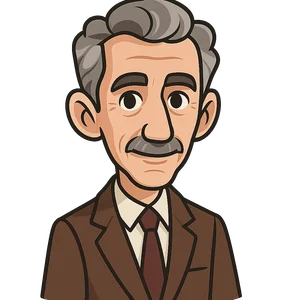
Claude Shannon was an American mathematician and electrical engineer known as 'the father of information…
Reads at Grades 6–8 Listens at Grades 4–8
Print & create
Answer keys·No prep·Free with an account
28 worksheets · answer keys · full story · quiz · Ages 10-12 · CEFR B2
Plus adds 244,000+ more stories in 27 languages, audio for every one, and printables for all of them.
Just want Claude Shannon?
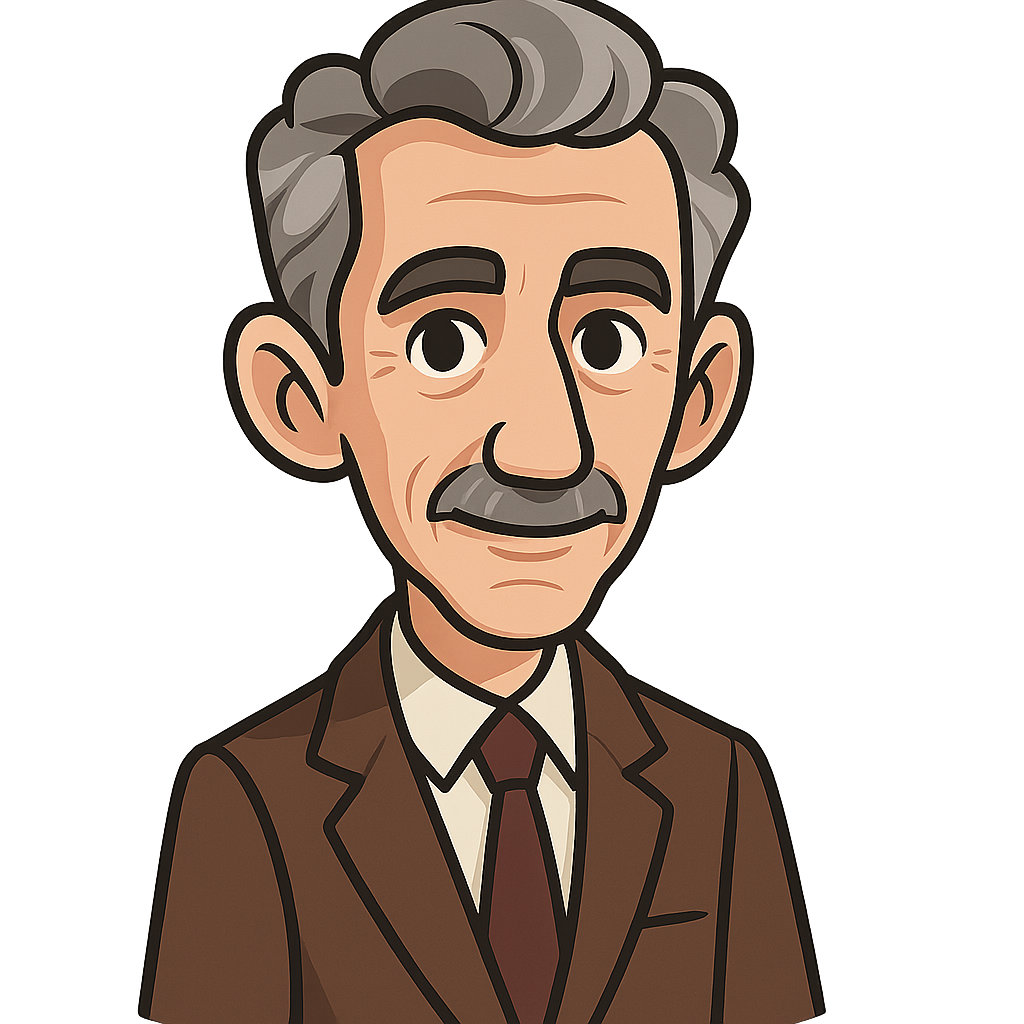
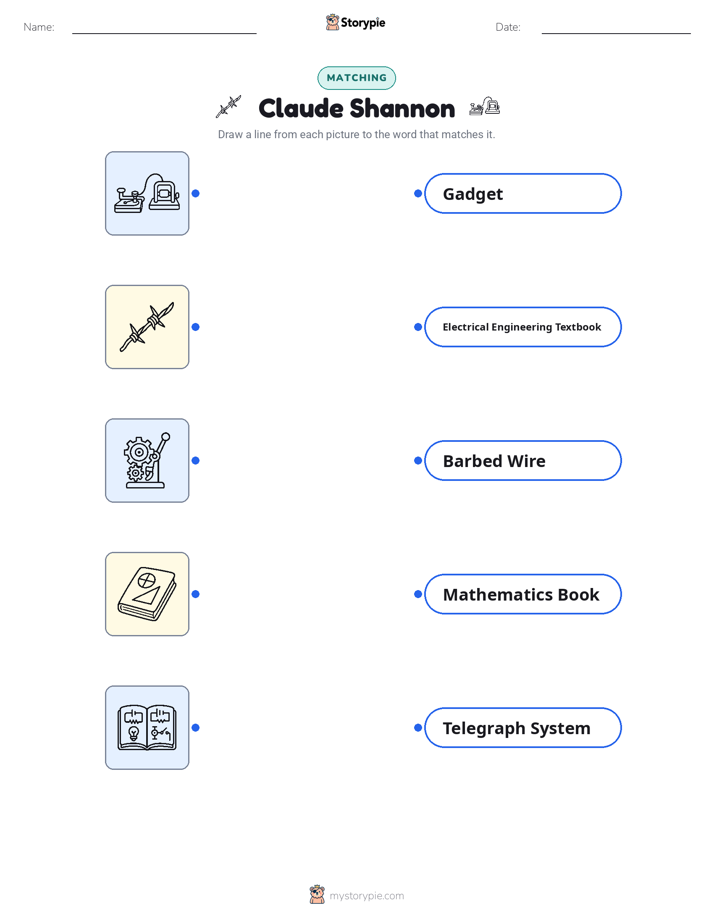
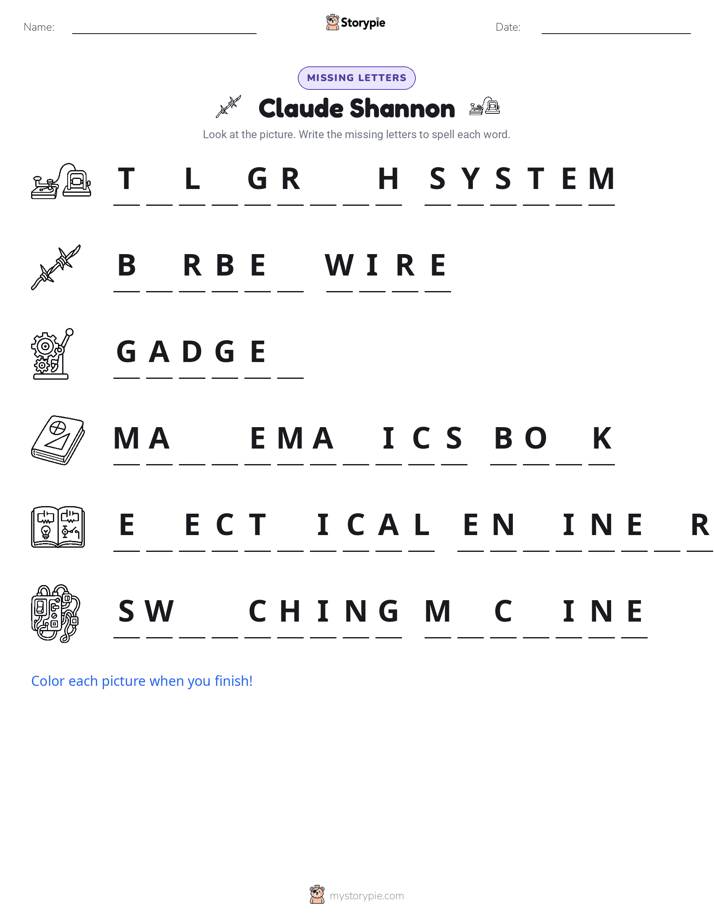
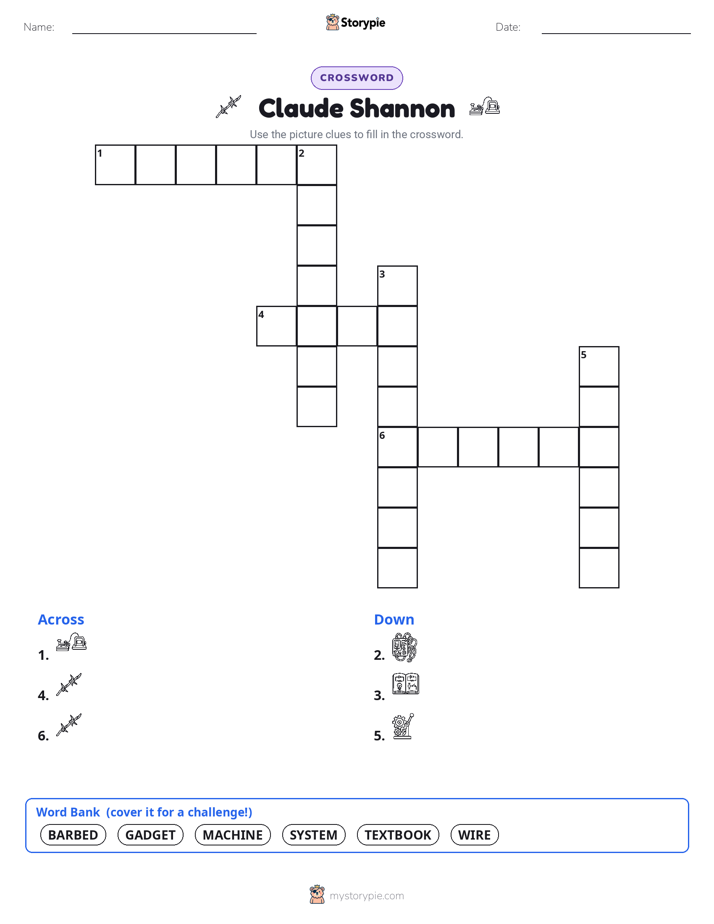
Hello, my name is Claude Shannon, and I want to tell you how a simple idea changed the world. I was born on April 30th, 1916, in a small town in Michigan. From a very young age, I was fascinated by how things worked. While other kids were playing games, I was building gadgets. I once created a working telegraph system that connected my house to my friend's, using the wire from a barbed-wire fence to send our messages back and forth. My hero wasn't a sports star but a great inventor: Thomas Edison. I spent hours reading about his life and his inventions, dreaming that one day I could create something just as important. This early love for taking things apart, figuring out puzzles, and using mathematics to solve problems set the stage for my entire life. My curiosity was my greatest tool, and I knew early on that I wanted to spend my life exploring the worlds of engineering and logic.
After high school, my journey into higher learning began. In 1932, I enrolled at the University of Michigan, where I studied both electrical engineering and mathematics. The two subjects felt like two sides of the same coin to me. Then, in 1936, I moved on to the prestigious Massachusetts Institute of Technology, or MIT, for my graduate studies. It was there, while working on a complicated electrical switching machine, that I had the biggest idea of my life. For my master's thesis in 1937, I realized something no one had put together before. I saw that the principles of Boolean algebra, a type of logic that uses just two values—'true' and 'false'—could be applied to electrical circuits. A circuit could be 'on' or 'off,' just like a statement could be 'true' or 'false.' If 'on' was represented by the number 1 and 'off' by the number 0, then any logical problem could be solved using electrical switches. This single, powerful idea became the fundamental principle for all digital computers that would ever be built.
Claude Shannon: The Father of the Information Age
Hello, my name is Claude Shannon, and I want to tell you how a simple idea changed the world. I was born on April 30th, 1916, in a small town in Michigan. From a very young age, I was fascinated by how things worked. While other kids were playing games, I was building gadgets. I once created a working telegraph system that connected my house to my friend's, using the wire from a barbed-wire fence to send our messages back and forth. My hero wasn't a sports star but a great inventor: Thomas Edison. I spent hours reading about his life and his inventions, dreaming that one day I could create something just as important. This early love for taking things apart, figuring out puzzles, and using mathematics to solve problems set the stage for my entire life. My curiosity was my greatest tool, and I knew early on that I wanted to spend my life exploring the worlds of engineering and logic.
After high school, my journey into higher learning began. In 1932, I enrolled at the University of Michigan, where I studied both electrical engineering and mathematics. The two subjects felt like two sides of the same coin to me. Then, in 1936, I moved on to the prestigious Massachusetts Institute of Technology, or MIT, for my graduate studies. It was there, while working on a complicated electrical switching machine, that I had the biggest idea of my life. For my master's thesis in 1937, I realized something no one had put together before. I saw that the principles of Boolean algebra, a type of logic that uses just two values—'true' and 'false'—could be applied to electrical circuits. A circuit could be 'on' or 'off,' just like a statement could be 'true' or 'false.' If 'on' was represented by the number 1 and 'off' by the number 0, then any logical problem could be solved using electrical switches. This single, powerful idea became the fundamental principle for all digital computers that would ever be built.
My work continued to grow in importance. In 1941, I joined a famous research center called Bell Labs. Soon after, the world was deep in World War II, and my skills were needed for something very serious: cryptography, the science of making and breaking secret codes. I worked on systems to securely transmit messages, and during this time, I even had the chance to meet the brilliant British codebreaker, Alan Turing. This work on secret codes made me think deeply about the nature of information itself. What was it, really? How could you measure it? In 1948, I published a paper that answered these questions and created a whole new field of science called 'Information Theory.' In it, I proposed a way to measure information in units. I named the smallest possible unit of information a 'bit,' which stands for binary digit. My theory provided a complete mathematical framework for how to send any kind of message—words, pictures, or sounds—as a stream of ones and zeros, and how to do it perfectly, without any errors. It was the blueprint for the digital age.
Even though my work was very serious, I always believed that curiosity and play were essential for discovery. I was known for being a bit of a character around the halls of Bell Labs. It wasn't unusual to see me juggling balls or riding a unicycle down the hallway, sometimes doing both at the same time! I loved building gadgets just for the fun of it. One of my favorite creations was a small mechanical mouse I named Theseus. I built a maze for him, and through a system of switches and relays, Theseus could 'learn' the maze. The first time through, he would bump around until he found the exit. But on the second try, he would remember the correct path and run straight to the goal. This little mouse was one of the very first experiments in artificial intelligence, showing that a machine could be designed to solve a problem on its own. It was proof that playful inventions could lead to profound scientific insights.
I spent my later years as a professor at MIT, sharing my passion for invention with new generations of students. I lived a full and curious life for 84 years. Today, people often call me 'the Father of the Information Age.' That's because my ideas about information and the 'bit' became the foundation for the entire digital world we live in. Every time you use a computer, send a message on a smartphone, or stream a video on the internet, you are using the principles I discovered back in 1948. My work showed the world that even the most complex information, from a beautiful song to a secret message, could be understood and shared using nothing more than simple ones and zeros.
Wow facts
About
Claude Shannon was an American mathematician and electrical engineer known as 'the father of information theory.' His work laid the foundation for the digital age, establishing the basic concepts of how all information can be encoded and transmitted electronically.
Take a Quiz
Question 1 of 5
In your own words, describe the progression of Claude Shannon's key ideas, from his 1937 master's thesis to his 1948 Information Theory.
Explore next




Want to do even more?
Go beyond exploring. Unlock tools that turn every story into real learning.

Storypie Plus for families
Full stories, quizzes, and printables. Nights and car rides, sorted.
- Unlimited audio stories
- Create Mode: your child stars in the story
- Offline downloads
- Printable worksheets & coloring pages

Why Storypie for Schools
Students engaged. Prep in seconds. Evenings back to you.
- Worksheets & Quizzes
- Classroom Management
- Formative Assessment
- Custom Curriculum & Lesson Plans
- 27 Languages

Why Storypie for Homeschool
Curriculum done. They'll ask for more. Hours back in your day.
- Worksheet Generator
- First-Person Audio Stories
- Built-in Comprehension Quizzes
- Custom Curriculum & Lesson Plans
- Print & Go Activities