English


Ismail al-Jazari
Ismail al-Jazari was a Muslim scholar, inventor, and mechanical engineer during the Islamic Golden Age…
Reads at Grades 6–8 Listens at Grades 4–8
Print & create
Answer keys·No prep·Free with an account
28 worksheets · answer keys · full story · quiz · Ages 10-12 · CEFR B2
Plus adds 208,000+ more stories in 27 languages, audio for every one, and printables for all of them.
Just want Ismail al-Jazari?

Hello! My name is Ismail al-Jazari. I want to tell you the story of my life, which was filled with gears, gadgets, and amazing machines. I was born in the year 1136 in a beautiful city called Cizre, in a region known as Jazira. It was a bustling place in the heart of the Artuqid kingdom, and the world around me was a rich tapestry of culture and learning. Even as a boy, I wasn't as interested in common games as I was in taking things apart and figuring out how they worked. My father was a brilliant craftsman and the chief engineer for the king, and I learned so much just by watching him. I loved seeing how a simple gear could turn another, and how the power of flowing water could be harnessed to create motion. I knew from a young age that I wanted to follow in his footsteps and spend my life building wonderful and useful things.
When I grew up, I was honored to become the chief engineer for the Artuqid kings who ruled from the grand palace in Diyarbakır. For over 25 years, starting around the year 1181, I served three different kings from the same family. My job was to design and build all sorts of mechanical devices. Some were practical, like machines designed to lift water from the river to the palace gardens, making life easier for everyone. Others were meant to delight and entertain the king and his guests, showcasing the beauty of engineering. The palace was a place of great learning and art, and it was important that my work was not only clever and functional but also beautiful to look at. I saw every project as a puzzle, a challenge to combine my knowledge of mechanics and mathematics with my love for art to create something the world had never seen before.
Ismail al-Jazari: The Father of Robotics
Hello! My name is Ismail al-Jazari. I want to tell you the story of my life, which was filled with gears, gadgets, and amazing machines. I was born in the year 1136 in a beautiful city called Cizre, in a region known as Jazira. It was a bustling place in the heart of the Artuqid kingdom, and the world around me was a rich tapestry of culture and learning. Even as a boy, I wasn't as interested in common games as I was in taking things apart and figuring out how they worked. My father was a brilliant craftsman and the chief engineer for the king, and I learned so much just by watching him. I loved seeing how a simple gear could turn another, and how the power of flowing water could be harnessed to create motion. I knew from a young age that I wanted to follow in his footsteps and spend my life building wonderful and useful things.
When I grew up, I was honored to become the chief engineer for the Artuqid kings who ruled from the grand palace in Diyarbakır. For over 25 years, starting around the year 1181, I served three different kings from the same family. My job was to design and build all sorts of mechanical devices. Some were practical, like machines designed to lift water from the river to the palace gardens, making life easier for everyone. Others were meant to delight and entertain the king and his guests, showcasing the beauty of engineering. The palace was a place of great learning and art, and it was important that my work was not only clever and functional but also beautiful to look at. I saw every project as a puzzle, a challenge to combine my knowledge of mechanics and mathematics with my love for art to create something the world had never seen before.
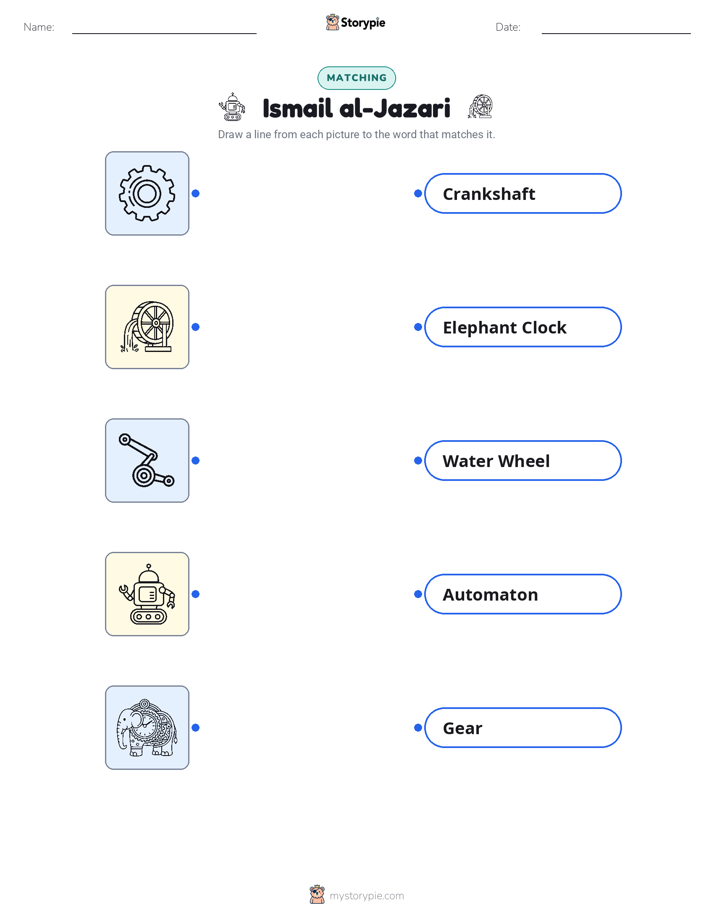
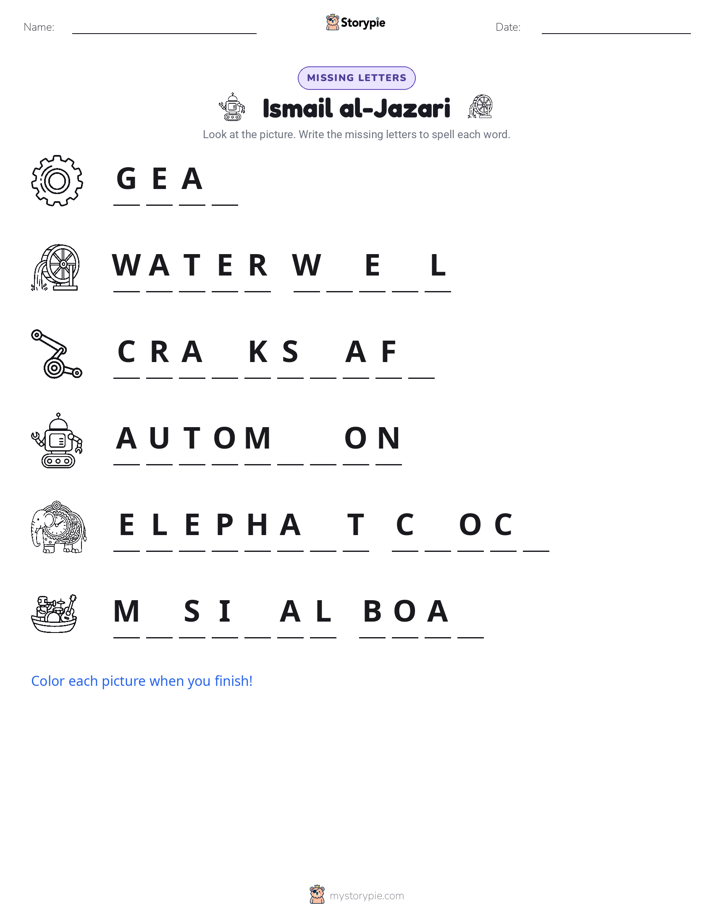
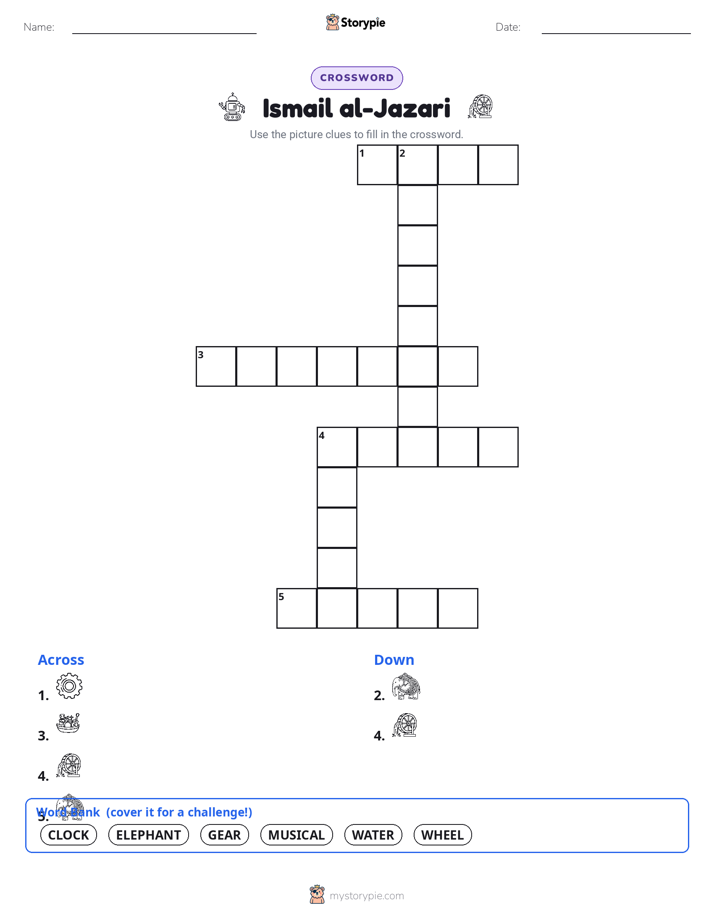
People were often amazed by my creations, which they called automata—machines that could move all on their own! One of my most famous inventions was the Elephant Clock. It was enormous and magnificent, a true spectacle. The elephant's body cleverly hid a water tank with a sinking bowl inside that precisely controlled the timing. Every half hour, a wonderful series of events would happen: a bird on top would chirp, a man would drop a ball into a dragon's mouth, and the elephant's driver, perched on its back, would strike a cymbal. It was a clock that celebrated cultures from around the world in its design. I also built a musical boat with four robot musicians that could play instruments to entertain guests during parties on the palace lake. For more practical purposes, I designed a peacock fountain where automated servants would offer soap and a towel when you clapped your hands. I also improved many existing devices, like water-raising machines, and I made important use of the crankshaft. This device turns circular motion into back-and-forth motion, a fundamental principle that is still a key part of most engines today.
After many years of service, the king, Nasir al-Din Mahmud, shared a concern with me. He said, 'You have created devices that are unlike any other. You must write a book to describe them, so your knowledge is not lost.' He understood that without a written record, my life's work could disappear. So, in the year 1206, I did just that. I wrote 'The Book of Knowledge of Ingenious Mechanical Devices.' It was my life's work, all collected in one place. I didn't just write about my ideas; I filled the book with detailed diagrams and step-by-step instructions for building more than 100 of my machines. I wanted to make sure that future engineers and inventors could not only see what I had done but could also learn from my work, build upon it, and create even more amazing things for the world.
I finished my book in 1206 and passed away later that same year, having lived a full life of invention and discovery. My book, however, lived on. It was carefully copied by hand and studied by scholars and engineers for hundreds of years, influencing inventors across the Islamic world and even in Europe. Some people today call me the 'father of robotics' because my automated machines were some of the first and most complex of their time. It makes me happy to know that my passion for figuring things out and building new things has inspired people long after I was gone, showing that a little curiosity and dedication can truly change the world.
Wow facts
About
Ismail al-Jazari was a Muslim scholar, inventor, and mechanical engineer during the Islamic Golden Age, best known for his 1206 book, 'The Book of Knowledge of Ingenious Mechanical Devices,' which described 50 of his inventions.
Take a Quiz
Question 1 of 5
Based on the story, what does the word 'automata' mean?
Explore next






Want to do even more?
Go beyond exploring. Unlock tools that turn every story into real learning.

Storypie Plus for families
Full stories, quizzes, and printables. Nights and car rides, sorted.
- Unlimited audio stories
- Create Mode: your child stars in the story
- Offline downloads
- Printable worksheets & coloring pages

Why Storypie for Schools
Students engaged. Prep in seconds. Evenings back to you.
- Worksheets & Quizzes
- Classroom Management
- Formative Assessment
- Custom Curriculum & Lesson Plans
- 27 Languages

Why Storypie for Homeschool
Curriculum done. They'll ask for more. Hours back in your day.
- Worksheet Generator
- First-Person Audio Stories
- Built-in Comprehension Quizzes
- Custom Curriculum & Lesson Plans
- Print & Go Activities