English


Mimar Sinan
Mimar Sinan was the chief Ottoman architect and civil engineer for Sultans Suleiman the Magnificent, Selim II…
Reads at Grades 6–8 Listens at Grades 4–8
Print & create
Answer keys·No prep·Free with an account
28 worksheets · answer keys · full story · quiz · Ages 10-12 · CEFR B2
Plus adds 244,000+ more stories in 27 languages, audio for every one, and printables for all of them.
Just want Mimar Sinan?

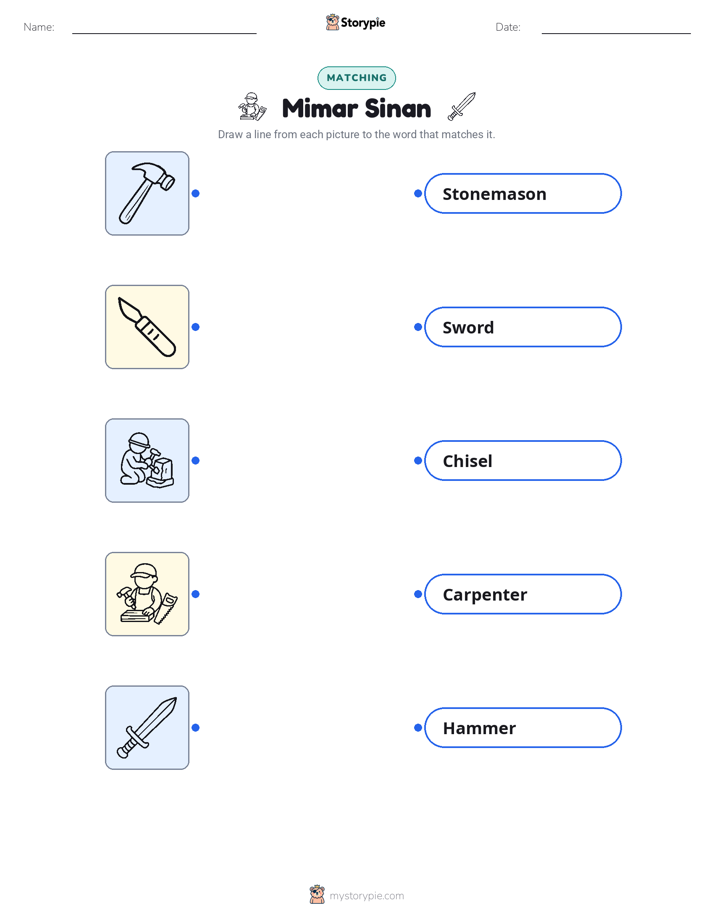
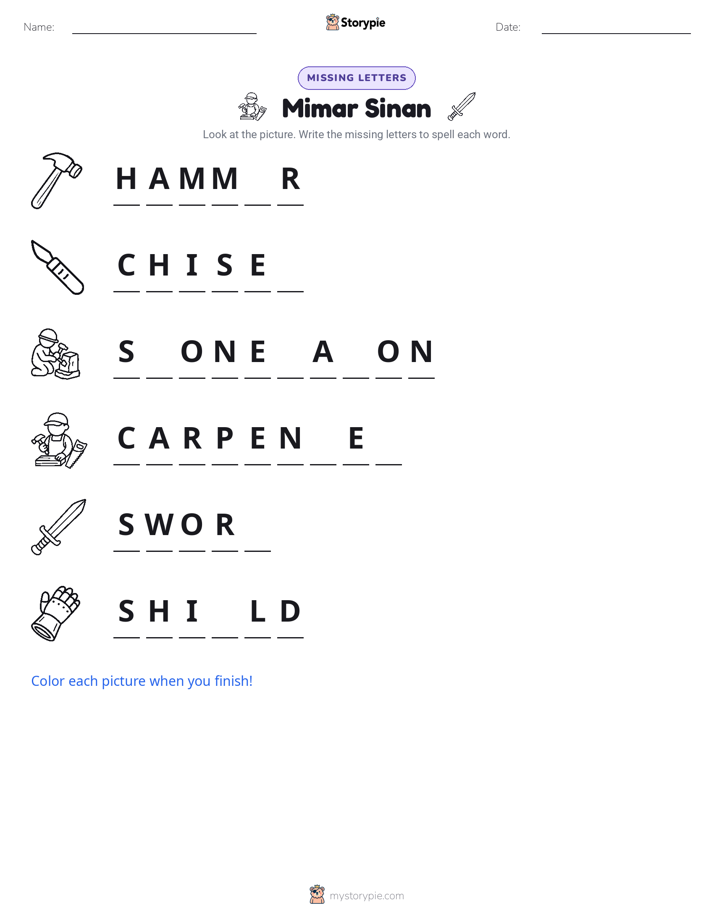
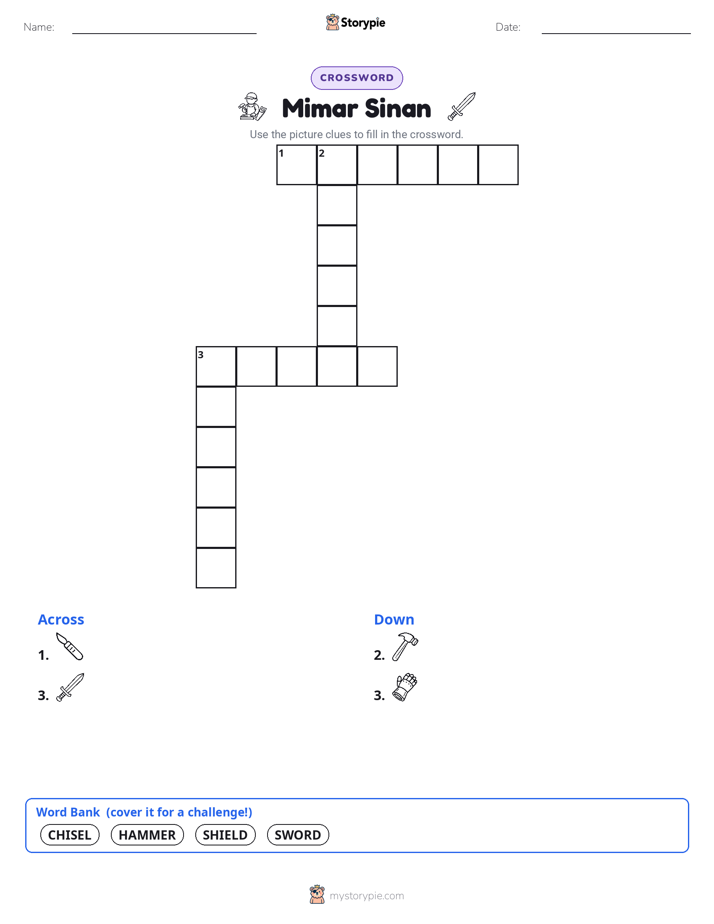
Hello! My name is Mimar Sinan, which means 'Sinan the Architect,' and I want to share my story with you. I was born around the year 1490 in the small village of Ağırnas, located in the heart of Anatolia, a region that is now part of Turkey. Growing up, my world was filled with the sounds of hammers and saws, as I spent my days helping my father, who was a skilled stonemason and carpenter. From him, I learned how to handle tools and shape stone and wood. I discovered a deep satisfaction in building things with my own hands, seeing raw materials transform into something strong and purposeful. My life took an unexpected turn around 1512. I was chosen through a system called the 'devşirme' to serve the powerful Ottoman Empire. This meant I had to leave my home and my family behind. I traveled to the bustling capital city, Constantinople, to begin a new chapter as a Janissary, a member of the Sultan's most elite group of soldiers.
Life as a Janissary was more than just military drills and combat; it was a profound education. I was trained not only as a soldier but also as a military engineer, which put my early skills to the test in new and challenging ways. Starting in the 1520s, I had the honor of marching in military campaigns alongside our powerful leader, Sultan Suleiman the Magnificent. Our journeys took us far and wide, across the vast lands of Europe, Asia, and Africa. During these travels, my eyes were opened to a world of incredible structures. I studied magnificent mosques, grand palaces, and the ancient ruins of past civilizations, and these sights filled my mind with countless ideas. My role in the army was to be a problem-solver. If our army encountered a wide river, I was tasked with designing and building a bridge to get us across. If we laid siege to a fortress, I would analyze its walls to find a structural weakness. I built fortifications to protect our camps, aqueducts to supply water, and even ships for our navy. Every campaign was a practical lesson in engineering and the art of architecture.
Mimar Sinan: Architect of an Empire
Hello! My name is Mimar Sinan, which means 'Sinan the Architect,' and I want to share my story with you. I was born around the year 1490 in the small village of Ağırnas, located in the heart of Anatolia, a region that is now part of Turkey. Growing up, my world was filled with the sounds of hammers and saws, as I spent my days helping my father, who was a skilled stonemason and carpenter. From him, I learned how to handle tools and shape stone and wood. I discovered a deep satisfaction in building things with my own hands, seeing raw materials transform into something strong and purposeful. My life took an unexpected turn around 1512. I was chosen through a system called the 'devşirme' to serve the powerful Ottoman Empire. This meant I had to leave my home and my family behind. I traveled to the bustling capital city, Constantinople, to begin a new chapter as a Janissary, a member of the Sultan's most elite group of soldiers.
Life as a Janissary was more than just military drills and combat; it was a profound education. I was trained not only as a soldier but also as a military engineer, which put my early skills to the test in new and challenging ways. Starting in the 1520s, I had the honor of marching in military campaigns alongside our powerful leader, Sultan Suleiman the Magnificent. Our journeys took us far and wide, across the vast lands of Europe, Asia, and Africa. During these travels, my eyes were opened to a world of incredible structures. I studied magnificent mosques, grand palaces, and the ancient ruins of past civilizations, and these sights filled my mind with countless ideas. My role in the army was to be a problem-solver. If our army encountered a wide river, I was tasked with designing and building a bridge to get us across. If we laid siege to a fortress, I would analyze its walls to find a structural weakness. I built fortifications to protect our camps, aqueducts to supply water, and even ships for our navy. Every campaign was a practical lesson in engineering and the art of architecture.
My work did not go unnoticed. Sultan Suleiman was a wise ruler who paid close attention to the people who served him. He observed my ability to design and construct sturdy, practical, and even beautiful structures under the pressures of military campaigns. He saw that I could work efficiently and creatively to solve complex problems. In the year 1538, he bestowed upon me the greatest honor of my life. He appointed me as the Chief Imperial Architect of the Ottoman Empire. This was a monumental change in my life's path. I was no longer just a soldier who built things out of necessity; I was now responsible for overseeing all major construction projects for one of the most powerful empires on Earth. My new mission was to create buildings that would stand as symbols of our faith and reflect the power and glory of our Sultan. It was a future I could have never dreamed of as a young boy in Ağırnas, but I was fully prepared to embrace the immense challenge.
I often look back on my long architectural career as a journey with three distinct stages, each marked by a special mosque I built. The first was my 'apprenticeship' piece, the Şehzade Mosque in Constantinople. I completed it in 1548 as a memorial to Sultan Suleiman's beloved son, who had passed away. It was a project filled with heart, but also one where I was still honing my skills. My next major work was what I consider my 'journeyman' piece: the magnificent Süleymaniye Mosque, which was finished in 1557. It is a vast complex that dominates the city's skyline, built on a prominent hill overlooking the Golden Horn. It is not just a mosque but a community hub, with schools, a hospital, and libraries surrounding it. But the culmination of all my life's work, my true 'masterpiece,' is the Selimiye Mosque in the city of Edirne. I completed this mosque in 1575 for Sultan Selim II. Its central dome is a marvel of engineering, one of the largest ever constructed, even wider than the dome of the famous Hagia Sophia. For me, the Selimiye Mosque represented the perfect harmony of balance, light, and open space.
While the great mosques are what I am most remembered for, my work touched every corner of the empire in many different ways. In total, I designed and oversaw the construction of over 300 different structures. I built strong, elegant bridges, like the famous Mehmed Paša Sokolović Bridge in Višegrad, which are so well-built that they still carry people safely across rivers today. I engineered impressive aqueduct systems that brought essential fresh water to the growing population of Constantinople, improving public health and daily life. My projects also included public service buildings such as schools where children could learn, kitchens that provided food for the poor, and relaxing public bathhouses known as 'hammams.' I held a firm belief that architecture should do more than just look beautiful; it must also serve the needs of the community and actively make people's lives better.
I lived a very long and fulfilling life, with the great privilege of serving not just one, but three different sultans. I lived to be nearly 100 years old, passing away in my cherished city of Constantinople on July 17th, 1588. Before my death, I designed a simple and humble tomb for myself, which was placed right next to my great Süleymaniye Mosque. Today, centuries later, hundreds of my buildings still stand proudly across many lands, admired by visitors from all over the world. I am remembered as the great architect of a golden age, and it is my greatest hope that my work continues to inspire future generations to build things that are both beautiful and useful for many centuries to come.
Wow facts
About
Mimar Sinan was the chief Ottoman architect and civil engineer for Sultans Suleiman the Magnificent, Selim II, and Murad III. He is considered the greatest architect of the classical period of Ottoman architecture, having designed over 300 major structures.
Take a Quiz
Question 1 of 5
In the story, the word 'masterpiece' is used to describe the Selimiye Mosque. Based on the context, what does 'masterpiece' mean?
Explore next





Want to do even more?
Go beyond exploring. Unlock tools that turn every story into real learning.

Storypie Plus for families
Full stories, quizzes, and printables. Nights and car rides, sorted.
- Unlimited audio stories
- Create Mode: your child stars in the story
- Offline downloads
- Printable worksheets & coloring pages

Why Storypie for Schools
Students engaged. Prep in seconds. Evenings back to you.
- Worksheets & Quizzes
- Classroom Management
- Formative Assessment
- Custom Curriculum & Lesson Plans
- 27 Languages

Why Storypie for Homeschool
Curriculum done. They'll ask for more. Hours back in your day.
- Worksheet Generator
- First-Person Audio Stories
- Built-in Comprehension Quizzes
- Custom Curriculum & Lesson Plans
- Print & Go Activities