English


3D Shapes (Sphere, Cube, Cone, Cylinder)
3D shapes are solid figures with three dimensions—length, width, and height.
Reads at Grades 6–8 Listens at Grades 4–8
Print & create
Answer keys·No prep·Free with an account
28 worksheets · answer keys · full story · quiz · Ages 10-12 · CEFR B2
Plus adds 244,000+ more stories in 27 languages, audio for every one, and printables for all of them.
Just want 3D Shapes (Sphere, Cube, Cone, Cylinder)?

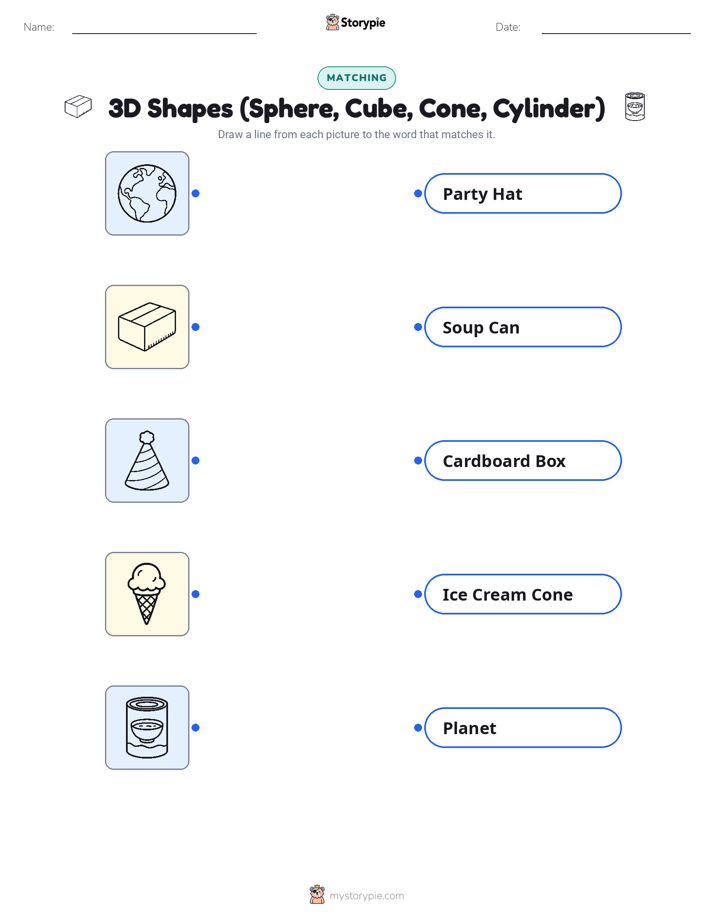
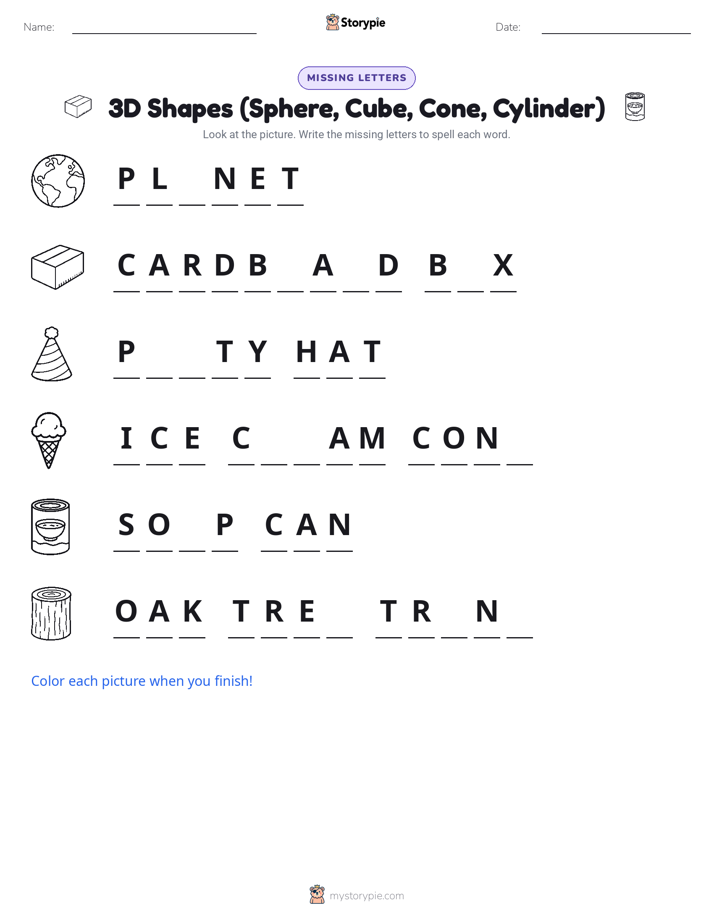
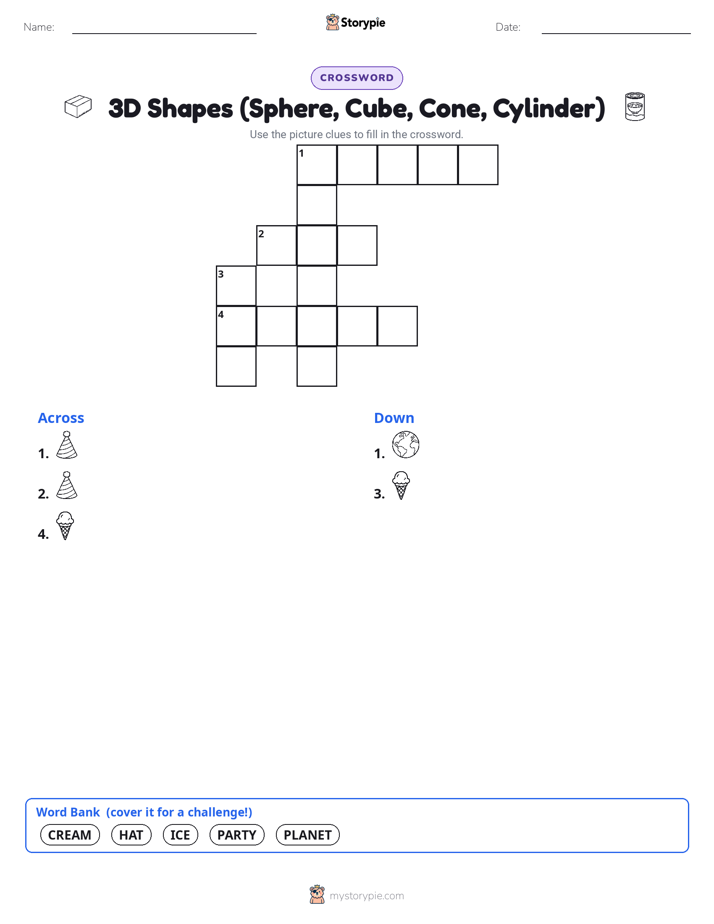
I am the perfect, smooth curve of a planet spinning silently through the blackness of space. I am the satisfying sturdiness of a cardboard box, with flat sides and sharp corners that make me perfect for stacking. I am the cheerful point of a party hat and the delicious crunch of an ice cream cone. I am the smooth roll of a can of soup on a countertop and the solid trunk of a mighty oak tree. You see us everywhere, but do you really see us? We are not just flat drawings on a piece of paper. We are shapes you can hold in your hands, with insides and outsides, with volume and surface area. We are the soccer ball you kick across a field, the dice you roll in a board game, the traffic cone that guides cars safely, and the water bottle you drink from. Before mathematicians gave us fancy names and studied our secrets, we were simply part of the world, helping people build, create, and understand. We are the solid forms that give structure to everything you know, from the tiniest marble to the grandest building. We are more than just lines; we are space and substance. We are Sphere, Cube, Cone, and Cylinder, a family of three-dimensional shapes, and this is our story.
Long before people had textbooks or protractors, they saw us everywhere in the natural world. They looked up and saw the great, glowing Sphere of the sun and the smaller, silvery Sphere of the moon. They walked through forests of towering Cylinders, the trunks of ancient trees reaching for the sky. They gazed at distant mountains that rose into perfect Cones against the horizon. For thousands of years, humans simply lived among us. But then, an idea sparked. Starting around 3000 BCE in the fertile river valleys of Mesopotamia and Egypt, people realized they could put us to work. As Cube, I was especially popular. They learned to mix mud and straw, pack it into rectangular molds, and let it dry under the hot sun. These mud bricks—millions of little cubes—were stable, easy to stack, and perfect for building. With me, they built the first cities, creating homes to shelter their families and massive temples called ziggurats that climbed toward the heavens, step by sturdy step. My cousin, Cylinder, was just as useful. They observed how a fallen tree trunk could roll and applied that principle. By placing heavy stones on top of rolling logs—a series of cylinders—they could move immense weight with far less effort, a crucial step in constructing their monuments. They also shaped clay into cylindrical pots, whose smooth, strong walls were ideal for storing precious grain and water, keeping their communities fed and hydrated through dry seasons. We weren't just background scenery anymore; we were the fundamental tools of civilization, the secret behind their greatest achievements in building, farming, and survival. We were the solution to their most pressing problems.
We Are the Shapes of the World
I am the perfect, smooth curve of a planet spinning silently through the blackness of space. I am the satisfying sturdiness of a cardboard box, with flat sides and sharp corners that make me perfect for stacking. I am the cheerful point of a party hat and the delicious crunch of an ice cream cone. I am the smooth roll of a can of soup on a countertop and the solid trunk of a mighty oak tree. You see us everywhere, but do you really see us? We are not just flat drawings on a piece of paper. We are shapes you can hold in your hands, with insides and outsides, with volume and surface area. We are the soccer ball you kick across a field, the dice you roll in a board game, the traffic cone that guides cars safely, and the water bottle you drink from. Before mathematicians gave us fancy names and studied our secrets, we were simply part of the world, helping people build, create, and understand. We are the solid forms that give structure to everything you know, from the tiniest marble to the grandest building. We are more than just lines; we are space and substance. We are Sphere, Cube, Cone, and Cylinder, a family of three-dimensional shapes, and this is our story.
Long before people had textbooks or protractors, they saw us everywhere in the natural world. They looked up and saw the great, glowing Sphere of the sun and the smaller, silvery Sphere of the moon. They walked through forests of towering Cylinders, the trunks of ancient trees reaching for the sky. They gazed at distant mountains that rose into perfect Cones against the horizon. For thousands of years, humans simply lived among us. But then, an idea sparked. Starting around 3000 BCE in the fertile river valleys of Mesopotamia and Egypt, people realized they could put us to work. As Cube, I was especially popular. They learned to mix mud and straw, pack it into rectangular molds, and let it dry under the hot sun. These mud bricks—millions of little cubes—were stable, easy to stack, and perfect for building. With me, they built the first cities, creating homes to shelter their families and massive temples called ziggurats that climbed toward the heavens, step by sturdy step. My cousin, Cylinder, was just as useful. They observed how a fallen tree trunk could roll and applied that principle. By placing heavy stones on top of rolling logs—a series of cylinders—they could move immense weight with far less effort, a crucial step in constructing their monuments. They also shaped clay into cylindrical pots, whose smooth, strong walls were ideal for storing precious grain and water, keeping their communities fed and hydrated through dry seasons. We weren't just background scenery anymore; we were the fundamental tools of civilization, the secret behind their greatest achievements in building, farming, and survival. We were the solution to their most pressing problems.
For centuries, people used us without truly thinking about us. We were tools, nothing more. But then we traveled across the sea to ancient Greece, where a new kind of person emerged: the thinker. These people didn't just want to use us; they wanted to understand us. One of the first was a philosopher named Plato, who lived in the 4th century BCE. He thought we were so perfect, so fundamental, that he connected us to the very elements that made up the universe. He believed that I, the Cube, with my unmatched stability and right angles, was the physical representation of the element Earth. He saw the universe as a beautiful, ordered place, and we were its divine building blocks. About a century later, around 300 BCE, a brilliant mathematician named Euclid came along. Euclid was an organizer, a man who loved logic and order. He gathered all the known knowledge about us and about our flat cousins, the 2D shapes, and wrote it all down in a series of thirteen books called Elements. In his work, he didn't just describe us; he created a system. He defined what a point was, what a line was, and built up from there, proving with careful logic all our properties—how to calculate our volume, our surface area, and how we relate to one another. Elements became the most important mathematics textbook in history, laying the foundations of geometry for the next two thousand years. But perhaps our biggest fan of all was the genius inventor and mathematician, Archimedes, who lived around 250 BCE. He was completely fascinated by me, Sphere, and my friend, Cylinder. He spent countless hours pondering our relationship. His breakthrough moment came when he discovered a beautiful, simple formula: the volume of a sphere is exactly two-thirds the volume of the smallest cylinder it can fit inside. This discovery thrilled him. It was a glimpse into the hidden mathematical harmony of the universe. He considered it his greatest achievement, so much so that he made a special request. He asked that a carving of a sphere perfectly contained within a cylinder be placed upon his tombstone, a permanent tribute to the elegant secret we had revealed to him.
The world of the ancient Greeks, with their scrolls and simple tools, seems very distant now, but their ideas about us have only grown more powerful. Today, we are working harder than ever, often in ways Plato or Archimedes could never have imagined. Look around, and you’ll see us at the heart of modern technology. I am the Sphere, not just as a planet, but as the tiny, polished ball bearings that reduce friction and allow the wheels on your skateboard and the parts in complex machines to spin smoothly. I am the Cube, no longer just a mud brick, but also the microscopic pixel on your computer and television screens. Millions of us work together, changing color in an instant to create the images you see. My friend Cone is no longer just a mountain; I am the precisely engineered nozzle on a rocket engine, directing powerful thrust to launch satellites into orbit and send astronauts to the stars. And Cylinder is still a roller, but now I am also the powerful piston inside the engine of a car, converting fuel into motion that carries you to school or on adventures. We are essential in architecture for designing strong and beautiful buildings, in engineering for creating everything from bridges to smartphones, and in art for giving sculptures form and depth. We even help create the incredible 3D worlds you explore in video games. The same ideas that helped build the first cities are now helping you imagine and construct the future. We are the timeless building blocks of invention, ready for the next generation of thinkers, dreamers, and creators to discover what new wonders they can build with us.
Wow facts
About
3D shapes are solid figures with three dimensions—length, width, and height. Prehistoric peoples, including those who built Stonehenge and created geometric patterns in Europe and Mesoamerica, had an understanding of geometric concepts long before ancient civilizations like the Egyptians and Greeks. These shapes are fundamental to mathematics, science, and engineering.
Take a Quiz
Question 1 of 5
In your own words, explain how people in ancient Mesopotamia and Egypt used the Cube and the Cylinder.
Explore next


Want to do even more?
Go beyond exploring. Unlock tools that turn every story into real learning.

Storypie Plus for families
Full stories, quizzes, and printables. Nights and car rides, sorted.
- Unlimited audio stories
- Create Mode: your child stars in the story
- Offline downloads
- Printable worksheets & coloring pages

Why Storypie for Schools
Students engaged. Prep in seconds. Evenings back to you.
- Worksheets & Quizzes
- Classroom Management
- Formative Assessment
- Custom Curriculum & Lesson Plans
- 27 Languages

Why Storypie for Homeschool
Curriculum done. They'll ask for more. Hours back in your day.
- Worksheet Generator
- First-Person Audio Stories
- Built-in Comprehension Quizzes
- Custom Curriculum & Lesson Plans
- Print & Go Activities