English


3D Shapes (Sphere, Cube, Cone, Cylinder)
3D shapes are solid figures with three dimensions—length, width, and height.
Reads at Grades 3–5 Listens at Grades 1–5
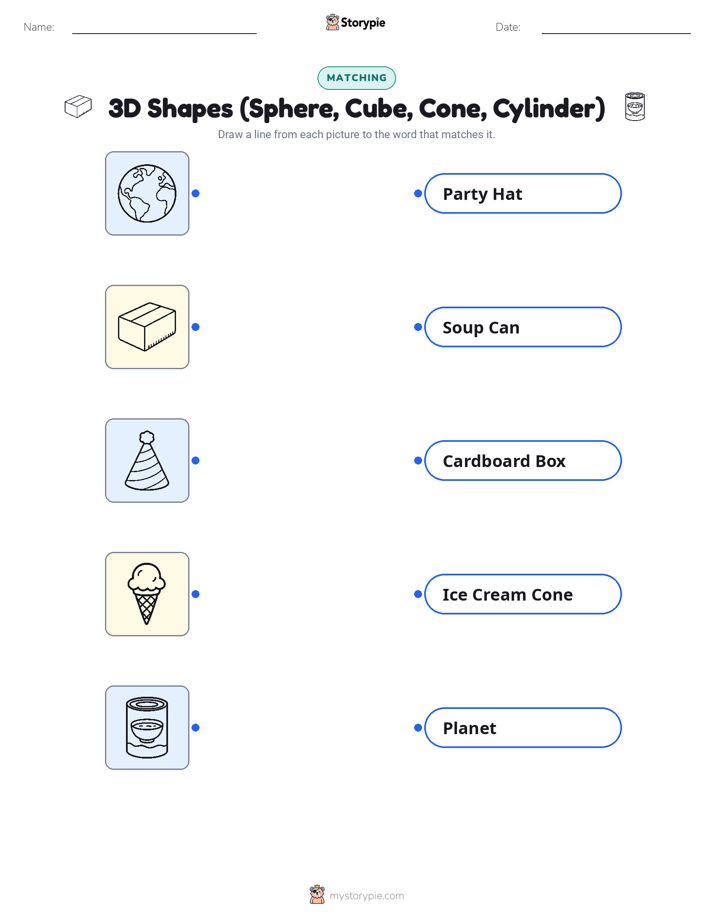
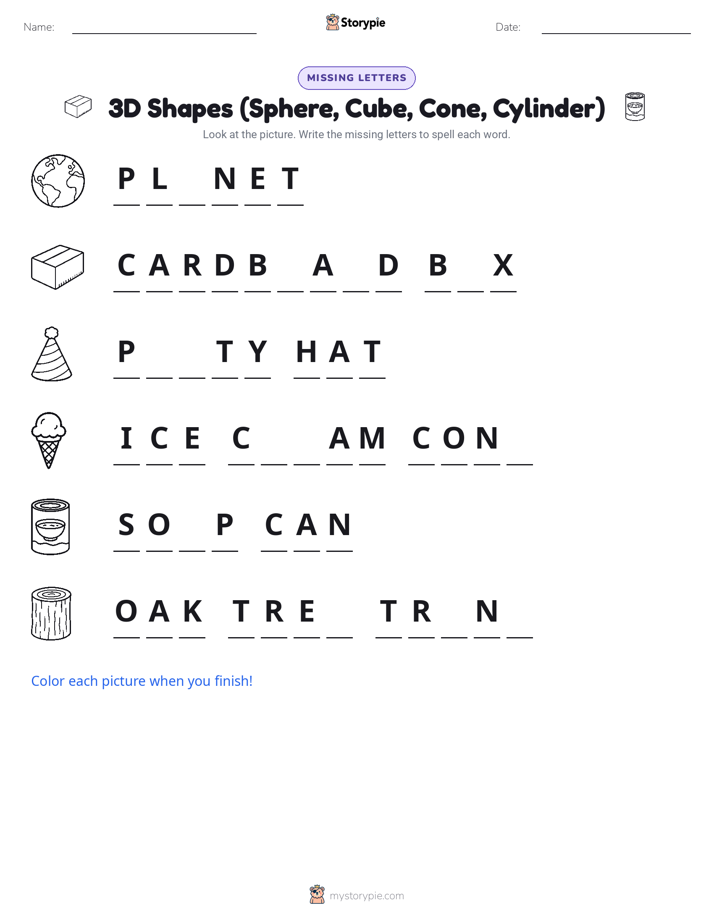
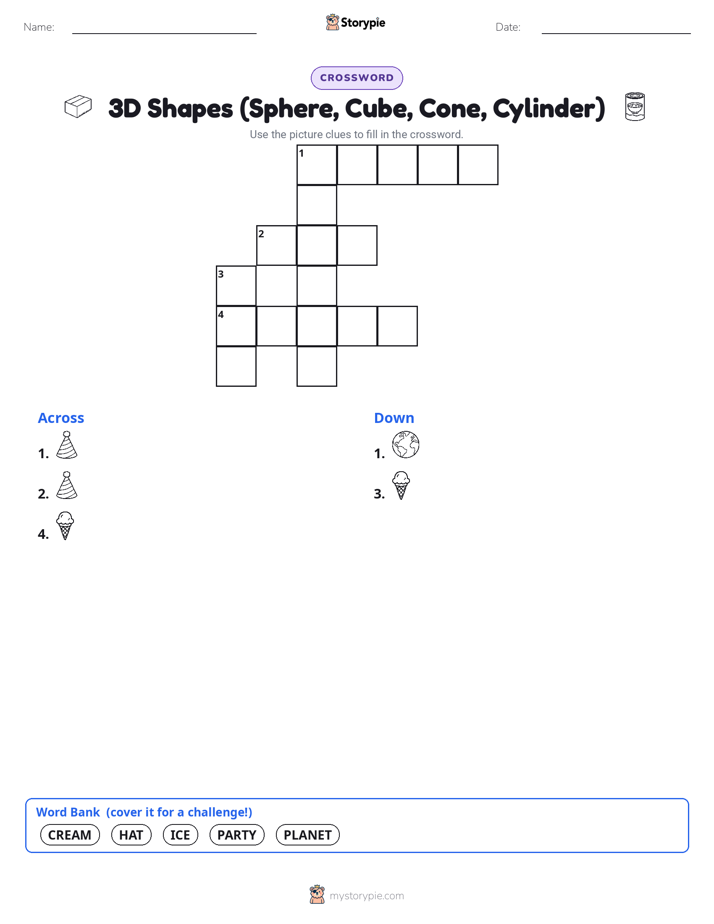
Print & create
Answer keys·No prep·Free with an account
28 worksheets · answer keys · full story · quiz · Ages 8-10 · CEFR B1
Plus adds 244,000+ more stories in 27 languages, audio for every one, and printables for all of them.
Just want 3D Shapes (Sphere, Cube, Cone, Cylinder)?

Have you ever kicked a perfectly round ball and watched it soar, or stacked blocky towers so high they wobble and fall? Have you worn a pointy party hat that sits just right on your head, or sipped juice from a can that feels smooth and cool in your hands? You probably see us every single day. We are not like flat drawings on a piece of paper. You can hold us. You can feel our sides, our edges, and our curves. We are solid. We take up space in your world, from the tiniest bead to the biggest building. We have been here all along, waiting for you to notice us in all our different forms. Can you guess who we are? We are 3D shapes—the sphere, the cube, the cone, and the cylinder.
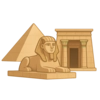
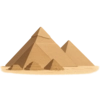
Long before people gave us fancy names, we were here. Early humans saw us in the world all around them. They looked up at the bright sun and the glowing moon and saw a sphere. They looked at the strong trunks of trees and saw a cylinder. As people began to build and create, they put us to work. Imagine the land of Mesopotamia, way back around 3000 BCE. Farmers there used cylinders to roll across clay tablets, creating official seals. They also used cylinder-shaped containers to measure out grain and make sure everyone got their fair share. Then, travel across the desert to ancient Egypt. Around the 26th century BCE, the Egyptians became master builders. They cut enormous blocks of stone into shapes like us cubes and stacked them with amazing skill, one on top of the other, to build the magnificent Great Pyramids that still stand today. They knew that a cube's flat faces made it perfect for building something strong and mighty.
We Are the Shapes of Your World
Have you ever kicked a perfectly round ball and watched it soar, or stacked blocky towers so high they wobble and fall? Have you worn a pointy party hat that sits just right on your head, or sipped juice from a can that feels smooth and cool in your hands? You probably see us every single day. We are not like flat drawings on a piece of paper. You can hold us. You can feel our sides, our edges, and our curves. We are solid. We take up space in your world, from the tiniest bead to the biggest building. We have been here all along, waiting for you to notice us in all our different forms. Can you guess who we are? We are 3D shapes—the sphere, the cube, the cone, and the cylinder.
Long before people gave us fancy names, we were here. Early humans saw us in the world all around them. They looked up at the bright sun and the glowing moon and saw a sphere. They looked at the strong trunks of trees and saw a cylinder. As people began to build and create, they put us to work. Imagine the land of Mesopotamia, way back around 3000 BCE. Farmers there used cylinders to roll across clay tablets, creating official seals. They also used cylinder-shaped containers to measure out grain and make sure everyone got their fair share. Then, travel across the desert to ancient Egypt. Around the 26th century BCE, the Egyptians became master builders. They cut enormous blocks of stone into shapes like us cubes and stacked them with amazing skill, one on top of the other, to build the magnificent Great Pyramids that still stand today. They knew that a cube's flat faces made it perfect for building something strong and mighty.
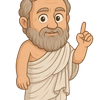
For thousands of years, people used us without thinking too much about our secrets. But then, in a place called Ancient Greece, some very clever thinkers began to study us just for the love of learning. A wise man named Plato, who lived in the 4th century BCE, thought we were the keys to understanding the universe. He believed the cube was a perfect, stable shape that represented the element of Earth. Not long after, around 300 BCE, a mathematician named Euclid wrote a famous book called Elements. It was like a rulebook for us. It explained how we worked, our angles, our faces, and how we relate to each other. Then came the brilliant Archimedes in the 3rd century BCE. He was a genius who loved to solve puzzles. He figured out some of our biggest secrets, like the exact amount of space a sphere takes up and how it relates to the cylinder that fits perfectly around it. He was so proud of this discovery that he asked for a carving of a sphere and a cylinder to be placed on his tombstone when he died.
That knowledge from long ago didn't stay in the past. It traveled through time, and today, we are the building blocks of your entire world. Look at a tall skyscraper touching the clouds; you’ll see us in its rectangular prism shape, a cousin of the cube. The cars that zoom down the street have wheels that are like cylinders and spheres working together. Even the cans of soup in your kitchen pantry are perfect cylinders, just like the ones Archimedes studied. We are also part of your fun. When you watch a 3D movie or play a video game, artists and programmers use us to create the amazing characters and worlds you see on the screen. We are everywhere, in art, science, and nature. So next time you look around, see how many of us you can find. What new and amazing things will you imagine and build with us?
Wow facts
About
3D shapes are solid figures with three dimensions—length, width, and height. Prehistoric peoples, including those who built Stonehenge and created geometric patterns in Europe and Mesoamerica, had an understanding of geometric concepts long before ancient civilizations like the Egyptians and Greeks. These shapes are fundamental to mathematics, science, and engineering.
Take a Quiz
Question 1 of 5
The story says Archimedes was so proud of his discovery that he wanted it on his tombstone. What does this tell you about how he felt about his work?
Explore next


Want to do even more?
Go beyond exploring. Unlock tools that turn every story into real learning.

Storypie Plus for families
Full stories, quizzes, and printables. Nights and car rides, sorted.
- Unlimited audio stories
- Create Mode: your child stars in the story
- Offline downloads
- Printable worksheets & coloring pages

Why Storypie for Schools
Students engaged. Prep in seconds. Evenings back to you.
- Worksheets & Quizzes
- Classroom Management
- Formative Assessment
- Custom Curriculum & Lesson Plans
- 27 Languages

Why Storypie for Homeschool
Curriculum done. They'll ask for more. Hours back in your day.
- Worksheet Generator
- First-Person Audio Stories
- Built-in Comprehension Quizzes
- Custom Curriculum & Lesson Plans
- Print & Go Activities