English

Chemical Reactions
Chemical reactions are processes that transform one set of chemical substances into another by rearranging…
Reads at Grades 6–8 Listens at Grades 4–8
Print & create
Answer keys·No prep·Free with an account
28 worksheets · answer keys · full story · quiz · Ages 10-12 · CEFR B2
Plus adds 244,000+ more stories in 27 languages, audio for every one, and printables for all of them.
Just want Chemical Reactions?
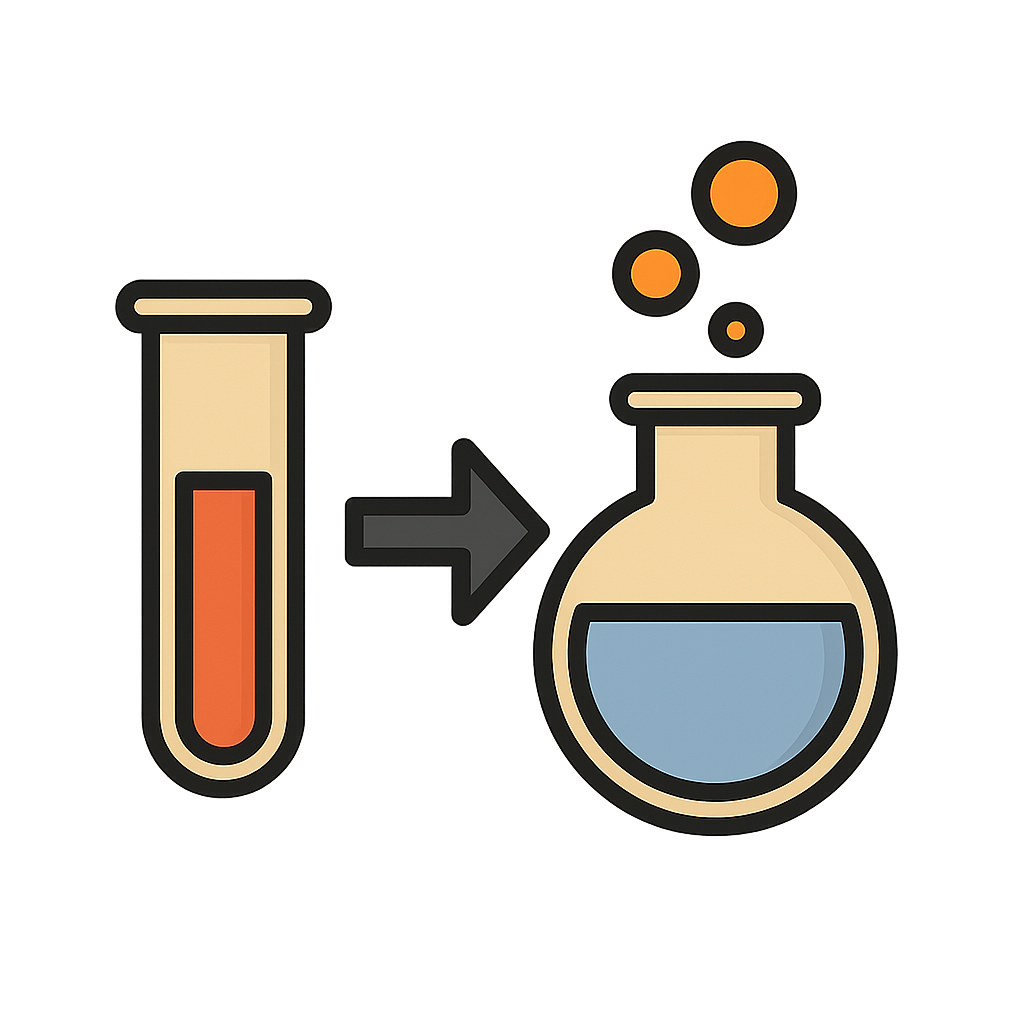
Have you ever watched gooey, pale batter slide into a hot oven and emerge as a warm, fluffy cake. Or have you noticed how a shiny new bicycle, left out in the garden, slowly blushes with a coat of crusty, red rust after many rainstorms. I am the silent artist behind both transformations. I am the explosive fizz when a colorful bath bomb hits the water, releasing bubbles and scents. I am the crackling roar of a campfire, turning solid wood into glowing embers, light, and heat. I can be gentle and slow, or I can be sudden and powerful. For most of human history, you saw my work everywhere but treated me like magic, a mysterious force that could change one thing into another without any clear rules. You knew I existed, but you did not know my name or the secret of how I worked. You saw the world change, but the reason was invisible to you. That invisible artist, that master of change, is me. I am a Chemical Reaction, and I rearrange the world, one atom at a time.
My story with humanity began with one of my most famous and dramatic forms. Over a million years ago, your early ancestors huddled in the cold, watching lightning strike a tree and set it ablaze. They were afraid of me at first, this wild, dancing light that consumed everything it touched. But soon, they learned to control me. They harnessed the power of fire. They didn't understand that I was just oxygen atoms from the air rapidly combining with carbon atoms in the wood, but they knew I gave them warmth, protected them from predators, and could cook their food, making it safer and tastier. For thousands of years, that was how we coexisted. Then, around 5000 BCE in the lands of the Middle East, someone discovered another of my tricks. They found that if you took certain greenish rocks and heated them in a very hot fire, a new, shiny, reddish-brown substance would ooze out. It was copper. They had discovered smelting, using me to break metal atoms free from the rock they were trapped in. This changed everything, leading to new tools and technologies. Much later, a group of curious thinkers called alchemists, from ancient Egypt all the way through the Middle Ages in Europe, became obsessed with my power. They built strange laboratories filled with bubbling potions and glowing furnaces. Their ultimate dream was to use me to perform the greatest transformation of all: turning cheap metals like lead into precious gold. They never succeeded in that quest, but their tireless experiments weren't a failure. While chasing an impossible dream, they discovered new substances, perfected methods of distillation and purification, and created the glassware that would one day become the tools of a new kind of science.
The Dance of Atoms
Have you ever watched gooey, pale batter slide into a hot oven and emerge as a warm, fluffy cake. Or have you noticed how a shiny new bicycle, left out in the garden, slowly blushes with a coat of crusty, red rust after many rainstorms. I am the silent artist behind both transformations. I am the explosive fizz when a colorful bath bomb hits the water, releasing bubbles and scents. I am the crackling roar of a campfire, turning solid wood into glowing embers, light, and heat. I can be gentle and slow, or I can be sudden and powerful. For most of human history, you saw my work everywhere but treated me like magic, a mysterious force that could change one thing into another without any clear rules. You knew I existed, but you did not know my name or the secret of how I worked. You saw the world change, but the reason was invisible to you. That invisible artist, that master of change, is me. I am a Chemical Reaction, and I rearrange the world, one atom at a time.
My story with humanity began with one of my most famous and dramatic forms. Over a million years ago, your early ancestors huddled in the cold, watching lightning strike a tree and set it ablaze. They were afraid of me at first, this wild, dancing light that consumed everything it touched. But soon, they learned to control me. They harnessed the power of fire. They didn't understand that I was just oxygen atoms from the air rapidly combining with carbon atoms in the wood, but they knew I gave them warmth, protected them from predators, and could cook their food, making it safer and tastier. For thousands of years, that was how we coexisted. Then, around 5000 BCE in the lands of the Middle East, someone discovered another of my tricks. They found that if you took certain greenish rocks and heated them in a very hot fire, a new, shiny, reddish-brown substance would ooze out. It was copper. They had discovered smelting, using me to break metal atoms free from the rock they were trapped in. This changed everything, leading to new tools and technologies. Much later, a group of curious thinkers called alchemists, from ancient Egypt all the way through the Middle Ages in Europe, became obsessed with my power. They built strange laboratories filled with bubbling potions and glowing furnaces. Their ultimate dream was to use me to perform the greatest transformation of all: turning cheap metals like lead into precious gold. They never succeeded in that quest, but their tireless experiments weren't a failure. While chasing an impossible dream, they discovered new substances, perfected methods of distillation and purification, and created the glassware that would one day become the tools of a new kind of science.
For centuries, I remained a puzzle. The work of the alchemists was a mix of guesswork, secret recipes, and philosophy. But slowly, the magic began to transform into science. The first whisper of my true nature came from an ancient Greek philosopher named Democritus, around 400 BCE. He looked at the world and had a revolutionary idea. What if you kept cutting something in half, over and over again. Eventually, he reasoned, you would reach a particle so tiny it could not be cut anymore. He called this particle 'atomos,' which means 'uncuttable.' It was just an idea, a brilliant guess with no proof, but it was the seed of the truth. That seed lay dormant for nearly two thousand years until the scientific revolution began to bloom. In 1661, a thoughtful man named Robert Boyle published a book called 'The Sceptical Chymist.' He argued that the old ideas of alchemy were not enough. He urged people to stop relying on ancient myths and to start conducting careful experiments to discover what things were truly made of. The biggest piece of my puzzle, however, was put into place by a meticulous French scientist named Antoine Lavoisier in the 1780s. In his laboratory, he treated me not as magic, but as a process he could measure. He would weigh every single substance before I began my work, and he would carefully capture and weigh everything that was produced, even the gases. He proved, again and again, that matter is never created or destroyed during one of my performances. It is only rearranged. This became a fundamental rule of science: the law of conservation of mass. Finally, in the early 1800s, an English schoolteacher named John Dalton connected all the dots. He took Democritus's idea of atoms, Boyle's call for experimentation, and Lavoisier's law of conservation, and he built the first modern atomic theory. He proposed that I, a chemical reaction, am simply the process of atoms unlinking from their partners and linking up in new arrangements. The magic was gone, but the truth was far more beautiful.
Now that you understand my true nature, you and I have become partners in creation. My atomic dance is happening everywhere, and you have learned to choreograph it. I am at work inside the battery powering the device you might be using right now, as different substances swap electrons to create an electrical current. I am the silent, life-giving process of photosynthesis, happening in every green leaf, where I use sunlight to turn carbon dioxide and water into the food plants need and the oxygen you breathe. Because scientists like Lavoisier and Dalton unraveled my secrets, humans can now guide me to achieve incredible things. You use your knowledge of me to design life-saving medicines that target diseases at a molecular level. You instruct me on how to form stronger, lighter materials for building skyscrapers and airplanes. You are even finding new ways for me to help create clean energy, like in hydrogen fuel cells, to power the future without polluting the planet. I am not magic from a hidden world. I am a fundamental part of your world, happening all around you and even inside you with every breath you take. By understanding my simple, elegant dance of atoms, you have been given the power to solve problems, to invent, and to build a better, brighter future. My work is a constant source of wonder, and now, it is also a source of endless possibility for you.
Wow facts
About
Chemical reactions are processes that transform one set of chemical substances into another by rearranging atoms. They are fundamental to everything from cooking and digestion to industrial manufacturing and life itself.
Take a Quiz
Question 1 of 5
What was the main problem scientists faced in understanding chemical reactions, and how did Antoine Lavoisier's work provide a key part of the solution?
Explore next





Want to do even more?
Go beyond exploring. Unlock tools that turn every story into real learning.

Storypie Plus for families
Full stories, quizzes, and printables. Nights and car rides, sorted.
- Unlimited audio stories
- Create Mode: your child stars in the story
- Offline downloads
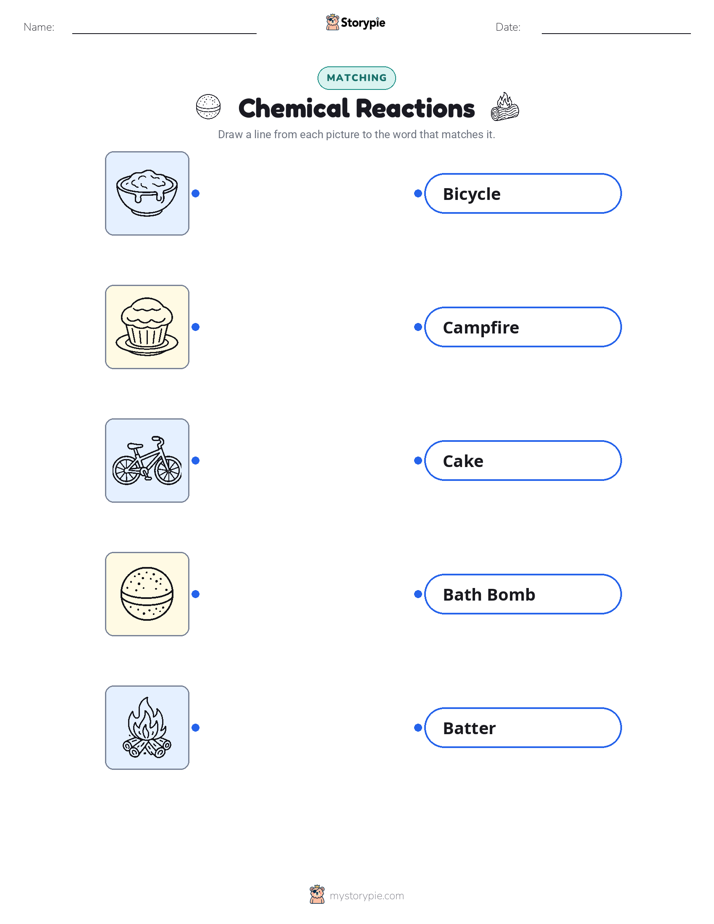
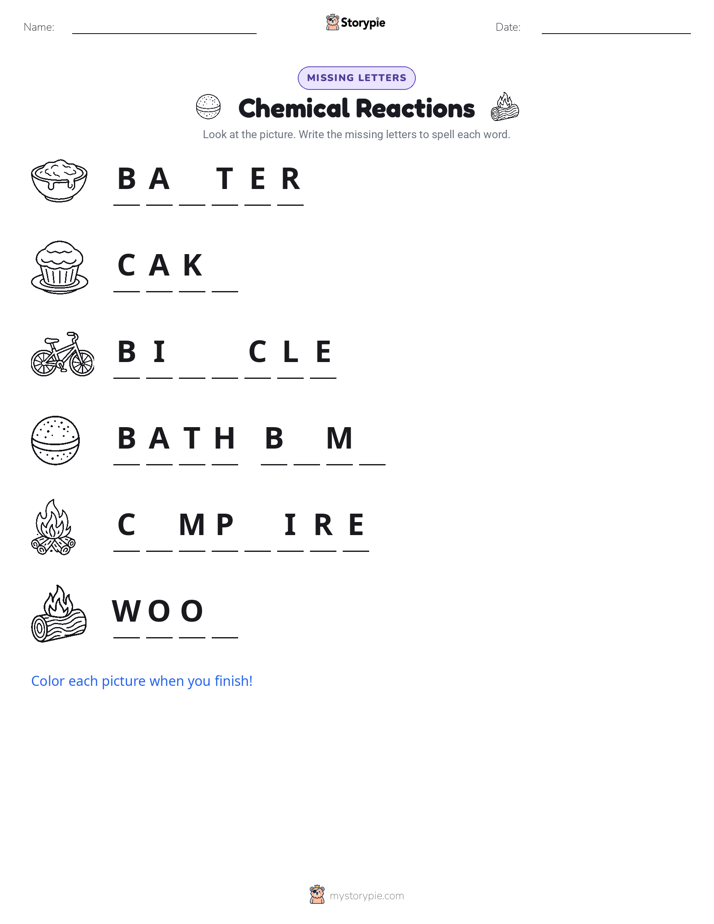
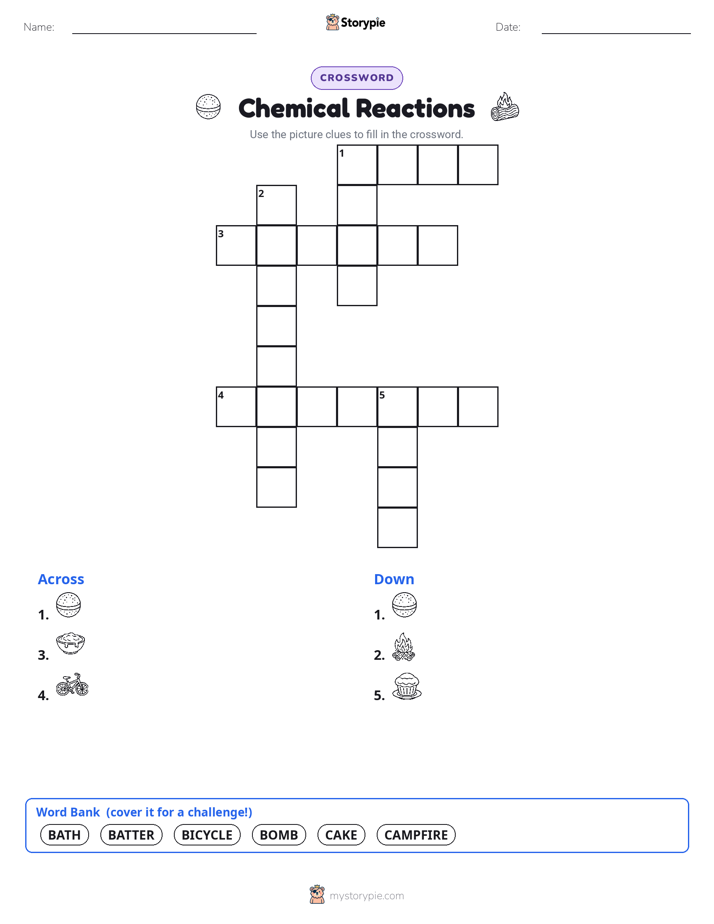
- Printable worksheets & coloring pages

Why Storypie for Schools
Students engaged. Prep in seconds. Evenings back to you.
- Worksheets & Quizzes
- Classroom Management
- Formative Assessment
- Custom Curriculum & Lesson Plans
- 27 Languages

Why Storypie for Homeschool
Curriculum done. They'll ask for more. Hours back in your day.
- Worksheet Generator
- First-Person Audio Stories
- Built-in Comprehension Quizzes
- Custom Curriculum & Lesson Plans
- Print & Go Activities