English

Chemical Reactions
Chemical reactions are processes that transform one set of chemical substances into another by rearranging…
Reads at Grades 3–5 Listens at Grades 1–5
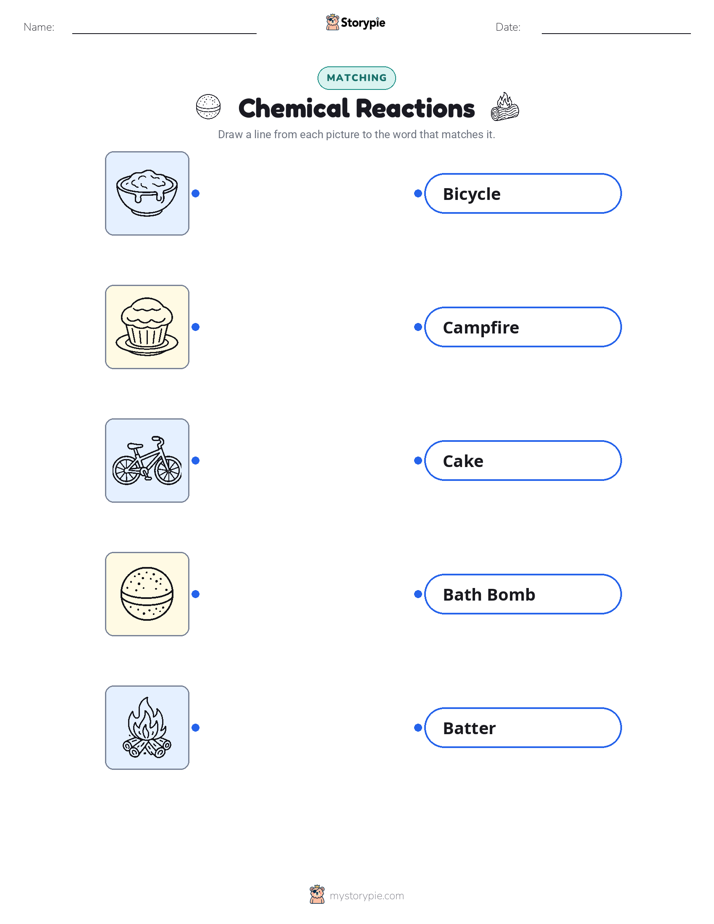
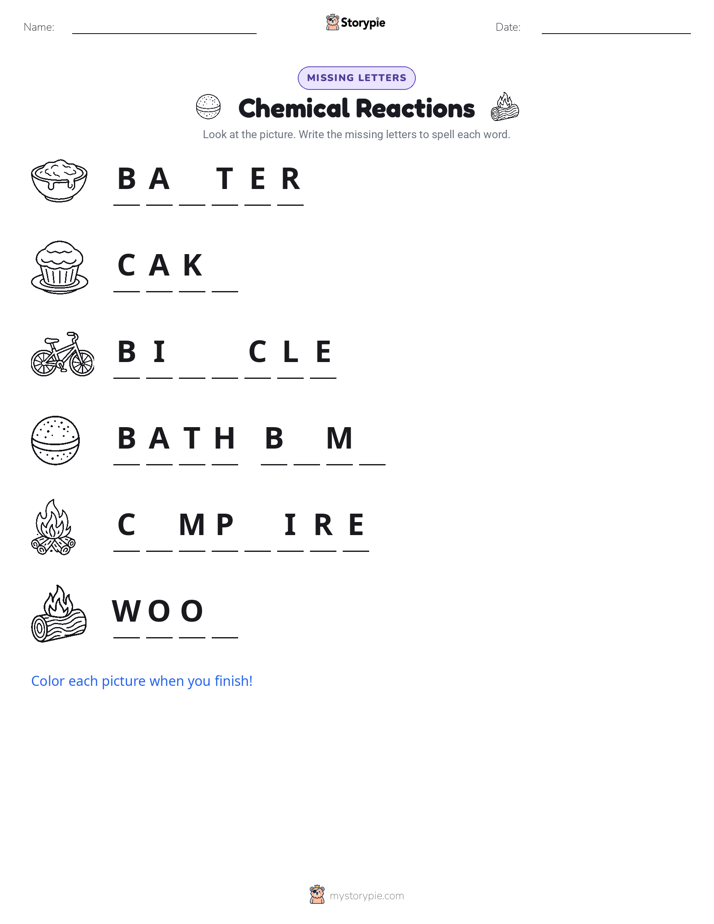
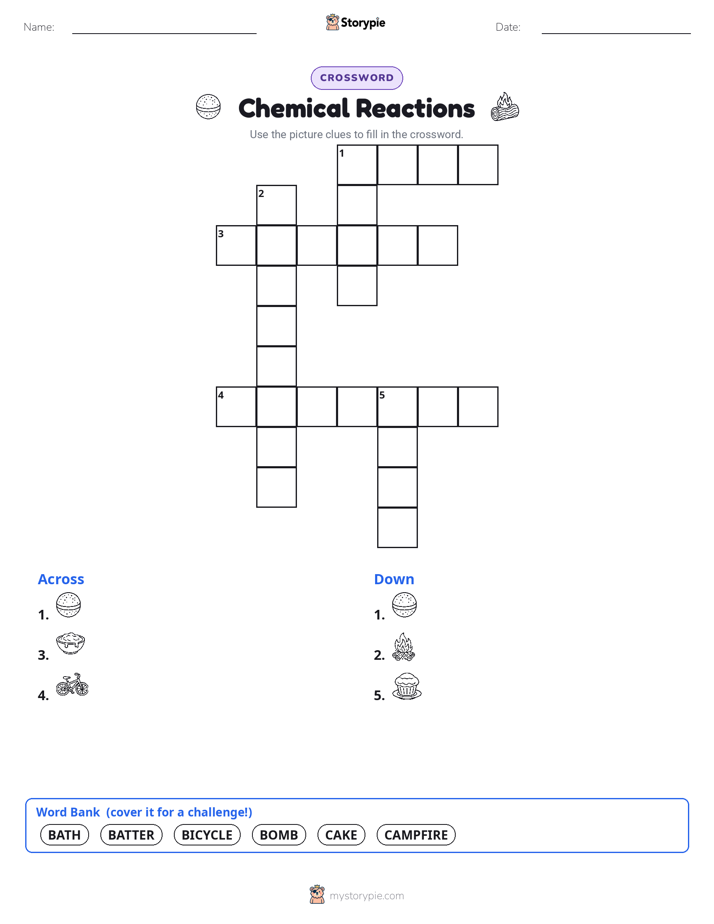
Print & create
Answer keys·No prep·Free with an account
28 worksheets · answer keys · full story · quiz · Ages 8-10 · CEFR B1
Plus adds 244,000+ more stories in 27 languages, audio for every one, and printables for all of them.
Just want Chemical Reactions?
Have you ever wondered about the sharp sizzle when an egg hits a hot pan, turning from clear goo into a firm, white circle. That's me at work. I am the thousands of tiny bubbles that tickle your nose when you pour a fresh soda, fizzing their way to the top in a rush of excitement. I am the cozy warmth and flickering orange light of a campfire on a cool night, changing a solid log of wood into dancing flames, glowing embers, and floating ash. I am a secret artist, silently working behind the scenes to paint the world with change. In the autumn, I sneak into the trees and dip my paintbrush into an invisible palette, turning the plain green leaves of summer into a brilliant masterpiece of reds, oranges, and yellows. In your kitchen, I am the magical baker who takes a bowl of sticky, gooey dough and, with the help of a hot oven, puffs it up into a soft, fluffy cake that fills the whole house with a delicious smell. I am a master of transformation. I love to take the tiny, invisible building blocks that make up everything and rearrange them, like a cosmic LEGO builder, creating something completely new and different. I break old connections and forge new ones, turning one substance into another. I am Chemical Reactions, and I'm happening all around you, and inside you, every single second of every day.
For thousands and thousands of years, people used me every day without even knowing my name. Can you imagine a world without a warm fire. Way back, as far as 1 million years ago, early humans discovered how to control me. They learned to create fire, using my power to cook their food, which made it safer and tastier to eat, and to keep themselves warm against the cold, dark nights. They were my first partners. Thousands of years later, around 5000 BCE, people in places like ancient Mesopotamia found another one of my tricks. They realized that if they heated up certain greenish rocks to very high temperatures, I would perform a little magic and turn them into a shiny, strong metal called copper. They used this new material to make better tools and weapons. For a very long time after that, many clever people thought I really was a form of magic. They were called alchemists, and from about the 8th century all the way to the 17th century, they worked in bubbling laboratories trying to unlock my deepest secrets. A famous alchemist named Jabir ibn Hayyan, who lived in the 8th century, was one of the first to experiment with me in a systematic way. The alchemists' biggest dream was to use me to turn a cheap, dull metal like lead into precious, shiny gold. They never succeeded, but in trying, they discovered many of my secrets and invented a lot of the equipment that scientists still use today. The biggest change in my story came thanks to a super-curious French scientist named Antoine Lavoisier in the late 1700s. He was a very careful observer. He used precise scales and sealed jars to show that I don't make things magically appear or disappear. Instead, I just rearrange the ingredients. In 1789, he shared his big idea, which he called the Law of Conservation of Mass. It proved I was not magic, but a predictable and amazing part of science.
I Am Chemical Reactions
Have you ever wondered about the sharp sizzle when an egg hits a hot pan, turning from clear goo into a firm, white circle. That's me at work. I am the thousands of tiny bubbles that tickle your nose when you pour a fresh soda, fizzing their way to the top in a rush of excitement. I am the cozy warmth and flickering orange light of a campfire on a cool night, changing a solid log of wood into dancing flames, glowing embers, and floating ash. I am a secret artist, silently working behind the scenes to paint the world with change. In the autumn, I sneak into the trees and dip my paintbrush into an invisible palette, turning the plain green leaves of summer into a brilliant masterpiece of reds, oranges, and yellows. In your kitchen, I am the magical baker who takes a bowl of sticky, gooey dough and, with the help of a hot oven, puffs it up into a soft, fluffy cake that fills the whole house with a delicious smell. I am a master of transformation. I love to take the tiny, invisible building blocks that make up everything and rearrange them, like a cosmic LEGO builder, creating something completely new and different. I break old connections and forge new ones, turning one substance into another. I am Chemical Reactions, and I'm happening all around you, and inside you, every single second of every day.
For thousands and thousands of years, people used me every day without even knowing my name. Can you imagine a world without a warm fire. Way back, as far as 1 million years ago, early humans discovered how to control me. They learned to create fire, using my power to cook their food, which made it safer and tastier to eat, and to keep themselves warm against the cold, dark nights. They were my first partners. Thousands of years later, around 5000 BCE, people in places like ancient Mesopotamia found another one of my tricks. They realized that if they heated up certain greenish rocks to very high temperatures, I would perform a little magic and turn them into a shiny, strong metal called copper. They used this new material to make better tools and weapons. For a very long time after that, many clever people thought I really was a form of magic. They were called alchemists, and from about the 8th century all the way to the 17th century, they worked in bubbling laboratories trying to unlock my deepest secrets. A famous alchemist named Jabir ibn Hayyan, who lived in the 8th century, was one of the first to experiment with me in a systematic way. The alchemists' biggest dream was to use me to turn a cheap, dull metal like lead into precious, shiny gold. They never succeeded, but in trying, they discovered many of my secrets and invented a lot of the equipment that scientists still use today. The biggest change in my story came thanks to a super-curious French scientist named Antoine Lavoisier in the late 1700s. He was a very careful observer. He used precise scales and sealed jars to show that I don't make things magically appear or disappear. Instead, I just rearrange the ingredients. In 1789, he shared his big idea, which he called the Law of Conservation of Mass. It proved I was not magic, but a predictable and amazing part of science.
Once Antoine Lavoisier showed everyone that I followed rules, a whole new world of discovery opened up. Scientists were eager to figure out what those rules were. In the early 1800s, an English schoolteacher named John Dalton had a brilliant idea that changed everything. He imagined that everything in the universe—the air, the water, you, and even a donut—was made of incredibly tiny particles called atoms. He thought of them like super-tiny, individual building blocks. Dalton realized that I, a chemical reaction, was simply the process of these atoms rearranging themselves. He pictured them breaking away from their old partners and forming new bonds with different partners, like a grand dance where everyone swaps partners to create new groups. His atomic theory, which he began publishing around 1808, gave scientists a map to finally understand what I was actually doing on a tiny, invisible scale. This map got even better a little later. In 1869, a Russian chemist with a fantastically wild beard named Dmitri Mendeleev created something amazing. He organized all the known types of atoms, which are called elements, into a special chart. He called it the Periodic Table. It was like a giant family tree for all the elements, showing which ones were related and how they were likely to behave. This incredible chart was so clever that it even left empty spaces for elements that hadn't been discovered yet, and it correctly predicted what they would be like. Thanks to Mendeleev's table, scientists could look at two different elements and guess how they might dance together, making it so much easier to work with me to create amazing and useful new things.
Today, now that you know my secrets, you can see me everywhere. I am the silent worker inside the batteries that power your video games and tablets, creating a flow of electricity. When you eat your lunch, I get busy inside your body, breaking down the food to give you the energy you need to run, play, and learn. I am even working inside the green leaves of every plant and tree, using a process called photosynthesis to turn sunlight, water, and air into food for the plant to grow. My work is in the medicines that help you feel better when you are sick and in the strong plastics and metals used to build our homes, cars, and airplanes. I am the power of change, and my story shows that new and wonderful things can always be created from what we already have. Every time a scientist discovers a new medicine to fight a disease, or a chef bakes a delicious pie, they are using my power to make the world a better, more interesting place. What new and wonderful things will you create with me.
Wow facts
About
Chemical reactions are processes that transform one set of chemical substances into another by rearranging atoms. They are fundamental to everything from cooking and digestion to industrial manufacturing and life itself.
Take a Quiz
Question 1 of 5
In the story, I am called a 'master of transformation.' Based on the story's examples, what does the word 'transformation' mean?
Explore next





Want to do even more?
Go beyond exploring. Unlock tools that turn every story into real learning.

Storypie Plus for families
Full stories, quizzes, and printables. Nights and car rides, sorted.
- Unlimited audio stories
- Create Mode: your child stars in the story
- Offline downloads
- Printable worksheets & coloring pages

Why Storypie for Schools
Students engaged. Prep in seconds. Evenings back to you.
- Worksheets & Quizzes
- Classroom Management
- Formative Assessment
- Custom Curriculum & Lesson Plans
- 27 Languages

Why Storypie for Homeschool
Curriculum done. They'll ask for more. Hours back in your day.
- Worksheet Generator
- First-Person Audio Stories
- Built-in Comprehension Quizzes
- Custom Curriculum & Lesson Plans
- Print & Go Activities