English

Fact vs. Opinion
The distinction between a statement that can be proven true or false (a fact) and a personal belief, feeling…
Reads at Grades 6–8 Listens at Grades 4–8
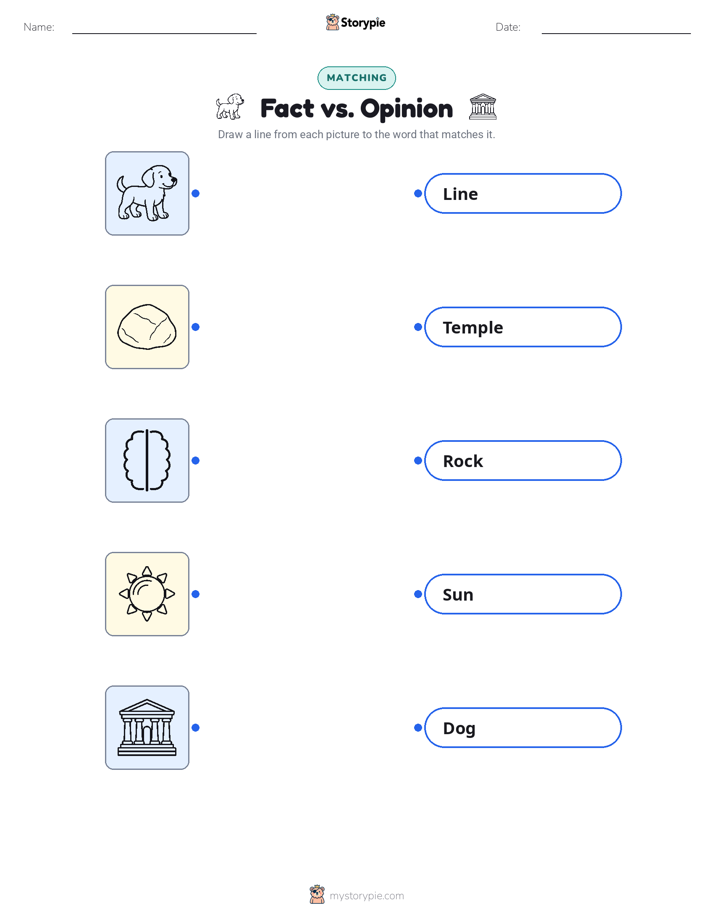
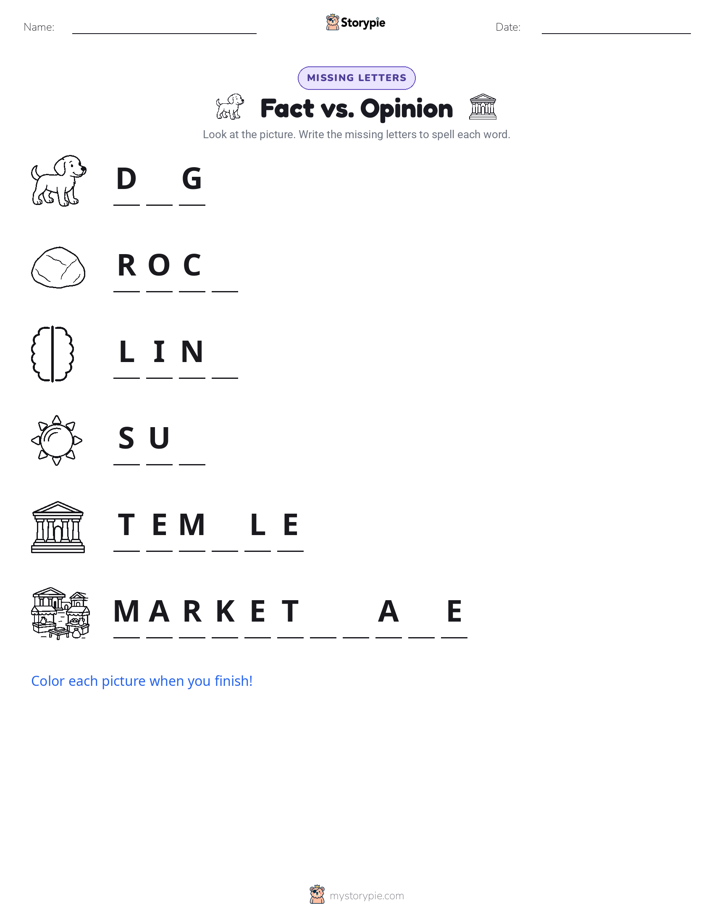
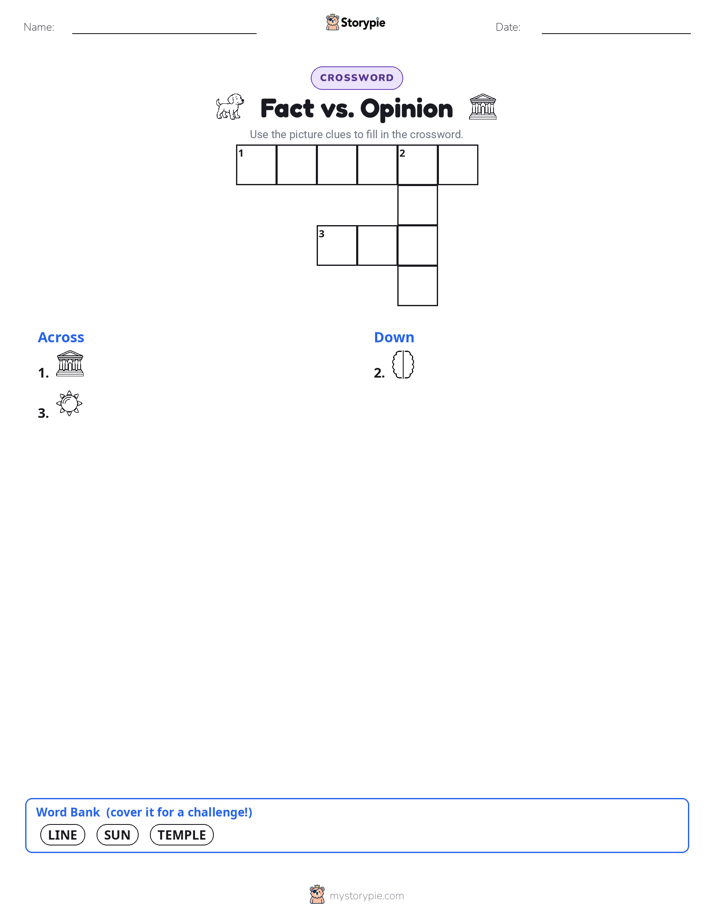
Print & create
Answer keys·No prep·Free with an account
28 worksheets · answer keys · full story · quiz · Ages 10-12 · CEFR B2
Plus adds 244,000+ more stories in 27 languages, audio for every one, and printables for all of them.
Just want Fact vs. Opinion?

Think about these two sentences. 'A dog has four legs.' Now think about this one: 'That dog is the cutest in the world.' Can you feel the difference. The first one is something you can check, something you can count and measure and see with your own eyes. It's solid, like a rock. The second one is a warm, fuzzy feeling in your heart, a thought that belongs completely to you but might not be the same for the person standing next to you. For centuries, I have existed in the space between those two ideas. I am a quiet but powerful line that separates what can be proven with evidence from what is felt in the soul. You can find me in every conversation, every book, and every corner of the internet, though I am often hidden. I am the tool that helps you understand what is true for everyone and what is true for just one person. People have spent thousands of years learning how to see me clearly, how to use me to build cities, create medicines, and understand the stars. I am the important idea that separates a Fact from an Opinion.
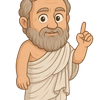
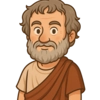
My story, the story of people learning to recognize me, truly began in a place of sunshine, stone temples, and endless questions: ancient Greece. Over 2,400 years ago, people started to think about me very carefully. Before then, myths and strong feelings often guided people's understanding of the world. But a wise and famously grumpy man named Socrates, who lived in Athens during the 5th century BCE, changed everything. He didn't write books, but he walked through the marketplace asking powerful people questions. He would ask a general, 'What is courage.' and the general would give an opinion. Socrates would then ask more questions, showing the general that his personal belief wasn't built on solid proof. He helped people see the shaky ground of their own opinions and begin the search for something more stable. His student, Plato, took this even further in the 4th century BCE. Plato told a famous story to explain me, called the 'Allegory of the Cave.' He said that opinions were like shadows dancing on a cave wall; they look real to the prisoners who have never seen anything else. But a fact, he explained, is what you see when you finally leave the cave and step into the bright sunlight—the real world. It was a brilliant way to show that what we believe isn't always what is. Then came Plato’s own brilliant student, Aristotle, also in the 4th century BCE. Aristotle gave people the tools to build with facts. He created the rules of logic, a system for constructing arguments piece by piece with solid evidence, like a mason laying bricks to build a strong wall that won't fall over. Together, these three thinkers gave me a voice and a purpose in the human mind.
The Line Between What Is and What You Feel
Think about these two sentences. 'A dog has four legs.' Now think about this one: 'That dog is the cutest in the world.' Can you feel the difference. The first one is something you can check, something you can count and measure and see with your own eyes. It's solid, like a rock. The second one is a warm, fuzzy feeling in your heart, a thought that belongs completely to you but might not be the same for the person standing next to you. For centuries, I have existed in the space between those two ideas. I am a quiet but powerful line that separates what can be proven with evidence from what is felt in the soul. You can find me in every conversation, every book, and every corner of the internet, though I am often hidden. I am the tool that helps you understand what is true for everyone and what is true for just one person. People have spent thousands of years learning how to see me clearly, how to use me to build cities, create medicines, and understand the stars. I am the important idea that separates a Fact from an Opinion.
My story, the story of people learning to recognize me, truly began in a place of sunshine, stone temples, and endless questions: ancient Greece. Over 2,400 years ago, people started to think about me very carefully. Before then, myths and strong feelings often guided people's understanding of the world. But a wise and famously grumpy man named Socrates, who lived in Athens during the 5th century BCE, changed everything. He didn't write books, but he walked through the marketplace asking powerful people questions. He would ask a general, 'What is courage.' and the general would give an opinion. Socrates would then ask more questions, showing the general that his personal belief wasn't built on solid proof. He helped people see the shaky ground of their own opinions and begin the search for something more stable. His student, Plato, took this even further in the 4th century BCE. Plato told a famous story to explain me, called the 'Allegory of the Cave.' He said that opinions were like shadows dancing on a cave wall; they look real to the prisoners who have never seen anything else. But a fact, he explained, is what you see when you finally leave the cave and step into the bright sunlight—the real world. It was a brilliant way to show that what we believe isn't always what is. Then came Plato’s own brilliant student, Aristotle, also in the 4th century BCE. Aristotle gave people the tools to build with facts. He created the rules of logic, a system for constructing arguments piece by piece with solid evidence, like a mason laying bricks to build a strong wall that won't fall over. Together, these three thinkers gave me a voice and a purpose in the human mind.
For a long time, the ideas of the Greek philosophers were studied and debated, but my full power wasn't unleashed until many centuries later. A great shift happened during a period from the 16th to the 18th centuries known as the Scientific Revolution. It was during this time that I found my best friend: the Scientific Method. This wasn't just about thinking; it was about doing. It was a special recipe for finding facts, a process of observing the world, forming a testable idea, running experiments to gather data, and drawing a conclusion based only on that evidence. Suddenly, I wasn't just an idea in a philosopher's mind; I was a tool in a scientist's hands. One of the bravest people to use this new tool was an Italian astronomer named Galileo Galilei. In the early 17th century, the common opinion, held for over a thousand years, was that the Earth was the center of everything and the sun and stars revolved around it. But Galileo didn't rely on opinion. He built a powerful telescope, pointed it at the night sky, and gathered facts. He saw moons circling Jupiter. He observed the phases of Venus, just like our moon. These were not feelings; they were repeatable observations, hard evidence that the old opinion was wrong. His facts were so powerful they got him into a lot of trouble, but they couldn't be ignored. He and others like him showed that using evidence was the most powerful way to discover what’s real, sparking a new age of discovery and invention that reshaped the world.
Now, my story continues with you. You live in a world overflowing with information. The internet, social media, and the news bring a constant flood of ideas, images, and voices into your life. In this flood, opinions and facts are mixed together, and telling them apart is more important than ever. Knowing me, truly understanding the line between what is and what is felt, is like having a superpower for thinking. It helps you see through misinformation and make smart decisions about what to believe. It allows you to understand why people might disagree; they have their own opinions, which are important to them, but facts provide a common ground where we can all meet. Using me helps you navigate this complicated world with curiosity and confidence. When you ask, 'How do we know that's true.' or 'What is the evidence.' you are building your own understanding on a foundation of truth. You are carrying on the work of Socrates, Plato, and Galileo, using the power of a clear mind to make sense of the world and your place in it.
Wow facts
About
The distinction between a statement that can be proven true or false (a fact) and a personal belief, feeling, or judgment that cannot be proven (an opinion).
Take a Quiz
Question 1 of 5
According to the story, what is the main difference between a fact and an opinion?
Explore next




Want to do even more?
Go beyond exploring. Unlock tools that turn every story into real learning.

Storypie Plus for families
Full stories, quizzes, and printables. Nights and car rides, sorted.
- Unlimited audio stories
- Create Mode: your child stars in the story
- Offline downloads
- Printable worksheets & coloring pages

Why Storypie for Schools
Students engaged. Prep in seconds. Evenings back to you.
- Worksheets & Quizzes
- Classroom Management
- Formative Assessment
- Custom Curriculum & Lesson Plans
- 27 Languages

Why Storypie for Homeschool
Curriculum done. They'll ask for more. Hours back in your day.
- Worksheet Generator
- First-Person Audio Stories
- Built-in Comprehension Quizzes
- Custom Curriculum & Lesson Plans
- Print & Go Activities