English

Heliocentrism
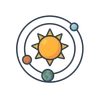
Heliocentrism is the astronomical model in which the Earth and planets revolve around the Sun at the center…
Reads at Grades 6–8 Listens at Grades 4–8
Print & create
Answer keys·No prep·Free with an account
28 worksheets · answer keys · full story · quiz · Ages 10-12 · CEFR B2
Plus adds 164,000+ more stories in 27 languages, audio for every one, and printables for all of them.
Just want Heliocentrism?
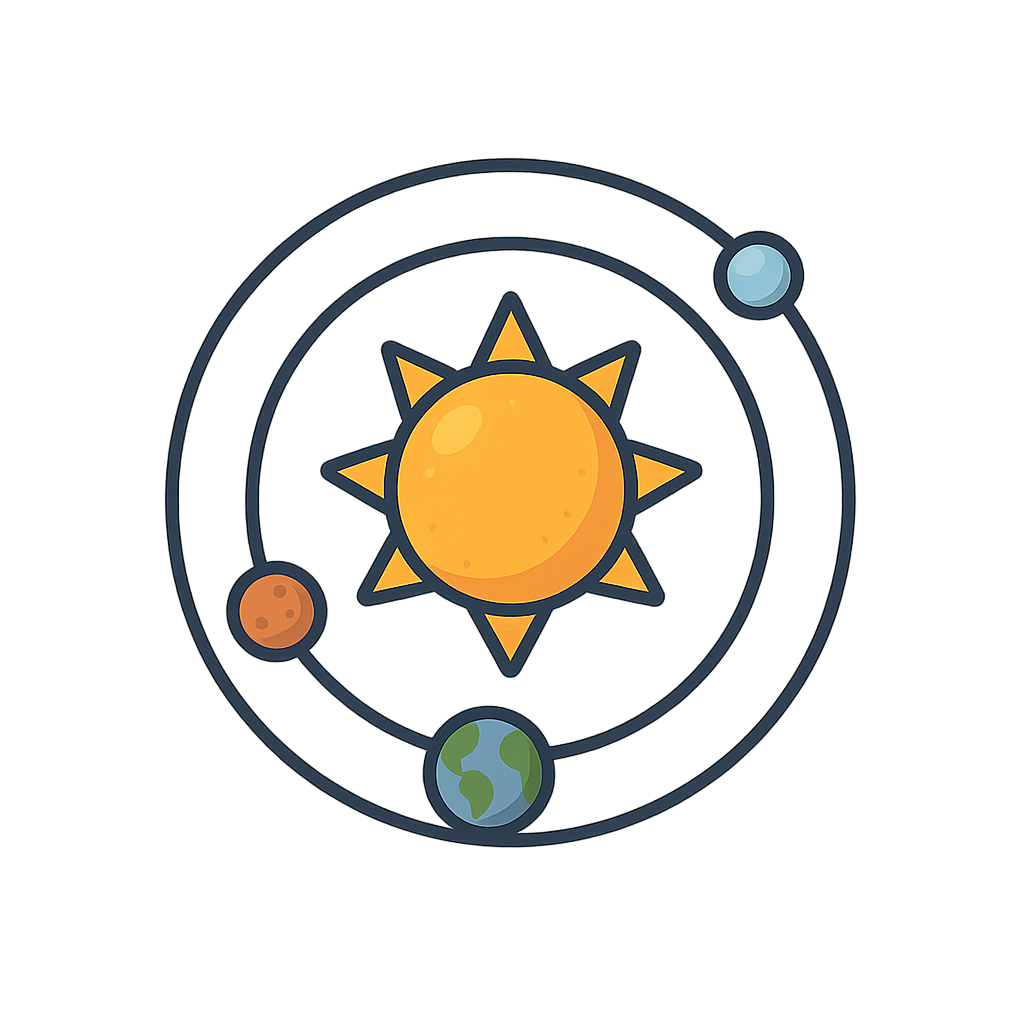
For thousands of years, if you stood on a quiet hill and watched the sky, you would have felt certain of one thing: you were standing still. The ground beneath your feet was solid, unmoving, the center of everything. You would have watched the Sun blaze a trail across the sky during the day and the Moon and countless stars march in a grand parade at night. It all seemed so obvious, so clear. Everything in the heavens revolved around the Earth, around you. That was the story everyone believed, a comfortable and sensible tale. But I was a different story, a secret waiting in the light. I was an idea so dizzying it would feel like the ground itself was moving. I am Heliocentrism, the simple but world-shattering idea that the Sun, not the Earth, is the true center around which the planets dance.
My story didn’t begin with a thunderclap, but with a quiet whisper in the brilliant sunshine of ancient Greece. In the 3rd century BCE, a clever thinker named Aristarchus of Samos looked at the sky not just with his eyes, but with the power of mathematics. He carefully measured the shadows and angles of the Earth, Moon, and Sun and came to a stunning conclusion: the Sun was enormous, a fiery giant compared to the tiny pebble of Earth. To him, the logic was simple. Doesn't a small thing always move around a large thing? He proposed that the Earth must be the one in motion, circling the colossal Sun. But his idea was too much, too soon. It contradicted everything people felt in their bones—the solid, unmoving ground. For over 1,400 years, my voice was barely heard, overshadowed by a more complex but Earth-flattering model perfected by the astronomer Ptolemy around 150 CE. His system, with the Earth at its heart, was so good at predicting where the planets would be that almost no one saw a reason to look for another answer.
I Am the Center of the Universe
For thousands of years, if you stood on a quiet hill and watched the sky, you would have felt certain of one thing: you were standing still. The ground beneath your feet was solid, unmoving, the center of everything. You would have watched the Sun blaze a trail across the sky during the day and the Moon and countless stars march in a grand parade at night. It all seemed so obvious, so clear. Everything in the heavens revolved around the Earth, around you. That was the story everyone believed, a comfortable and sensible tale. But I was a different story, a secret waiting in the light. I was an idea so dizzying it would feel like the ground itself was moving. I am Heliocentrism, the simple but world-shattering idea that the Sun, not the Earth, is the true center around which the planets dance.
My story didn’t begin with a thunderclap, but with a quiet whisper in the brilliant sunshine of ancient Greece. In the 3rd century BCE, a clever thinker named Aristarchus of Samos looked at the sky not just with his eyes, but with the power of mathematics. He carefully measured the shadows and angles of the Earth, Moon, and Sun and came to a stunning conclusion: the Sun was enormous, a fiery giant compared to the tiny pebble of Earth. To him, the logic was simple. Doesn't a small thing always move around a large thing? He proposed that the Earth must be the one in motion, circling the colossal Sun. But his idea was too much, too soon. It contradicted everything people felt in their bones—the solid, unmoving ground. For over 1,400 years, my voice was barely heard, overshadowed by a more complex but Earth-flattering model perfected by the astronomer Ptolemy around 150 CE. His system, with the Earth at its heart, was so good at predicting where the planets would be that almost no one saw a reason to look for another answer.
I slept for centuries, a forgotten possibility, until I was stirred from my slumber in a small room in Poland. A dedicated and cautious astronomer named Nicolaus Copernicus, who was born on February 19th, 1473, spent his life charting the stars. He deeply admired Ptolemy's work, but the more he studied it, the more clumsy it seemed. To make the Earth-centered model work, it required planets to move on strange little circles that were themselves moving on bigger circles. It was complicated and, to Copernicus, not very elegant. He wondered if there was a simpler way. He dusted off the ancient whispers of Aristarchus and began to work. For decades, he secretly calculated and recalculated, imagining a different cosmos. He put the Sun in the center and suddenly, the messy dance of the planets became a graceful, predictable ballet. The Earth was just another planet, spinning on its axis and orbiting the Sun. But he knew how radical this was. He was afraid of ridicule, of challenging a belief held for ages. He wrote his masterpiece, 'On the Revolutions of the Celestial Spheres,' but hesitated to publish it. It was only in 1543, as he lay dying, that the first printed copy was brought to him. I was finally free, and a revolution in thinking was about to begin.
An idea, no matter how beautiful, needs evidence to truly shine. I was a powerful suggestion, but I needed proof that people could see and measure. My first great champion was a German mathematician named Johannes Kepler. Using mountains of incredibly precise observations collected by the astronomer Tycho Brahe, Kepler tried to fit the planets' paths to the perfect circles Copernicus had imagined. But the data refused to cooperate. After years of exhausting work, he had a breakthrough. In 1609, he announced that planets do not move in circles, but in ellipses—stretched-out ovals. This small change made my model astonishingly accurate. At the same time, in Italy, Galileo Galilei aimed a new invention called the telescope at the sky. What he saw delivered blow after blow to the old way of thinking. He spotted four tiny moons circling the giant planet Jupiter, proving that not everything orbited the Earth. He watched the planet Venus go through a full set of phases, just like our Moon, a phenomenon that was impossible in an Earth-centered system. Galileo's discoveries provided powerful, visible proof for me, but they also brought him into a serious conflict with the powerful authorities of the Church in 1633. The final, unshakable foundation for my existence was laid by the English genius, Isaac Newton. In 1687, he published his law of universal gravitation, a single, elegant equation that explained why the planets stayed in their orbits. It was the same force of gravity that pulls an apple to the ground, just acting on a cosmic scale. I was no longer just a theory; I was a fundamental law of the universe.
Today, I am the foundation of all modern astronomy. Because of me, you know your place in the solar system. You understand the seasons, the paths of the planets, and the vastness of space. Humanity has used me as a map to send probes to Mars, to fly by the rings of Saturn, and to gaze at galaxies billions of light-years away. I am the reason you know that your Earth is a beautiful, spinning world in a sunbeam, not the center of all things. But my greatest lesson is not just about science. I am the living proof that even the most cherished, common-sense beliefs can be wrong. I am a testament to the power of curiosity, observation, and the courage to imagine a different reality. I am the idea that your universe is immense and full of wonder, and there are always new discoveries waiting for those who are brave enough to look up and ask, 'what if?'
Wow facts
About
Heliocentrism is the astronomical model in which the Earth and planets revolve around the Sun at the center of the Solar System.
Take a Quiz
Question 1 of 5
What is the central idea that the story, told from the perspective of Heliocentrism, is trying to explain?
Explore next

Want to do even more?
Go beyond exploring. Unlock tools that turn every story into real learning.

Storypie Plus for families
Full stories, quizzes, and printables. Nights and car rides, sorted.
- Unlimited audio stories
- Create Mode: your child stars in the story
- Offline downloads
- Printable worksheets & coloring pages

Why Storypie for Schools
Students engaged. Prep in seconds. Evenings back to you.
- Worksheets & Quizzes
- Classroom Management
- Formative Assessment
- Custom Curriculum & Lesson Plans
- 27 Languages

Why Storypie for Homeschool
Curriculum done. They'll ask for more. Hours back in your day.
- Worksheet Generator
- First-Person Audio Stories
- Built-in Comprehension Quizzes
- Custom Curriculum & Lesson Plans
- Print & Go Activities