English

Heliocentrism
Heliocentrism is the astronomical model in which the Earth and planets revolve around the Sun at the center…
Reads at Grades 3–5 Listens at Grades 1–5
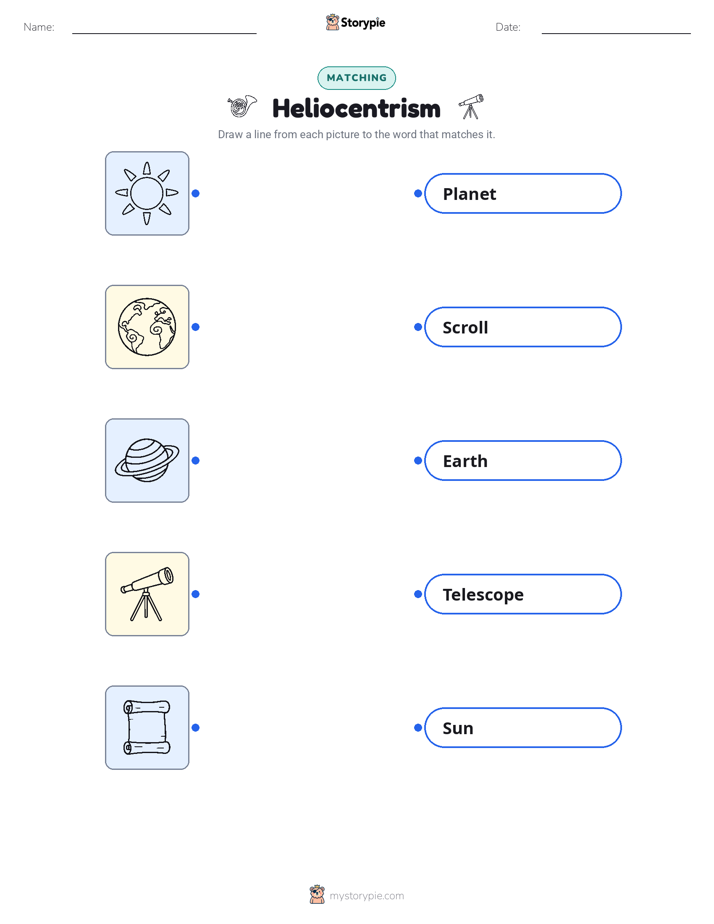
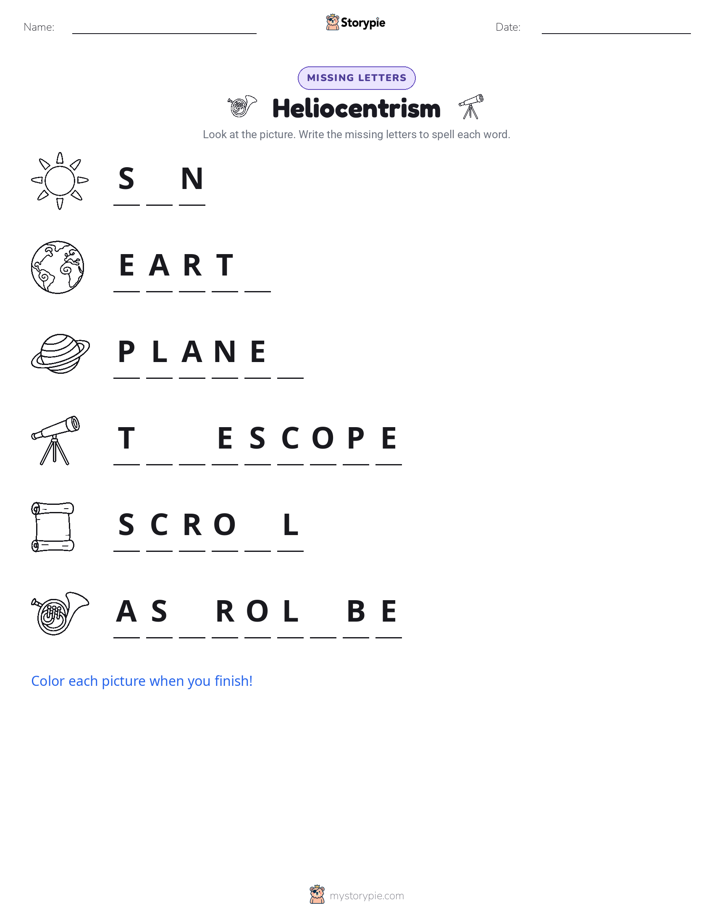
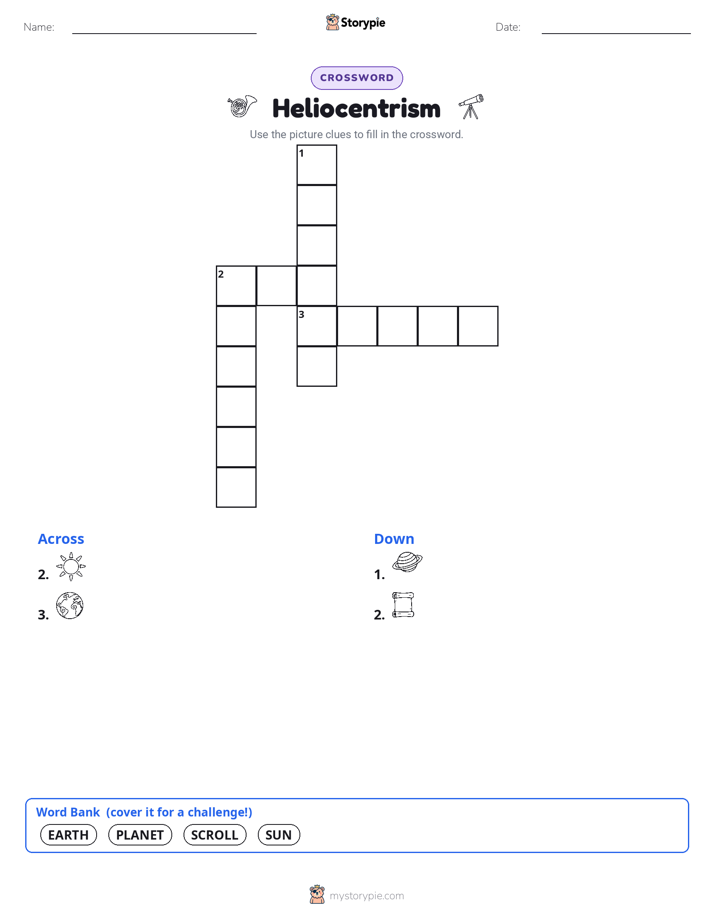
Print & create
Answer keys·No prep·Free with an account
28 worksheets · answer keys · full story · quiz · Ages 8-10 · CEFR B1
Plus adds 164,000+ more stories in 27 languages, audio for every one, and printables for all of them.
Just want Heliocentrism?
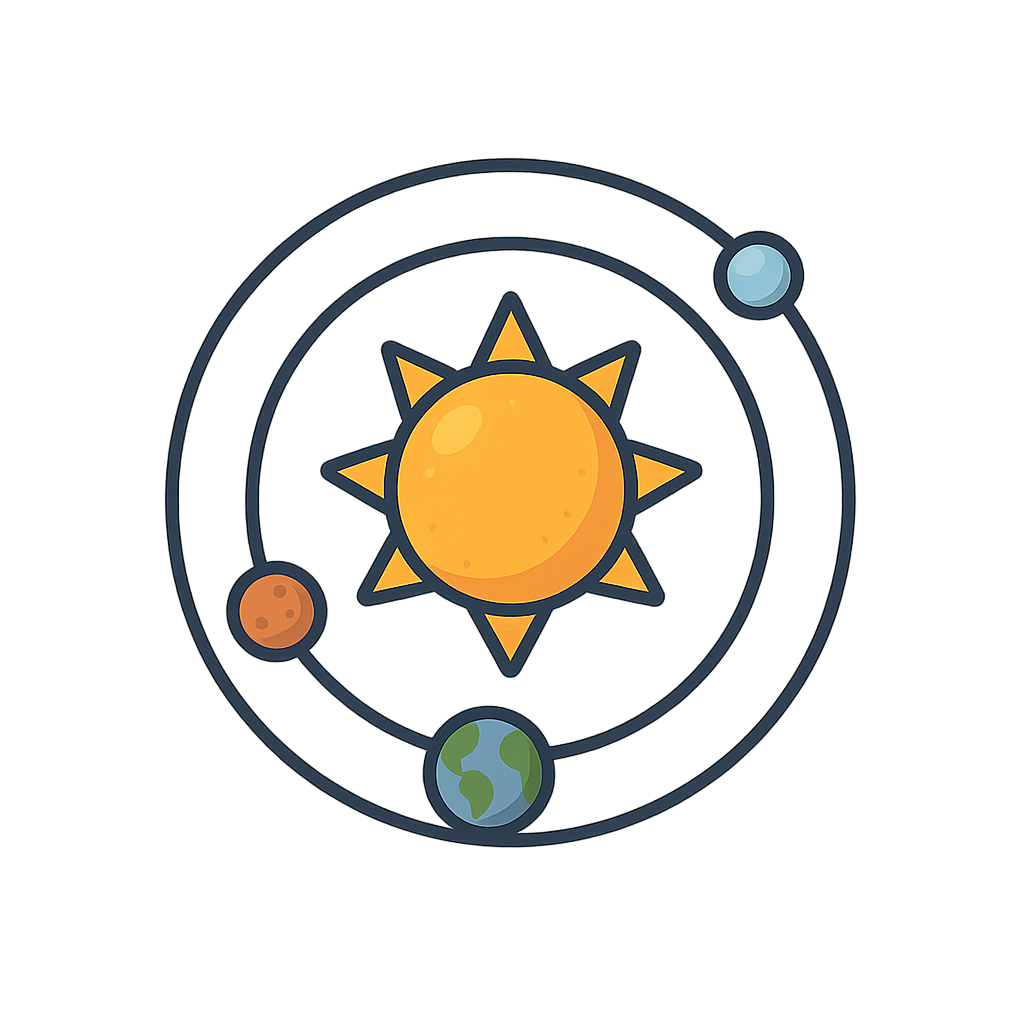
Can you feel it? A gentle, silent spin as you zoom through space. You probably don't, but your home, the Earth, is always moving, like a giant merry-go-round gliding through the dark. For thousands of years, people thought it was the other way around. They believed Earth was perfectly still, the unmoving center of everything. They watched the Sun rise and set, the Moon glow and fade, and the stars twinkle in their paths, thinking it was all a grand parade just for them. It was a cozy idea, but it didn't quite explain the funny loops and backwards dances the planets seemed to do in the night sky. That's where I come in. Hello there. I am the idea that the Sun is the real star of the show, and your home, Earth, is one of its graceful dancing partners. My name is Heliocentrism.
I wasn't always so well-known. My story began as a tiny whisper from a clever man in ancient Greece. His name was Aristarchus of Samos, and way back in the 3rd century BCE, he looked at the sky and thought, 'What if we're the ones moving?'. He suggested that the Earth and other planets might be circling the giant, fiery Sun. But his idea was like a single firefly in a huge, dark forest. It was mostly forgotten, and for over one thousand five hundred years, almost everyone continued to believe that the Earth was the center of it all. I had to wait patiently for someone else to find me again. That person was Nicolaus Copernicus, a Polish astronomer with a brilliant and curious mind. For decades, he watched the planets from a tower, tracking their paths and doing mountains of math. He realized that if you put the Sun in the middle, all the strange planetary dances suddenly made perfect sense. In 1543, he published his amazing book, 'On the Revolutions of the Heavenly Spheres', sharing me with the whole world.
The Sun's Secret Dance
Can you feel it? A gentle, silent spin as you zoom through space. You probably don't, but your home, the Earth, is always moving, like a giant merry-go-round gliding through the dark. For thousands of years, people thought it was the other way around. They believed Earth was perfectly still, the unmoving center of everything. They watched the Sun rise and set, the Moon glow and fade, and the stars twinkle in their paths, thinking it was all a grand parade just for them. It was a cozy idea, but it didn't quite explain the funny loops and backwards dances the planets seemed to do in the night sky. That's where I come in. Hello there. I am the idea that the Sun is the real star of the show, and your home, Earth, is one of its graceful dancing partners. My name is Heliocentrism.
I wasn't always so well-known. My story began as a tiny whisper from a clever man in ancient Greece. His name was Aristarchus of Samos, and way back in the 3rd century BCE, he looked at the sky and thought, 'What if we're the ones moving?'. He suggested that the Earth and other planets might be circling the giant, fiery Sun. But his idea was like a single firefly in a huge, dark forest. It was mostly forgotten, and for over one thousand five hundred years, almost everyone continued to believe that the Earth was the center of it all. I had to wait patiently for someone else to find me again. That person was Nicolaus Copernicus, a Polish astronomer with a brilliant and curious mind. For decades, he watched the planets from a tower, tracking their paths and doing mountains of math. He realized that if you put the Sun in the middle, all the strange planetary dances suddenly made perfect sense. In 1543, he published his amazing book, 'On the Revolutions of the Heavenly Spheres', sharing me with the whole world.
Even with Copernicus's incredible book, many people found me hard to believe. Changing your mind about the entire universe is a big deal. I needed a little help from my friends to show everyone the truth. First came Johannes Kepler in the early 1600s. He discovered that planets don't travel in perfect circles, but in slightly stretched-out ovals called ellipses. This discovery made my model of the solar system work even better. Then came the famous Galileo Galilei. Around the year 1610, he pointed a new invention called a telescope toward the heavens and saw things no one had ever seen before. He spotted tiny moons circling the giant planet Jupiter. Can you imagine the excitement? This proved that not everything in the universe orbited the Earth. He also saw that the planet Venus had phases, just like our Moon, which could only happen if Venus was traveling around the Sun. His telescope provided the proof people needed to see with their own eyes, even though it was a strange and challenging idea for many people at the time.
Because of me, humanity's view of the universe changed forever. People began to understand that Earth wasn't the center of everything, but a beautiful planet in a vast and wondrous solar system. This new way of thinking opened the door for other great minds, like Isaac Newton, who later explained that a force called gravity is what keeps the planets dancing in their orbits around the Sun. I showed people that there is always more to learn and discover. I hope I remind you to always stay curious, to ask big questions, and to look up at the stars and wonder what other amazing secrets the universe is waiting to share.
Wow facts
About
Heliocentrism is the astronomical model in which the Earth and planets revolve around the Sun at the center of the Solar System.
Take a Quiz
Question 1 of 5
In the story, Heliocentrism says it was a 'forgotten whisper' for a long time. What does 'whisper' mean in this sentence?
Explore next

Want to do even more?
Go beyond exploring. Unlock tools that turn every story into real learning.

Storypie Plus for families
Full stories, quizzes, and printables. Nights and car rides, sorted.
- Unlimited audio stories
- Create Mode: your child stars in the story
- Offline downloads
- Printable worksheets & coloring pages

Why Storypie for Schools
Students engaged. Prep in seconds. Evenings back to you.
- Worksheets & Quizzes
- Classroom Management
- Formative Assessment
- Custom Curriculum & Lesson Plans
- 27 Languages

Why Storypie for Homeschool
Curriculum done. They'll ask for more. Hours back in your day.
- Worksheet Generator
- First-Person Audio Stories
- Built-in Comprehension Quizzes
- Custom Curriculum & Lesson Plans
- Print & Go Activities