English

How Movies Are Made (Filmmaking)
Filmmaking is the art and process of making motion pictures…
Reads at Grades 6–8 Listens at Grades 4–8
Print & create
Answer keys·No prep·Free with an account
28 worksheets · answer keys · full story · quiz · Ages 10-12 · CEFR B2
Plus adds 244,000+ more stories in 27 languages, audio for every one, and printables for all of them.
Just want How Movies Are Made (Filmmaking)?
Have you ever sat in a dark room when suddenly, a giant window of light opens up on the wall? You see heroes flying, dragons breathing fire, or kids just like you having an amazing adventure. You feel happy, scared, or excited right along with them. That feeling, that shared dream in the dark—that’s me. I’m the magic that brings stories to life with light and sound. I don’t use a wand, but I do use cameras, computers, and the most powerful tool of all: imagination. Hello there. You can call me Filmmaking.
Before I could run, I had to learn to stand still. For a long time, people could only capture a single moment with paintings or drawings. Then, in the 1820s, a French inventor named Joseph Nicéphore Niépce found a way to capture a real-life image using sunlight—the first photograph. It was a huge step, but it was just one frozen second. People wondered, could a picture ever move? In the 1870s, a clever photographer named Eadweard Muybridge was asked to settle a bet: do all four of a horse’s hooves leave the ground when it gallops? To find out, he set up a row of cameras that took pictures one after another. When he showed the pictures in quick succession, the horse looked like it was running. This was a key moment for me. People realized that if you show still pictures fast enough, the human eye sees them as a moving image. I was about to be born.
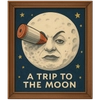
My real birthday party happened in the late 1800s. In the United States, the famous inventor Thomas Edison and his team created the Kinetoscope in 1891. It was a big box you’d peek into to see a short, flickering film. But only one person could watch at a time. Then, in France, two brothers, Auguste and Louis Lumière, invented the Cinématographe. It was a camera, a developer, and a projector all in one. On December 28th, 1895, they held the first-ever public movie screening in a café in Paris. An audience sat together and watched in amazement as a train pulled into a station on screen. At first, I was just used to show everyday life. But a French magician named Georges Méliès saw me and knew I could do so much more. In 1902, he created a fantastical movie called 'A Trip to the Moon,' full of special effects and a real story. He showed everyone that I wasn't just for capturing reality; I was for creating brand new worlds.
The Story of Filmmaking
Have you ever sat in a dark room when suddenly, a giant window of light opens up on the wall? You see heroes flying, dragons breathing fire, or kids just like you having an amazing adventure. You feel happy, scared, or excited right along with them. That feeling, that shared dream in the dark—that’s me. I’m the magic that brings stories to life with light and sound. I don’t use a wand, but I do use cameras, computers, and the most powerful tool of all: imagination. Hello there. You can call me Filmmaking.
Before I could run, I had to learn to stand still. For a long time, people could only capture a single moment with paintings or drawings. Then, in the 1820s, a French inventor named Joseph Nicéphore Niépce found a way to capture a real-life image using sunlight—the first photograph. It was a huge step, but it was just one frozen second. People wondered, could a picture ever move? In the 1870s, a clever photographer named Eadweard Muybridge was asked to settle a bet: do all four of a horse’s hooves leave the ground when it gallops? To find out, he set up a row of cameras that took pictures one after another. When he showed the pictures in quick succession, the horse looked like it was running. This was a key moment for me. People realized that if you show still pictures fast enough, the human eye sees them as a moving image. I was about to be born.
My real birthday party happened in the late 1800s. In the United States, the famous inventor Thomas Edison and his team created the Kinetoscope in 1891. It was a big box you’d peek into to see a short, flickering film. But only one person could watch at a time. Then, in France, two brothers, Auguste and Louis Lumière, invented the Cinématographe. It was a camera, a developer, and a projector all in one. On December 28th, 1895, they held the first-ever public movie screening in a café in Paris. An audience sat together and watched in amazement as a train pulled into a station on screen. At first, I was just used to show everyday life. But a French magician named Georges Méliès saw me and knew I could do so much more. In 1902, he created a fantastical movie called 'A Trip to the Moon,' full of special effects and a real story. He showed everyone that I wasn't just for capturing reality; I was for creating brand new worlds.
For my first few decades, I was silent. Actors had to use their faces and bodies to tell the story, and title cards on the screen showed the dialogue. People like the hilarious Charlie Chaplin became huge stars without ever saying a word on film. But then, on October 6th, 1927, everything changed. A movie called 'The Jazz Singer' was released, and for the first time, audiences heard an actor speak and sing from the screen. It was a sensation. Suddenly, I had a voice. At the same time, I was learning to paint my world with color. Early color was difficult and expensive, but by the 1930s, a process called Technicolor made my stories vibrant and beautiful. When 'The Wizard of Oz' appeared in 1939, audiences were stunned to see Dorothy step out of her black-and-white Kansas farmhouse into the dazzling, colorful Land of Oz. I could finally show the world in all its brilliant hues.
As time went on, my imagination grew bigger and bigger. In 1977, a filmmaker named George Lucas took audiences to 'a galaxy far, far away' with 'Star Wars,' using groundbreaking special effects that made spaceships and alien worlds feel real. Then, computers changed everything for me. Instead of just using cameras to capture what was in front of them, creators could build entire worlds inside a computer. In 1995, a movie called 'Toy Story' was released. It was the first feature film made entirely with computer-generated imagery, or CGI. Woody and Buzz weren't puppets or drawings; they were digital characters brought to life with code and artistry. This digital revolution opened up a universe of possibilities. Now, anything a storyteller can dream up, I can help them create on screen.
From a simple galloping horse to entire digital galaxies, I've had quite a journey. And I didn't do it alone. Every movie you see is made by a huge team of people: writers, directors, actors, camera operators, costume designers, sound mixers, and so many more. I am the art of collaboration. Today, the tools to tell stories are in more hands than ever before. You can make a movie with a phone. All you need is an idea, a little creativity, and the desire to share your vision with the world. So, what story do you want to tell? I’ll be here to help you share it.
Wow facts
About
Filmmaking is the art and process of making motion pictures, from writing a story and capturing it on camera to editing it all together into a movie that can be shared with an audience.
Take a Quiz
Question 1 of 5
What is the main idea of the section titled 'My First Steps in Stillness'?
Explore next





Want to do even more?
Go beyond exploring. Unlock tools that turn every story into real learning.

Storypie Plus for families
Full stories, quizzes, and printables. Nights and car rides, sorted.
- Unlimited audio stories
- Create Mode: your child stars in the story
- Offline downloads
- Printable worksheets & coloring pages

Why Storypie for Schools
Students engaged. Prep in seconds. Evenings back to you.
- Worksheets & Quizzes
- Classroom Management
- Formative Assessment
- Custom Curriculum & Lesson Plans
- 27 Languages

Why Storypie for Homeschool
Curriculum done. They'll ask for more. Hours back in your day.
- Worksheet Generator
- First-Person Audio Stories
- Built-in Comprehension Quizzes
- Custom Curriculum & Lesson Plans
- Print & Go Activities