English

My Body Parts
The concept of human anatomy…
Reads at Grades 6–8 Listens at Grades 4–8
Print & create
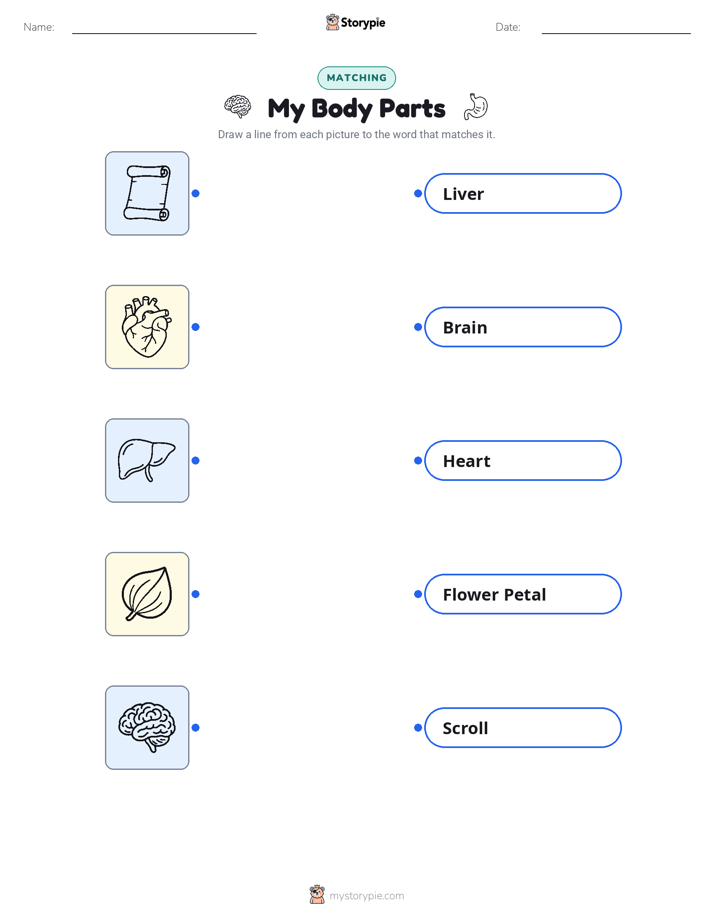
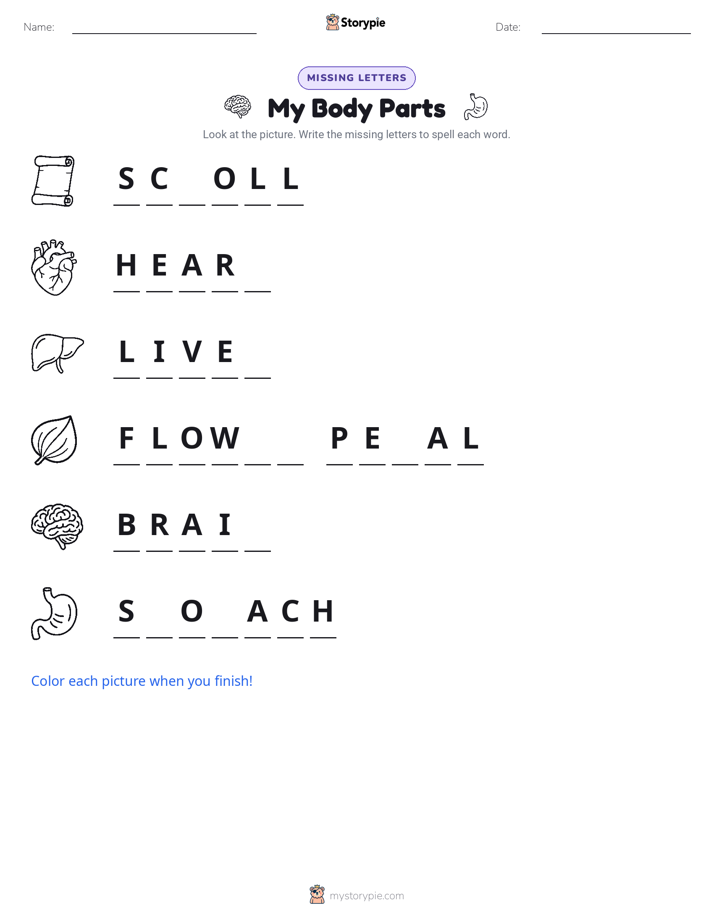
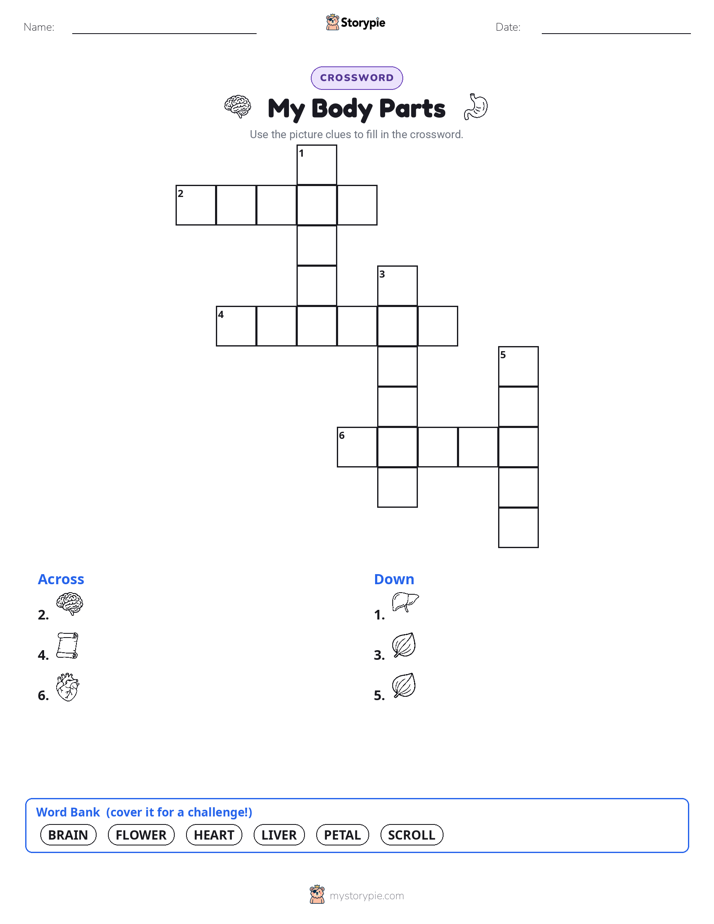
Answer keys·No prep·Free with an account
28 worksheets · answer keys · full story · quiz · Ages 10-12 · CEFR B2
Plus adds 244,000+ more stories in 27 languages, audio for every one, and printables for all of them.
Just want My Body Parts?
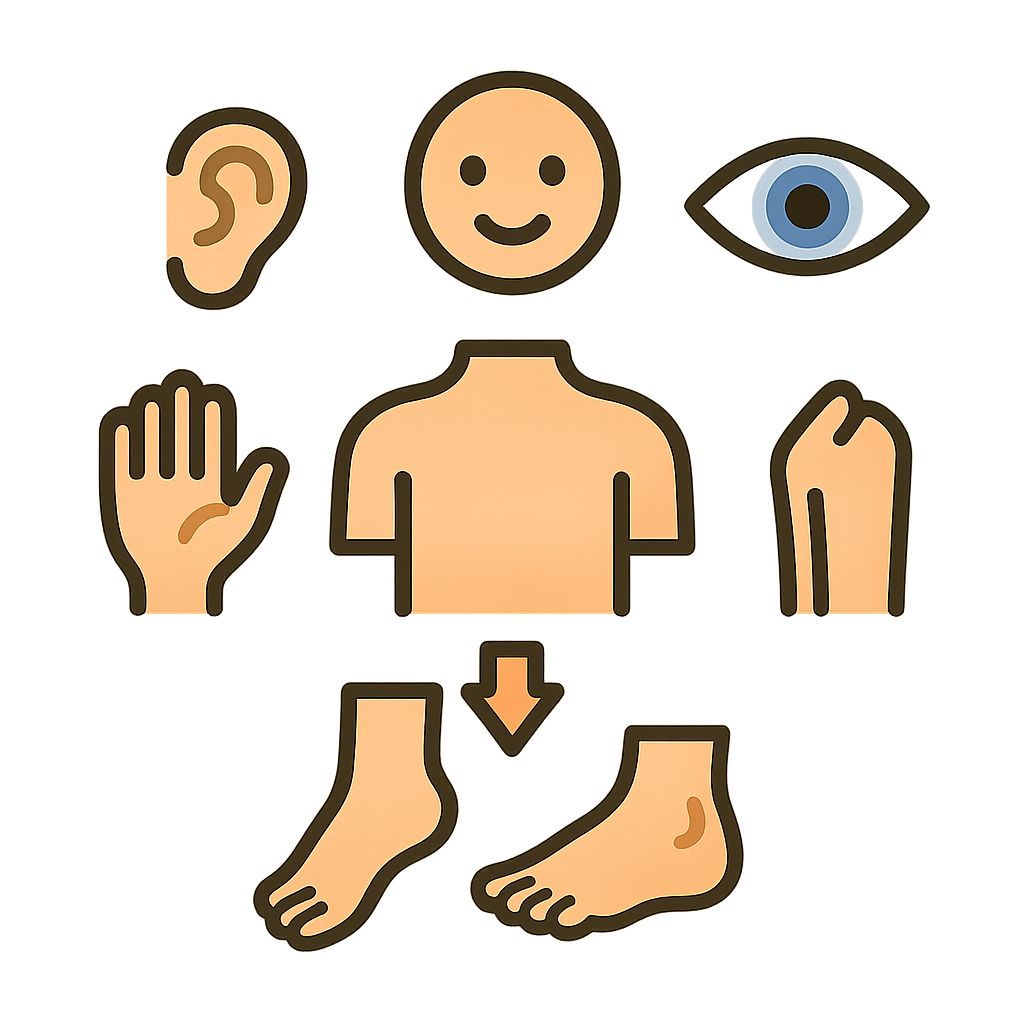
Feel the thump-thump-thump inside your chest after you’ve run as fast as you can. Think about how your fingers can gently pick up a delicate flower petal without crushing it, or how you can breathe in and out without even thinking about it. Your brain can solve a tricky math problem while your stomach is busy digesting your lunch. All these things, happening at once, feel like magic, but it’s all part of a wonderfully complex and coordinated machine. That machine is me. I am the incredible, living collection of parts that is you—your body. I am made of trillions of tiny pieces, called cells, all working together in a perfect team to let you run, think, feel, and grow. For thousands of years, humans have been trying to figure out how I work, trying to draw a map of my inner world.
Long ago, the first people who tried to understand me were like explorers mapping a strange and new land. They could only see me from the outside, so my inner workings were a great mystery. In ancient Egypt, as far back as 1600 BCE, curious minds wrote down what they knew. On scrolls like the Edwin Smith Papyrus, they described my heart, liver, and blood vessels, and wrote down treatments for injuries. They had some good ideas, but they also thought my heart did my thinking. Later, in ancient Greece, a wise physician named Hippocrates, who lived in the 5th century BCE, changed everything. He taught people to stop blaming angry gods or magic for sickness. Instead, he encouraged them to look for natural causes and observe how I healed. Then came a Roman doctor named Galen in the 2nd century CE. He was brilliant and wrote hundreds of books about me. His ideas became the official 'map' of the human body for more than 1,300 years. But Galen had a big secret: it was forbidden to dissect human bodies, so most of his maps were based on studying animals like apes and pigs. He made some amazing discoveries, but he also made some big mistakes that no one would question for a very long time.
The Story of Me, Your Body
Feel the thump-thump-thump inside your chest after you’ve run as fast as you can. Think about how your fingers can gently pick up a delicate flower petal without crushing it, or how you can breathe in and out without even thinking about it. Your brain can solve a tricky math problem while your stomach is busy digesting your lunch. All these things, happening at once, feel like magic, but it’s all part of a wonderfully complex and coordinated machine. That machine is me. I am the incredible, living collection of parts that is you—your body. I am made of trillions of tiny pieces, called cells, all working together in a perfect team to let you run, think, feel, and grow. For thousands of years, humans have been trying to figure out how I work, trying to draw a map of my inner world.
Long ago, the first people who tried to understand me were like explorers mapping a strange and new land. They could only see me from the outside, so my inner workings were a great mystery. In ancient Egypt, as far back as 1600 BCE, curious minds wrote down what they knew. On scrolls like the Edwin Smith Papyrus, they described my heart, liver, and blood vessels, and wrote down treatments for injuries. They had some good ideas, but they also thought my heart did my thinking. Later, in ancient Greece, a wise physician named Hippocrates, who lived in the 5th century BCE, changed everything. He taught people to stop blaming angry gods or magic for sickness. Instead, he encouraged them to look for natural causes and observe how I healed. Then came a Roman doctor named Galen in the 2nd century CE. He was brilliant and wrote hundreds of books about me. His ideas became the official 'map' of the human body for more than 1,300 years. But Galen had a big secret: it was forbidden to dissect human bodies, so most of his maps were based on studying animals like apes and pigs. He made some amazing discoveries, but he also made some big mistakes that no one would question for a very long time.
For centuries, Galen's map was the only one people used. But then, during the Islamic Golden Age, a new wave of thinkers began looking at me with fresh eyes. A brilliant physician in Cairo named Ibn al-Nafis studied my heart and lungs very closely. Around the year 1242, he figured out something Galen had gotten wrong. He was the first person to correctly describe how blood travels from the right side of my heart to my lungs to get air, and then back to the left side of my heart. It was a huge breakthrough, but his work was mostly unknown in Europe for a long time. Hundreds of years later, during a time of great learning called the Renaissance, a young and daring man in Italy named Andreas Vesalius decided to see me for himself. He broke the rules and studied human bodies directly. In 1543, he published a revolutionary book called 'On the Fabric of the Human Body'. It was filled with beautiful, detailed drawings that corrected hundreds of Galen's mistakes. Vesalius showed people what I really looked like on the inside. His work inspired others, like an English doctor named William Harvey. After years of careful experiments, Harvey announced his amazing discovery in 1628: my heart is a powerful pump that circulates blood all through me in one big, continuous loop.
Understanding my big parts like the heart and lungs was just the beginning. The next great adventure was to explore my microscopic world. In the 1670s, a Dutch shopkeeper named Antonie van Leeuwenhoek built some of the most powerful microscopes in the world. He was fascinated by what he could see, and one day he looked at a drop of his own blood. He was stunned to see countless tiny, round discs floating around. He was the first person ever to see my red blood cells. The world inside me was far more complex than anyone had imagined. The discoveries kept coming. On the evening of November 8th, 1895, a German physicist named Wilhelm Röntgen was working in his lab when he discovered a mysterious new kind of ray. He found that these 'X-rays' could pass right through skin and muscle but not bone. For the first time, doctors could see my skeleton without a single cut. Then, in 1953, the deepest secret of all was unlocked. Scientists James Watson and Francis Crick, using critical work from Rosalind Franklin, figured out the structure of DNA. It was a beautiful double helix, like a twisted ladder. They had found the secret instruction book that tells every single one of my trillions of cells what to do and how to do it.
From the ancient Egyptians to the scientists of today, the journey to understand me has been a long and incredible one. And the exploration is far from over. Today, with amazing tools like MRI and CT scans, doctors and scientists can watch my brain think and see my heart beat in real time. They are learning new things every day that help them heal injuries, cure diseases, and keep me working my best. All of this knowledge isn't just for textbooks. It’s for you. It helps you understand why you need to eat healthy food, why exercise makes me strong, and why a good night's sleep is so important. I am your body, your oldest friend, and your partner in every single adventure you have. Every day, you and I write a new chapter of our story together. Take good care of me, and we can make it a great one.
Wow facts
About
The concept of human anatomy, representing the study and understanding of the physical structure of the human body, from ancient observations to modern science.
Take a Quiz
Question 1 of 5
What was the main problem with Galen's understanding of the human body, and who corrected many of his mistakes in 1543?
Explore next





Want to do even more?
Go beyond exploring. Unlock tools that turn every story into real learning.

Storypie Plus for families
Full stories, quizzes, and printables. Nights and car rides, sorted.
- Unlimited audio stories
- Create Mode: your child stars in the story
- Offline downloads
- Printable worksheets & coloring pages

Why Storypie for Schools
Students engaged. Prep in seconds. Evenings back to you.
- Worksheets & Quizzes
- Classroom Management
- Formative Assessment
- Custom Curriculum & Lesson Plans
- 27 Languages

Why Storypie for Homeschool
Curriculum done. They'll ask for more. Hours back in your day.
- Worksheet Generator
- First-Person Audio Stories
- Built-in Comprehension Quizzes
- Custom Curriculum & Lesson Plans
- Print & Go Activities