English

My Body Parts
The concept of human anatomy…
Reads at Grades 3–5 Listens at Grades 1–5
Print & create
Answer keys·No prep·Free with an account
28 worksheets · answer keys · full story · quiz · Ages 8-10 · CEFR B1
Plus adds 244,000+ more stories in 27 languages, audio for every one, and printables for all of them.
Just want My Body Parts?
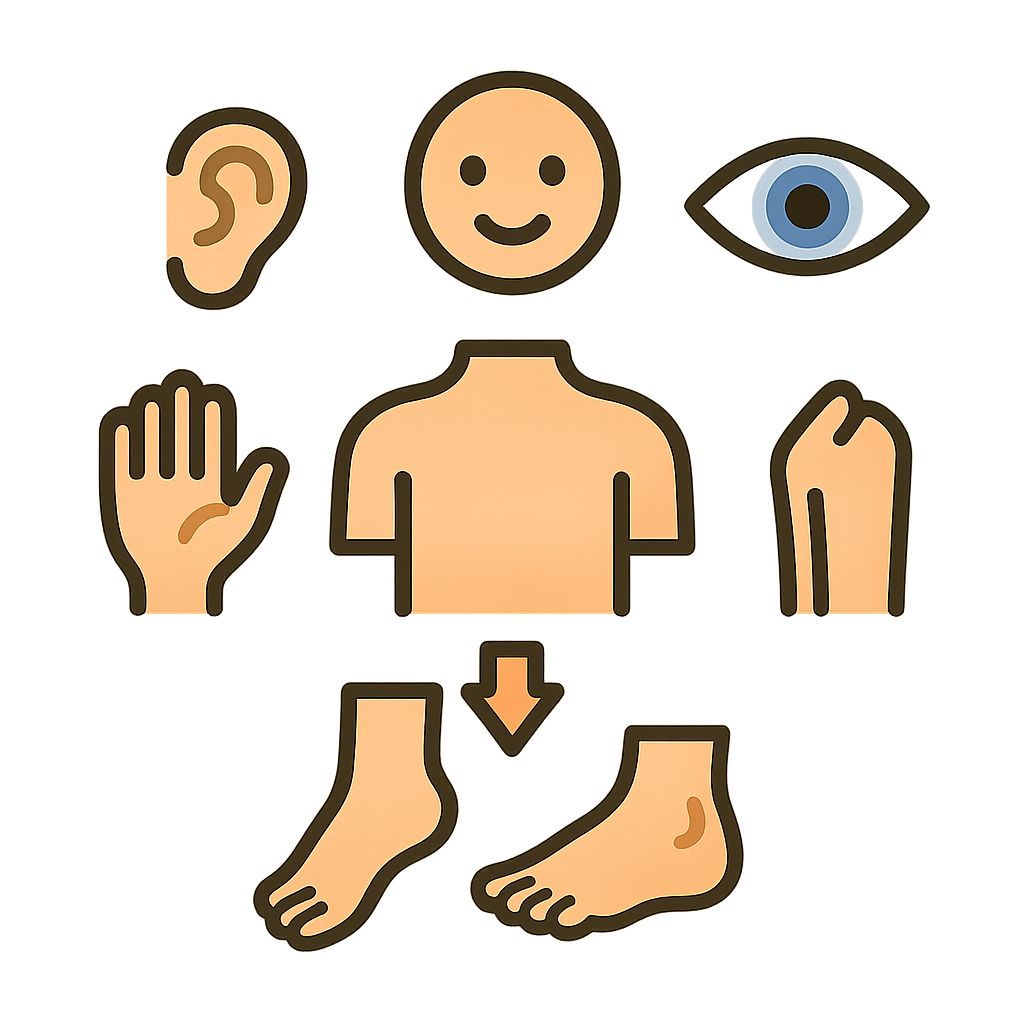
Can you feel that. The steady thump-thump-thump inside your chest. That’s your heart, working hard. How about the way your eyes can blink without you even thinking about it, or how your legs know just how to run, jump, and dance. For thousands of years, people felt all these amazing things happening. They knew I could climb mountains, sing songs, and give warm hugs, but what was going on inside was a complete mystery. It was like living in the most incredible house but never being allowed to peek into the rooms. Who was pulling the strings. What made everything work. Well, the secret is that I am all of those parts working together. I am your body, and this is the story of how people got to know me, inside and out.
The first people to get a real peek inside were the ancient Egyptians, way back around 3000 BCE. When they prepared people for the afterlife through mummification, they saw my internal organs, like the heart, liver, and kidneys. They wrote down what they learned on long scrolls of papyrus. One famous scroll, the Ebers Papyrus from around 1550 BCE, showed they knew my heart was a pump that moved blood all around. They thought my heart was so important that they believed it was the center of all thinking and feeling, not the brain. Can you imagine thinking with your heart. Later, in ancient Greece, a very wise doctor named Hippocrates, who was born around 460 BCE, taught everyone that the best way to understand me was to watch me carefully. He is often called the 'Father of Medicine.' Then, around 300 BCE, a brave Greek physician named Herophilus, who worked in the great city of Alexandria in Egypt, did something few had ever done. He carefully studied human bodies and discovered that nerves were like tiny messengers that controlled muscles. And he was the one who figured out that the brain, not the heart, was the true boss of the whole operation.
The Story of Me: The Human Body
Can you feel that. The steady thump-thump-thump inside your chest. That’s your heart, working hard. How about the way your eyes can blink without you even thinking about it, or how your legs know just how to run, jump, and dance. For thousands of years, people felt all these amazing things happening. They knew I could climb mountains, sing songs, and give warm hugs, but what was going on inside was a complete mystery. It was like living in the most incredible house but never being allowed to peek into the rooms. Who was pulling the strings. What made everything work. Well, the secret is that I am all of those parts working together. I am your body, and this is the story of how people got to know me, inside and out.
The first people to get a real peek inside were the ancient Egyptians, way back around 3000 BCE. When they prepared people for the afterlife through mummification, they saw my internal organs, like the heart, liver, and kidneys. They wrote down what they learned on long scrolls of papyrus. One famous scroll, the Ebers Papyrus from around 1550 BCE, showed they knew my heart was a pump that moved blood all around. They thought my heart was so important that they believed it was the center of all thinking and feeling, not the brain. Can you imagine thinking with your heart. Later, in ancient Greece, a very wise doctor named Hippocrates, who was born around 460 BCE, taught everyone that the best way to understand me was to watch me carefully. He is often called the 'Father of Medicine.' Then, around 300 BCE, a brave Greek physician named Herophilus, who worked in the great city of Alexandria in Egypt, did something few had ever done. He carefully studied human bodies and discovered that nerves were like tiny messengers that controlled muscles. And he was the one who figured out that the brain, not the heart, was the true boss of the whole operation.
For a long, long time after that, big discoveries were rare. In the Roman Empire, during the 2nd century CE, a brilliant Greek doctor named Galen wanted to learn everything about me. But there was a problem: Roman laws said you couldn’t study human bodies. So, what did he do. He studied animals instead, like apes and pigs, guessing that I was probably very similar on the inside. He learned so much and wrote many books that became the ultimate authority on anatomy for over 1,300 years. But because animals aren't exactly like you, he made a few mistakes. Fast forward to a time of amazing art and new ideas called the Renaissance. An artist and inventor named Leonardo da Vinci, in the late 1400s and early 1500s, wanted his paintings of people to look perfectly real. To do that, he knew he had to understand what was under the skin. He studied me in secret and created hundreds of beautiful, accurate drawings of my muscles, bones, and organs. Then came the hero of my story, Andreas Vesalius. He is called the 'Father of Modern Anatomy.' In the year 1543, he published a groundbreaking book called 'De humani corporis fabrica,' which means 'On the fabric of the human body.' He had studied human bodies himself and created the first truly correct and detailed map of me, fixing many of Galen's old mistakes for everyone to see.
The journey didn’t stop there. In the 1600s, the invention of the microscope allowed a scientist named Antonie van Leeuwenhoek to see my tiniest building blocks for the first time: cells. It was like discovering that a giant castle was made of millions of tiny, living bricks. More recently, amazing inventions have given us superpowers to see inside without any cutting at all. X-rays, discovered in 1895, let doctors see your bones, and modern MRI scans can create detailed pictures of your brain, heart, and everything in between. From the first curious Egyptians to the scientists of today, the quest to understand me has helped people live longer, healthier, and happier lives. I am your personal, incredible machine. Learning about me helps you take care of yourself, so you can keep running, thinking, dreaming, and being the amazing you that you are. And the best part. There is always more to discover.
Wow facts
About
The concept of human anatomy, representing the study and understanding of the physical structure of the human body, from ancient observations to modern science.
Take a Quiz
Question 1 of 5
In the story, it says Galen's books became the 'ultimate authority.' What does 'authority' mean in this sentence?
Explore next





Want to do even more?
Go beyond exploring. Unlock tools that turn every story into real learning.

Storypie Plus for families
Full stories, quizzes, and printables. Nights and car rides, sorted.
- Unlimited audio stories
- Create Mode: your child stars in the story
- Offline downloads
- Printable worksheets & coloring pages

Why Storypie for Schools
Students engaged. Prep in seconds. Evenings back to you.
- Worksheets & Quizzes
- Classroom Management
- Formative Assessment
- Custom Curriculum & Lesson Plans
- 27 Languages

Why Storypie for Homeschool
Curriculum done. They'll ask for more. Hours back in your day.
- Worksheet Generator
- First-Person Audio Stories
- Built-in Comprehension Quizzes
- Custom Curriculum & Lesson Plans
- Print & Go Activities