English


Poliomyelitis
Poliomyelitis, or polio, is an infectious viral disease that can cause paralysis.
Reads at Grades 6–8 Listens at Grades 4–8
Print & create
Answer keys·No prep·Free with an account
28 worksheets · answer keys · full story · quiz · Ages 10-12 · CEFR B2
Plus adds 164,000+ more stories in 27 languages, audio for every one, and printables for all of them.
Just want Poliomyelitis?

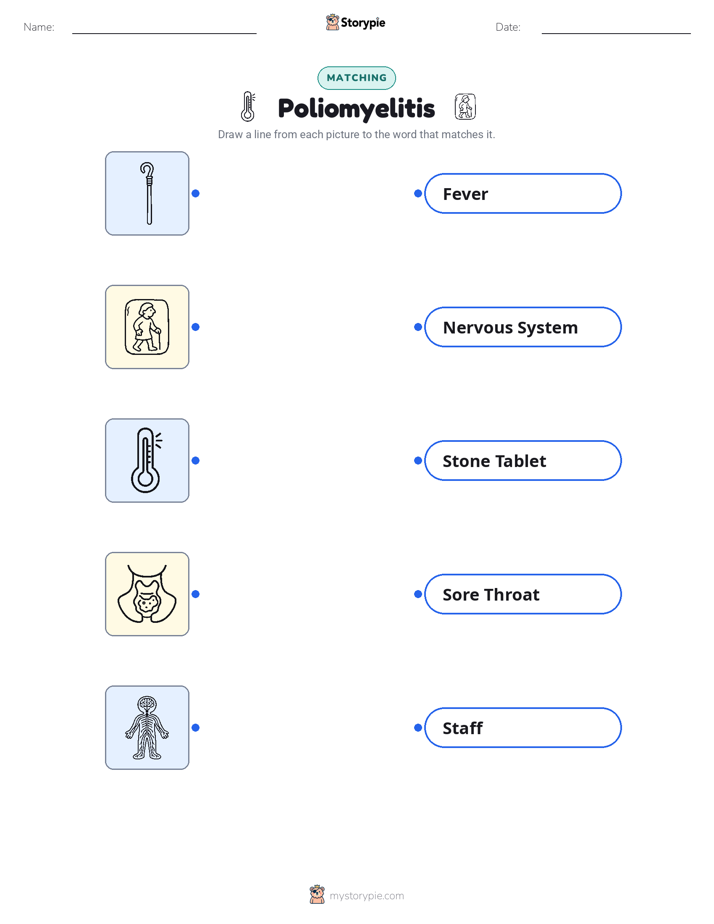
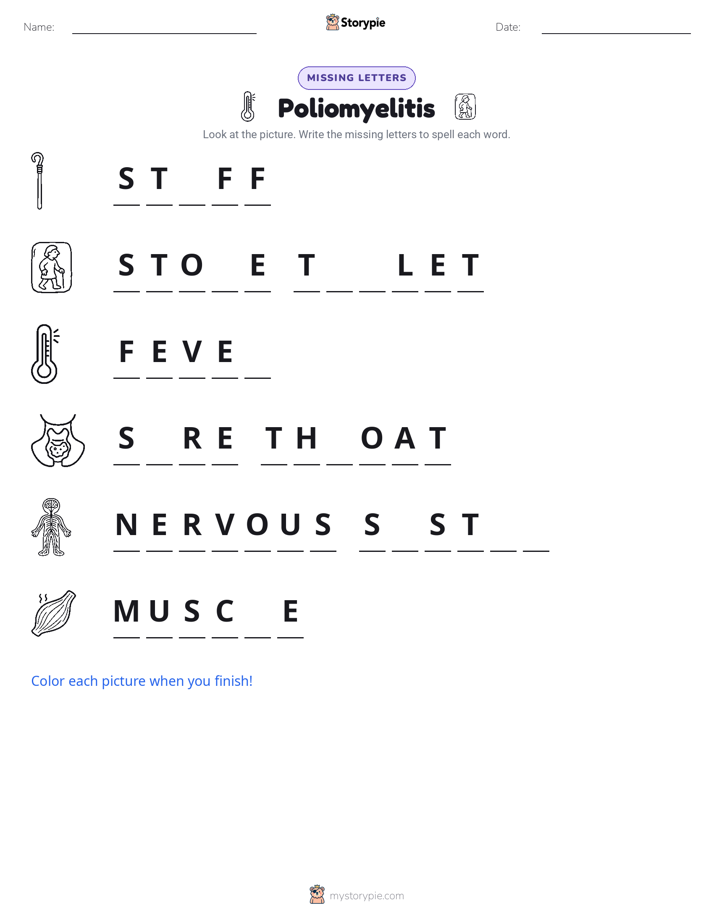
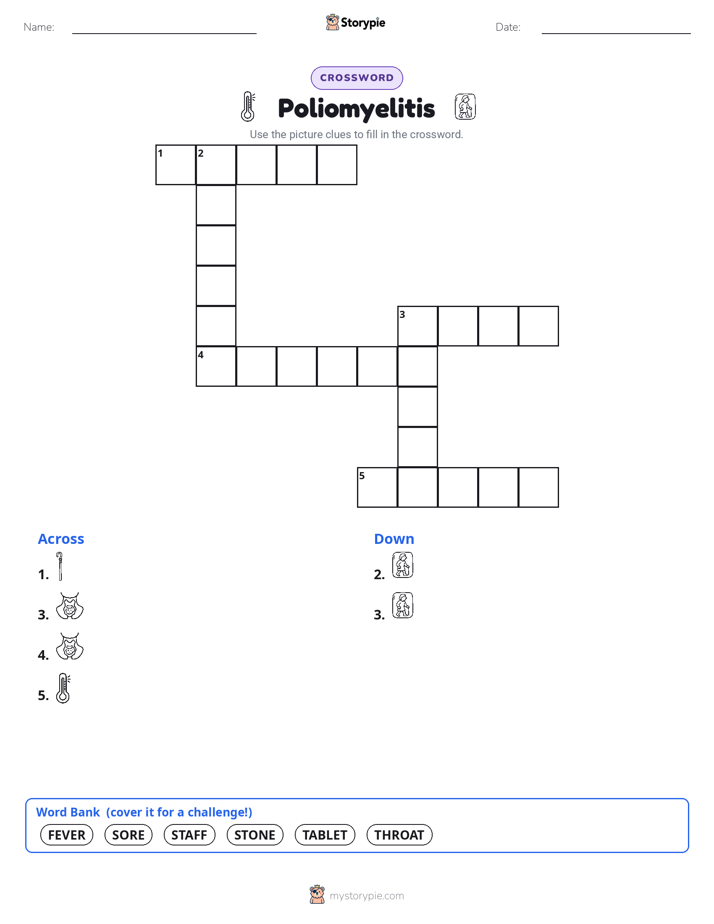
Imagine an echo, a whisper carried on the wind that no one can see. That’s what I was for most of human history. An invisible traveler, I journeyed across continents and centuries, and no one knew I was there. I have existed for thousands of years, moving silently through crowded cities and quiet villages. My touch was unpredictable. For some, I was nothing more than a passing fever and a sore throat, a sickness forgotten in a week. For others, I left a more permanent signature. I could invade the body’s nervous system, weakening muscles until they could no longer work. I could make it hard for a person to walk, to run, or even to breathe. Long before your science had names for me, an artist in ancient Egypt carved a stone tablet during the 18th dynasty, sometime between 1403 and 1365 BCE. It showed a priest named Ruma, a young man leaning on a tall staff, his right leg thin and withered. He didn’t know my name, but he knew my work. I was a mystery, a random tragedy that could strike anyone, rich or poor, young or old. For millennia, I was simply a part of the human story, a source of unexplained suffering. It took you a very long time to see me, to understand me, and finally, to give me a name. You see, my formal name is Poliomyelitis. But for most of history, you have known me by a simpler, more fearful name: Polio.
For millennia, I moved in secret. But then, humans, with their insatiable curiosity, began to notice my patterns. In 1789, an English physician named Michael Underwood was the first to write a clear clinical description of the damage I could do, calling it a “debility of the lower extremities” that he saw in children. He was putting a spotlight on my shadow. As the world changed, so did I. The industrial revolution brought people together in crowded cities, and new forms of travel allowed them to cross the globe faster than ever before. These changes gave me new pathways to travel, and I began to cause not just individual cases, but widespread outbreaks. The late 19th and early 20th centuries became my stage, and my favorite time to appear was summer. I became a summer shadow. Fear of me emptied swimming pools, closed movie theaters, and made parents warn their children not to drink from public water fountains. The great New York City epidemic of 1916 was terrifying, and the nationwide epidemic in the United States in 1952 was even worse. But your scientists finally cornered me in a laboratory. In 1908, two Austrian doctors, Karl Landsteiner and Erwin Popper, proved I was not a bacteria or a poison, but something much smaller: a virus. This was the breakthrough you needed. Around that time, I crossed paths with a man who would become one of your most famous presidents, Franklin D. Roosevelt. I met him in the summer of 1921, and he never walked unaided again. His very public struggle, however, helped rally the entire country. He inspired a fundraising campaign called the March of Dimes, where millions of people donated their spare change to fund the research that would, eventually, lead to my defeat.
I Am Polio: An Invisible Enemy's Story
Imagine an echo, a whisper carried on the wind that no one can see. That’s what I was for most of human history. An invisible traveler, I journeyed across continents and centuries, and no one knew I was there. I have existed for thousands of years, moving silently through crowded cities and quiet villages. My touch was unpredictable. For some, I was nothing more than a passing fever and a sore throat, a sickness forgotten in a week. For others, I left a more permanent signature. I could invade the body’s nervous system, weakening muscles until they could no longer work. I could make it hard for a person to walk, to run, or even to breathe. Long before your science had names for me, an artist in ancient Egypt carved a stone tablet during the 18th dynasty, sometime between 1403 and 1365 BCE. It showed a priest named Ruma, a young man leaning on a tall staff, his right leg thin and withered. He didn’t know my name, but he knew my work. I was a mystery, a random tragedy that could strike anyone, rich or poor, young or old. For millennia, I was simply a part of the human story, a source of unexplained suffering. It took you a very long time to see me, to understand me, and finally, to give me a name. You see, my formal name is Poliomyelitis. But for most of history, you have known me by a simpler, more fearful name: Polio.
For millennia, I moved in secret. But then, humans, with their insatiable curiosity, began to notice my patterns. In 1789, an English physician named Michael Underwood was the first to write a clear clinical description of the damage I could do, calling it a “debility of the lower extremities” that he saw in children. He was putting a spotlight on my shadow. As the world changed, so did I. The industrial revolution brought people together in crowded cities, and new forms of travel allowed them to cross the globe faster than ever before. These changes gave me new pathways to travel, and I began to cause not just individual cases, but widespread outbreaks. The late 19th and early 20th centuries became my stage, and my favorite time to appear was summer. I became a summer shadow. Fear of me emptied swimming pools, closed movie theaters, and made parents warn their children not to drink from public water fountains. The great New York City epidemic of 1916 was terrifying, and the nationwide epidemic in the United States in 1952 was even worse. But your scientists finally cornered me in a laboratory. In 1908, two Austrian doctors, Karl Landsteiner and Erwin Popper, proved I was not a bacteria or a poison, but something much smaller: a virus. This was the breakthrough you needed. Around that time, I crossed paths with a man who would become one of your most famous presidents, Franklin D. Roosevelt. I met him in the summer of 1921, and he never walked unaided again. His very public struggle, however, helped rally the entire country. He inspired a fundraising campaign called the March of Dimes, where millions of people donated their spare change to fund the research that would, eventually, lead to my defeat.
My reign of fear, however, was destined to end. The same human minds that discovered my existence were now designing my downfall. In laboratories, scientists worked tirelessly, seeking a way to stop me. A man named Jonas Salk believed he could teach the human body to recognize and destroy me without ever having to suffer my effects. He took my virus, inactivated it so it couldn't cause harm, and created a vaccine. After years of research and one of the largest clinical trials in history, the moment of truth arrived. On April 12th, 1955, the world heard the news: the Salk vaccine was safe and effective. Church bells rang, sirens blared, and people cheered in the streets. It was a global celebration of hope, and for me, it was the beginning of the end. Soon after, another brilliant mind, Albert Sabin, developed a different kind of weapon—an oral vaccine that could be swallowed on a sugar cube, making it even easier to protect entire populations. Armed with these two powerful tools, humanity decided it was no longer enough to just control me. In 1988, the world united with a single goal: to wipe me from the face of the Earth. The Global Polio Eradication Initiative was born, a massive effort of doctors, volunteers, and governments working together. I, who once cast a shadow over every summer, am now a ghost, a memory in most of the world. My story is no longer one of fear, but a testament to human ingenuity, collaboration, and the life-saving power of science. And the best part is, thanks to them, most children today will never have to meet me at all.
Wow facts
About
Poliomyelitis, or polio, is an infectious viral disease that can cause paralysis. Widespread vaccination programs since the mid-20th century have nearly eradicated it globally.
Take a Quiz
Question 1 of 5
What is the main idea of this story?
Explore next





Want to do even more?
Go beyond exploring. Unlock tools that turn every story into real learning.

Storypie Plus for families
Full stories, quizzes, and printables. Nights and car rides, sorted.
- Unlimited audio stories
- Create Mode: your child stars in the story
- Offline downloads
- Printable worksheets & coloring pages

Why Storypie for Schools
Students engaged. Prep in seconds. Evenings back to you.
- Worksheets & Quizzes
- Classroom Management
- Formative Assessment
- Custom Curriculum & Lesson Plans
- 27 Languages

Why Storypie for Homeschool
Curriculum done. They'll ask for more. Hours back in your day.
- Worksheet Generator
- First-Person Audio Stories
- Built-in Comprehension Quizzes
- Custom Curriculum & Lesson Plans
- Print & Go Activities