English

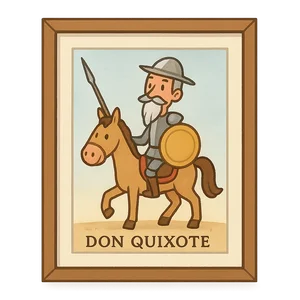
Don Quixote
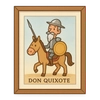
Don Quixote is a Spanish novel by Miguel de Cervantes, published in two parts in 1605 and 1615.
Reads at Grades 6–8 Listens at Grades 4–8
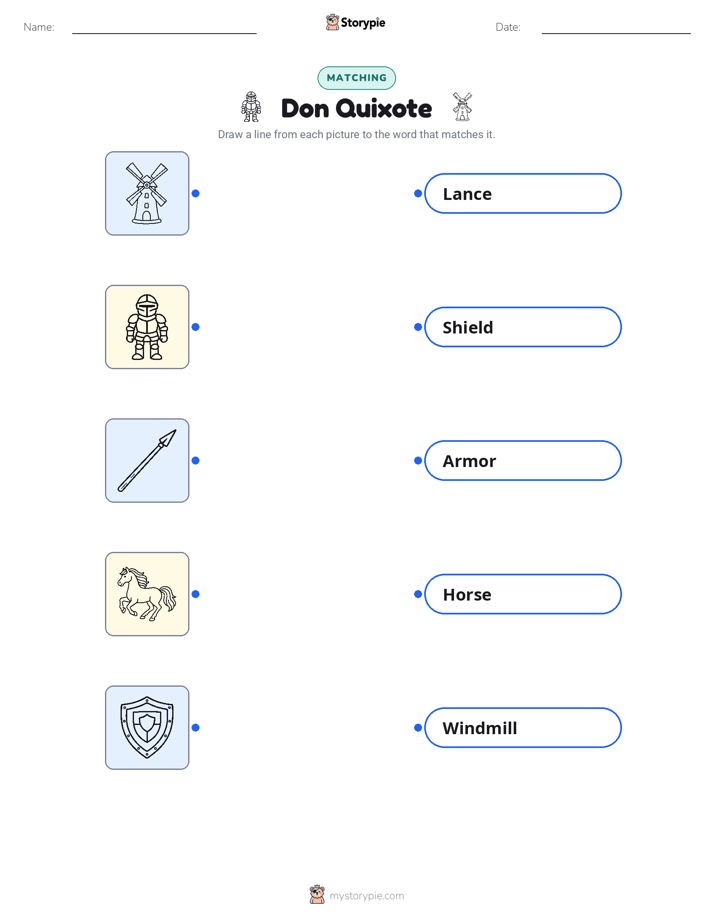
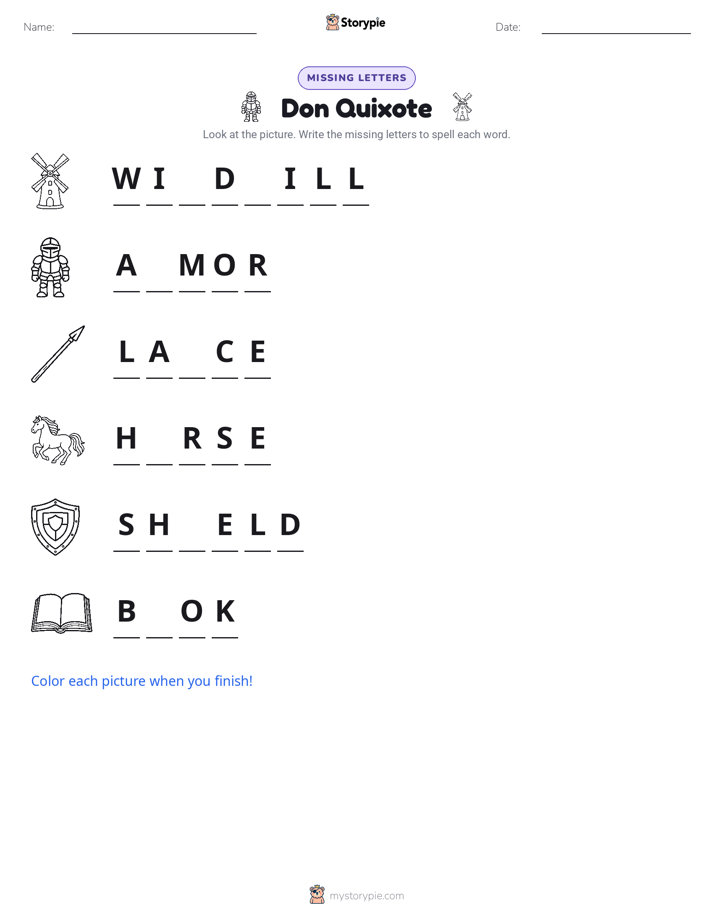
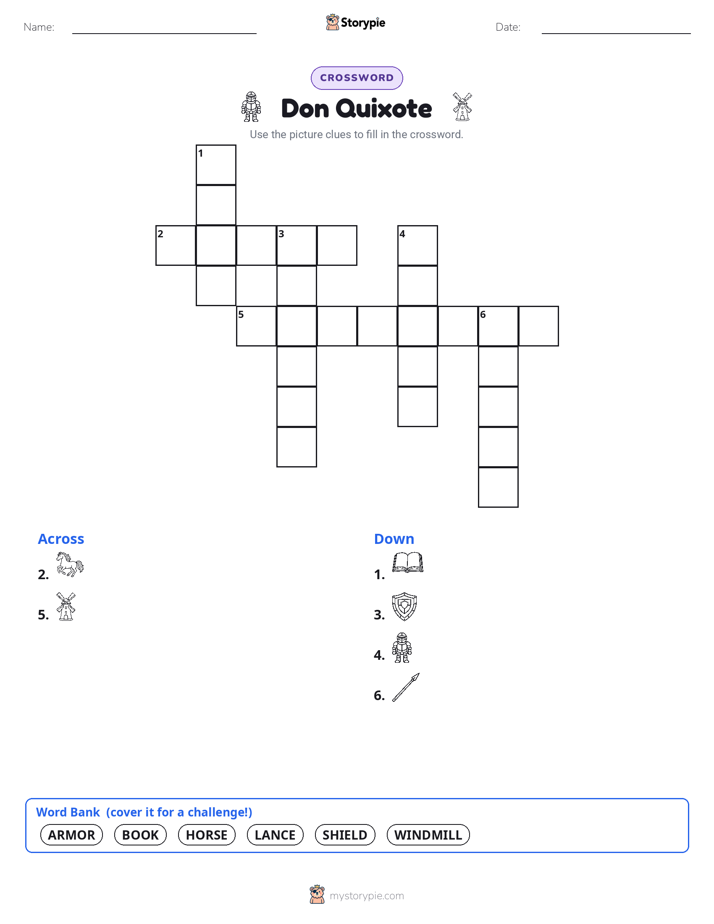
Print & create
Answer keys·No prep·Free with an account
28 worksheets · answer keys · full story · quiz · Ages 10-12 · CEFR B2
Plus adds 164,000+ more stories in 27 languages, audio for every one, and printables for all of them.
Just want Don Quixote?
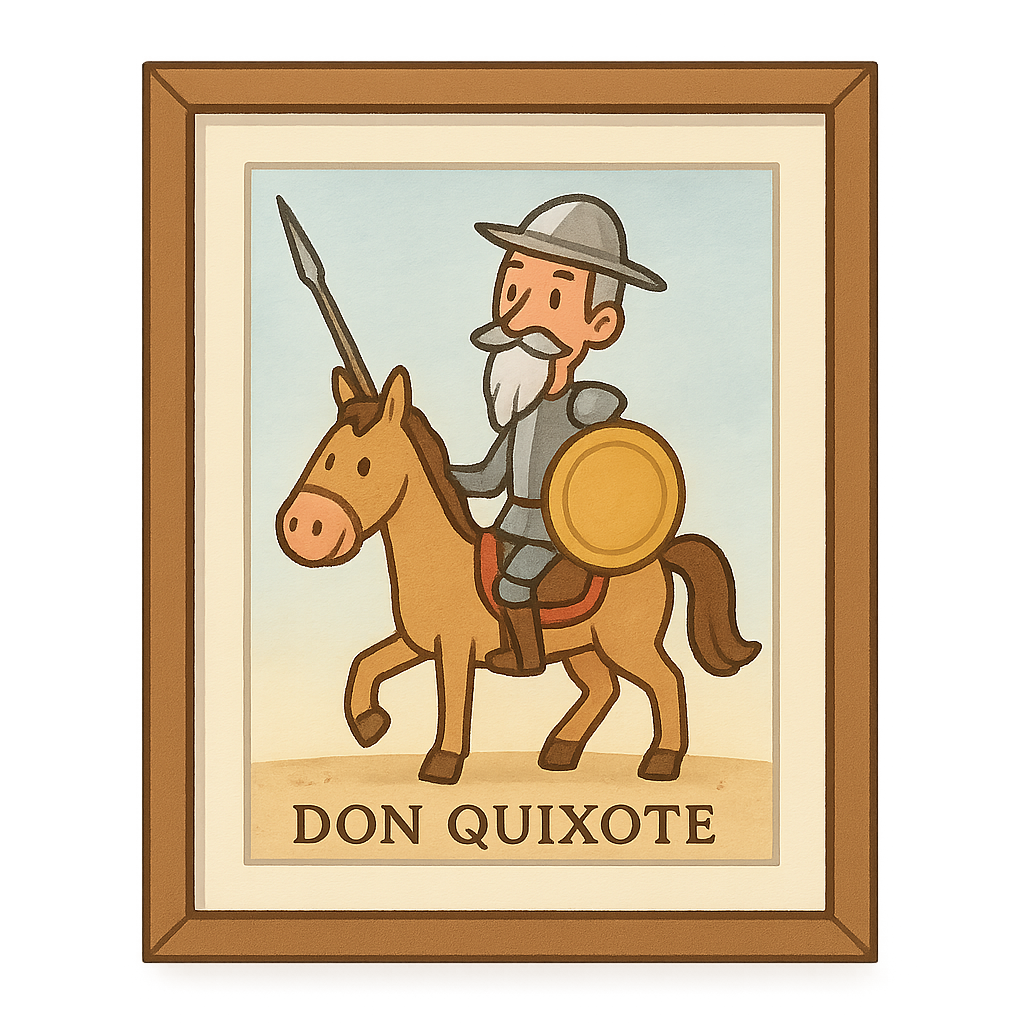
Before I had a cover or pages, I was an idea shimmering on the dusty plains of Spain. I was the sound of creaking leather, the glint of sun on old armor, and the sight of windmills standing like grumpy giants against a bright blue sky. I was a feeling in the heart of a man who dreamed of grand adventures, a gentleman so full of stories of brave knights that he decided to become one himself. He saw quests where others saw chores, and dragons where others saw windmills. Before the world knew my name, I was the wild, wonderful, and slightly silly dream of a hero. I am the story of Don Quixote.
I was brought to life by a man named Miguel de Cervantes Saavedra. He was not a king or a knight, but he had lived a life full of adventure that gave him a unique perspective on heroism and reality. As a young man, he was a soldier for Spain and fought bravely in a massive sea battle at Lepanto on October 7th, 1571, where his hand was permanently injured. He knew what courage looked like, but he also knew that life wasn't always as glorious as the stories made it seem. He began writing my first part while living in the city of Valladolid, Spain. On January 16th, 1605, my pages were printed, and my story was finally shared with the world. Cervantes wanted to create something entirely new. He aimed to write a story that poked fun at the wildly popular, but often ridiculous, tales of chivalry, while also celebrating the powerful and beautiful nature of human imagination. In my pages, he created my hero, the lanky and hopeful Don Quixote, and his faithful, funny, down-to-earth squire, Sancho Panza. Readers in Spain had never met characters quite like them, and they immediately fell in love with their travels, their comical arguments, and their unwavering friendship.
Don Quixote: A Story's Story
Before I had a cover or pages, I was an idea shimmering on the dusty plains of Spain. I was the sound of creaking leather, the glint of sun on old armor, and the sight of windmills standing like grumpy giants against a bright blue sky. I was a feeling in the heart of a man who dreamed of grand adventures, a gentleman so full of stories of brave knights that he decided to become one himself. He saw quests where others saw chores, and dragons where others saw windmills. Before the world knew my name, I was the wild, wonderful, and slightly silly dream of a hero. I am the story of Don Quixote.
I was brought to life by a man named Miguel de Cervantes Saavedra. He was not a king or a knight, but he had lived a life full of adventure that gave him a unique perspective on heroism and reality. As a young man, he was a soldier for Spain and fought bravely in a massive sea battle at Lepanto on October 7th, 1571, where his hand was permanently injured. He knew what courage looked like, but he also knew that life wasn't always as glorious as the stories made it seem. He began writing my first part while living in the city of Valladolid, Spain. On January 16th, 1605, my pages were printed, and my story was finally shared with the world. Cervantes wanted to create something entirely new. He aimed to write a story that poked fun at the wildly popular, but often ridiculous, tales of chivalry, while also celebrating the powerful and beautiful nature of human imagination. In my pages, he created my hero, the lanky and hopeful Don Quixote, and his faithful, funny, down-to-earth squire, Sancho Panza. Readers in Spain had never met characters quite like them, and they immediately fell in love with their travels, their comical arguments, and their unwavering friendship.
My first part became so popular that readers eagerly awaited a sequel. But before Cervantes could finish it, an anonymous author published a fake second part to my story in 1614. This unauthorized sequel deeply upset my true creator, and it motivated him to quickly finish the real conclusion to the adventure. In 1615, he published my official second part, which many critics and readers believe is even more brilliant and thoughtful than the first. In this part, something magical happened: Don Quixote and Sancho Panza are now celebrities. People they meet have read my first book and know all about their adventures. This was a revolutionary idea in storytelling, blurring the lines between fiction and reality. It is one of the main reasons I am often called the world's 'first modern novel'. My characters weren't just flat figures in a tale; they were complex, they learned from their experiences, they changed, and they even reflected on their own story. I also gave the world a new saying: 'tilting at windmills'. It comes from my dear knight's most famous battle against what he believed were giants, and it now means to fight imaginary enemies. I showed the world that a single story could be hilarious and heartbreaking, heroic and foolish, all at the same time.
For over 400 years, I have traveled far beyond the borders of Spain. My words have been translated into more than 140 languages, making me one of the most translated books in history, second only to the Bible. My story has inspired countless paintings, operas, ballets, plays, and movies. I live on in the hearts of anyone who has ever dared to dream a little differently or to see the world with more hopeful eyes. I am a timeless reminder that it is a beautiful and brave thing to see the world not just as it is, but as it could be. My legacy continues in the word 'quixotic', which is used to describe someone who is hopeful and idealistic, even when their goals seem impossible. I whisper to every new generation that it’s okay to be a little quixotic—to follow your ideals and chase your dreams, no matter how impossible they seem. My pages are always open, waiting to take you on an adventure where imagination is the greatest treasure of all.
Wow facts
About
Don Quixote is a Spanish novel by Miguel de Cervantes, published in two parts in 1605 and 1615. It is considered one of the most influential works of literature from the Spanish Golden Age and the entire Western literary canon.
Take a Quiz
Question 1 of 5
What problem prompted Miguel de Cervantes to write the second part of Don Quixote in 1615?
Explore next


Want to do even more?
Go beyond exploring. Unlock tools that turn every story into real learning.

Storypie Plus for families
Full stories, quizzes, and printables. Nights and car rides, sorted.
- Unlimited audio stories
- Create Mode: your child stars in the story
- Offline downloads
- Printable worksheets & coloring pages

Why Storypie for Schools
Students engaged. Prep in seconds. Evenings back to you.
- Worksheets & Quizzes
- Classroom Management
- Formative Assessment
- Custom Curriculum & Lesson Plans
- 27 Languages

Why Storypie for Homeschool
Curriculum done. They'll ask for more. Hours back in your day.
- Worksheet Generator
- First-Person Audio Stories
- Built-in Comprehension Quizzes
- Custom Curriculum & Lesson Plans
- Print & Go Activities