English

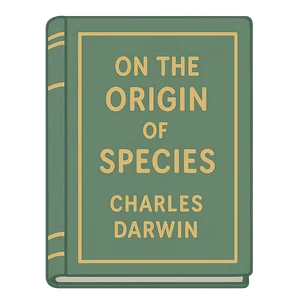
On the Origin of Species
A foundational work of scientific literature by Charles Darwin, published on November 24th, 1859…
Reads at Grades 6–8 Listens at Grades 4–8
On the Origin of Species: My Story
Before I was a book with a dark green cover and pages filled with ink, I was just an idea. I was a puzzle scattered across the entire globe, a collection of whispers carried on the wind. I was in the differently shaped beaks of finches living on separate islands, in the fossilized shells of ancient sea creatures found high in the mountains, and in the subtle, yet distinct, differences between tortoises from one part of an archipelago and another. I was the great question that hummed beneath the surface of the natural world: Why are there so many kinds of life, and how could they possibly all be connected? For millennia, I was a story waiting to be told, a secret that nature had been keeping for millions of years. The pieces were all there, waiting for a patient mind to gather them, see the pattern, and bind them together for the world to finally read.
My storyteller was a quiet and endlessly curious Englishman named Charles Darwin. His journey to discovering me began long before he wrote my first word. On December 27th, 1831, when he was just a young man, he boarded a ship called the HMS Beagle. It was the start of a five-year voyage that would take him all around the world. He wasn't a famous scientist yet, but he had an incredible eye for detail and a passion for observing everything. As the ship sailed along the coast of South America, he collected strange fossils of giant, extinct mammals. On the remote Galápagos Islands, he carefully noted how the local birds and reptiles were uniquely adapted to each specific island they inhabited. He filled notebook after notebook with his observations. When he returned to England on October 2nd, 1836, he didn't rush to tell my story. Instead, for more than twenty years, he painstakingly studied his specimens, corresponded with other naturalists, and slowly, carefully, pieced together the grand, unifying idea that would become my very soul.
For all those years, Darwin kept his revolutionary theory mostly to himself, sharing it with only a few trusted friends. He knew it would challenge everything people thought they knew about life. But an unexpected event forced his hand. In June of 1858, he received a letter from a fellow naturalist named Alfred Russel Wallace, who was working thousands of miles away in the Malay Archipelago. Incredibly, Wallace had independently come up with the very same idea of evolution by 'natural selection.' Darwin was stunned. He realized that if he waited any longer, his life's work might go unnoticed. This friendly competition was the spark that finally ignited my creation. Darwin was spurred into action, working frantically to condense over two decades of research and thought into a single, persuasive argument. He organized his vast evidence into chapters, writing with a sense of urgency he hadn't felt before. Finally, on November 24th, 1859, I was born. My pages were printed, my cover was bound, and I was published for all the world to see.
My arrival in bookstores caused an immediate storm of excitement and controversy. The 1,250 copies of my first printing sold out on the very first day. My pages told a radical new story about the history of life. I argued that all living things on Earth, from the smallest barnacle to the largest blue whale, were related and had descended from common ancestors over immense spans of time. I presented this concept as a great, branching 'tree of life.' And I gave the world a mechanism for how this happened: a process Darwin called natural selection. I explained that in the struggle for existence, individuals with traits that made them better suited to their environment were more likely to survive, reproduce, and pass those advantageous traits to their children. This simple but powerful idea was revolutionary. It thrilled some readers and deeply shocked others. I wasn't just another science book; I fundamentally changed how human beings understood the world and their place within it.
Today, more than 160 years after I was first published, the ideas I hold within my pages form the very foundation of modern biology. I admit, I didn't have all the answers. Charles Darwin knew nothing of genetics or DNA; those discoveries would come much later and would provide even stronger evidence for my central claims. But I gave scientists a map, a framework for understanding the history and diversity of life. I continue to inspire people to look at the world with curiosity, to ask questions, and to see the profound connections between all living things. I am a testament to a long and patient journey of discovery, and a reminder that the world is full of amazing puzzles just waiting for the next curious mind to try and solve them.
Wow facts
About
A foundational work of scientific literature by Charles Darwin, published on November 24th, 1859, which introduced the scientific theory of evolution by means of natural selection.
Take a Quiz
Question 1 of 5
What is the main idea of this story?
Explore next





Want to do even more?
Go beyond exploring. Unlock tools that turn every story into real learning.

Storypie Plus for families
Full stories, quizzes, and printables. Nights and car rides, sorted.
- Unlimited audio stories
- Create Mode: your child stars in the story
- Offline downloads
- Printable worksheets & coloring pages

Why Storypie for Schools
Students engaged. Prep in seconds. Evenings back to you.
- Worksheets & Quizzes
- Classroom Management
- Formative Assessment
- Custom Curriculum & Lesson Plans
- 27 Languages

Why Storypie for Homeschool
Curriculum done. They'll ask for more. Hours back in your day.
- Worksheet Generator
- First-Person Audio Stories
- Built-in Comprehension Quizzes
- Custom Curriculum & Lesson Plans
- Print & Go Activities