English

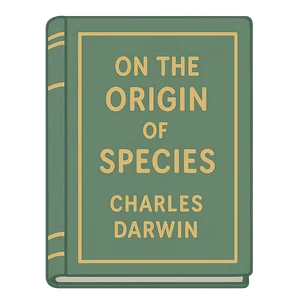
On the Origin of Species
A foundational work of scientific literature by Charles Darwin, published on November 24th, 1859…
Reads at Grades 3–5 Listens at Grades 1–5
The Story of the Tree of Life
Before I had pages or a cover, I was just a feeling. I was a collection of questions whispered on the wind as a ship rocked back and forth on a vast, blue ocean. Inside that ship, a young man with a curious mind was watching, thinking, and wondering about all the strange and beautiful creatures he saw. He wondered why birds on one island had different beaks than birds on another. He wondered why some animals had disappeared from the world, leaving only their giant bones behind. I was the story waiting to be told, a secret puzzle about how every bird, bug, and beast is connected in a giant family. I am a book, and my name is On the Origin of Species.
My creator was a brilliant and patient naturalist named Charles Darwin. His great adventure began on December 27th, 1831, when he set sail from England on a ship called the HMS Beagle. For five long years, he journeyed around the world, not as a tourist, but as a detective of nature. On the Galápagos Islands, he met giant tortoises that were so old they seemed to carry the world on their backs. He saw small birds called finches, and he noticed that the shape of their beaks was perfectly suited for the type of food they ate on each island. In South America, he dug up the fossils of enormous, ancient creatures that reminded him of the smaller armadillos and sloths he saw walking around. He filled notebook after notebook with his observations, questions, and sketches. Can you imagine filling hundreds of pages with notes about every plant and animal you saw. Those notebooks were like my very first baby pictures, holding all the tiny ideas that would one day grow up to become me.
When Charles Darwin’s voyage finally ended on October 2nd, 1836, he did not rush to write me. A great idea needs time to grow, and my idea was one of the biggest ever. For more than twenty years, he lived quietly in the English countryside, studying everything he had collected. He examined barnacles under his microscope, bred pigeons to see how they changed, and wrote letters to scientists all over the world, gathering clues like a detective solving a mystery. I was slowly taking shape in his mind, an idea about how all life on Earth slowly changes, or evolves, over millions of years. He was nervous to share me with the world. But in 1858, he received a letter from another naturalist, Alfred Russel Wallace, who was working far away in Malaysia. To Darwin's astonishment, Wallace had come up with the very same idea. This friendly nudge encouraged Darwin to finally share his life's work.
My big idea is called natural selection, and it's simpler than it sounds. Imagine a group of animals. Some are a little faster, some have slightly better eyesight, or some have colors that help them hide. In the struggle to survive, the ones with the features that are best suited to their home are more likely to live long enough to have babies. These helpful features are then passed down. Over a very, very, very long time—I’m talking millions of years—these tiny changes can add up, leading to whole new kinds of animals and plants. I painted a picture for my readers not of a ladder, but of a great branching 'tree of life,' showing how every living thing is related, from the tiniest insect to the tallest tree to you. On November 24th, 1859, I was finally born when I was published as a book in London. All 1,250 copies of me sold out on the very first day.
When my pages were first read, I caused a huge stir. My ideas changed everything people thought they knew about the history of life on our planet. Some people were shocked or upset because my story was different from the one they had always been told. But many scientists were thrilled. I gave them a powerful new tool for understanding the world. I explained why fossils of strange sea creatures could be found on top of mountains and why different animals on different continents looked so similar. I became one of the most important science books ever written, and my ideas helped start the field we now call evolutionary biology. I showed people that the natural world wasn't a finished painting but an epic story that was still being written
Wow facts
About
A foundational work of scientific literature by Charles Darwin, published on November 24th, 1859, which introduced the scientific theory of evolution by means of natural selection.
Take a Quiz
Question 1 of 5
In the story, the book calls Darwin's notebooks 'my very first baby pictures.' What does this comparison really mean?
Explore next





Want to do even more?
Go beyond exploring. Unlock tools that turn every story into real learning.

Storypie Plus for families
Full stories, quizzes, and printables. Nights and car rides, sorted.
- Unlimited audio stories
- Create Mode: your child stars in the story
- Offline downloads
- Printable worksheets & coloring pages

Why Storypie for Schools
Students engaged. Prep in seconds. Evenings back to you.
- Worksheets & Quizzes
- Classroom Management
- Formative Assessment
- Custom Curriculum & Lesson Plans
- 27 Languages

Why Storypie for Homeschool
Curriculum done. They'll ask for more. Hours back in your day.
- Worksheet Generator
- First-Person Audio Stories
- Built-in Comprehension Quizzes
- Custom Curriculum & Lesson Plans
- Print & Go Activities