English

On the Origin of Species
A foundational work of scientific literature by Charles Darwin, published on November 24th, 1859…
Reads at Grades K-2 Listens at K–3
The Story of On the Origin of Species
Before I had a name, I was just a whisper of an idea in a man’s mind. I wasn’t made of stone or paint, but of questions and thoughts. My pages started as empty sheets, waiting to be filled with secrets about every bird, bug, and buttercup in the world. Slowly, I filled up with drawings of finches with funny beaks, notes about fossils buried deep in the earth, and ideas as big as the sky. The man who dreamed me up wanted to understand how all living things came to be. I am a book, and my name is On the Origin of Species. I hold a very big secret about life on Earth.
My creator was a kind and curious man named Charles Darwin. He loved nature more than anything. On December 27th, 1831, he climbed aboard a big ship called the HMS Beagle and set off on a giant adventure that lasted five whole years. Imagine being on a boat for that long. He sailed to faraway places like the Galápagos Islands, which were like magical zoos. There, he saw giant tortoises munching on leaves. He could even tell which island they were from just by the shape of their shells. He also met little birds called finches with beaks of all different shapes and sizes. Some beaks were big and strong for cracking nuts, while others were tiny and sharp for catching insects. He wondered, why were they all so different, yet so similar? For more than twenty years after his trip, he worked quietly in his home in England. He studied worms in his garden, talked to pigeon breeders, and read many, many books. He wrote down everything he had learned and pieced together a giant puzzle about life on Earth. All his discoveries, his questions, and his big ideas were carefully poured onto my pages, making me who I am today.
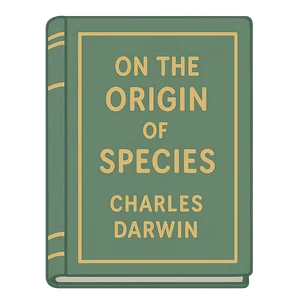
Finally, on November 24th, 1859, I was ready. I was printed and bound with a green cover, and my story was sent out into the world for everyone to read. Inside, I shared a very special idea called 'natural selection.' It sounds like a big, complicated word, but it’s really about how all living things are part of one big family tree. I explained that over a very, very long time—longer than your grandparents’ grandparents can remember—animals and plants can change a little bit to help them survive better in their homes. For example, a giraffe with a slightly longer neck might reach the tastiest leaves high in a tree, and a polar bear with thicker fur might stay warmer in the chilly snow. My ideas were new and exciting, and they made people look at the world with brand-new eyes.
Today, people all over the world still read my pages. I helped start the science we now call biology, which is the study of all living things. My story reminds everyone to stay curious, to watch the world closely, and to ask big, wonderful questions. I am a reminder that every living creature, from the tiniest ant humming in the grass to the biggest blue whale swimming in the ocean, is connected in the amazing, ever-changing story of life.
Wow facts
About
A foundational work of scientific literature by Charles Darwin, published on November 24th, 1859, which introduced the scientific theory of evolution by means of natural selection.
Take a Quiz
Question 1 of 4
What did Charles Darwin do right after his five-year trip on the HMS Beagle?
Explore next





Want to do even more?
Go beyond exploring. Unlock tools that turn every story into real learning.

Storypie Plus for families
Full stories, quizzes, and printables. Nights and car rides, sorted.
- Unlimited audio stories
- Create Mode: your child stars in the story
- Offline downloads
- Printable worksheets & coloring pages

Why Storypie for Schools
Students engaged. Prep in seconds. Evenings back to you.
- Worksheets & Quizzes
- Classroom Management
- Formative Assessment
- Custom Curriculum & Lesson Plans
- 27 Languages

Why Storypie for Homeschool
Curriculum done. They'll ask for more. Hours back in your day.
- Worksheet Generator
- First-Person Audio Stories
- Built-in Comprehension Quizzes
- Custom Curriculum & Lesson Plans
- Print & Go Activities