English

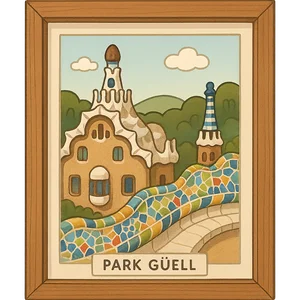
Park Güell
A whimsical public park in Barcelona, Spain, designed by architect Antoni Gaudí…
Reads at Grades 6–8 Listens at Grades 4–8
Print & create
Answer keys·No prep·Free with an account
28 worksheets · answer keys · full story · quiz · Ages 10-12 · CEFR B2
Plus adds 164,000+ more stories in 27 languages, audio for every one, and printables for all of them.
Just want Park Güell?
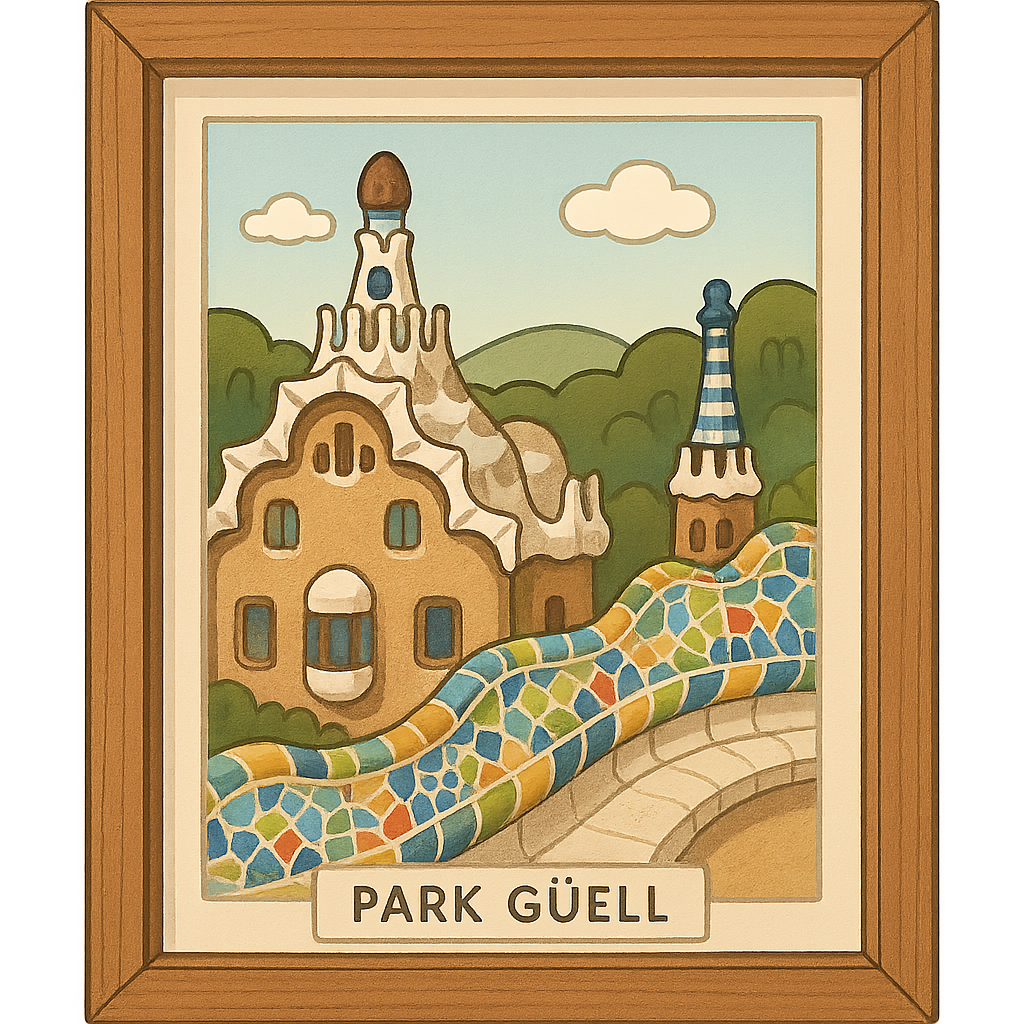
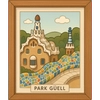
Imagine standing on a hillside, the warm Spanish sun warming your face as you look out over the beautiful city of Barcelona. You can see the rooftops stretching for miles, all the way to the sparkling blue of the Mediterranean Sea. Now, look around you. This is no ordinary place. The paths here don't run in straight lines; they curve and wind like rivers flowing down the hill. The columns holding up the walkways don't look like simple pillars; they lean and branch out, like a forest of ancient, stone trees. And the benches, oh, the benches. They aren't plain wood or cold metal. They shimmer with a rainbow of broken tiles, pieced together into a long, flowing wave of color that invites you to sit and dream. I was born from imagination, a place where art and nature dance together. I am not a place of sharp corners or rigid rules. I am a colorful, magical world perched above a busy city. I am Park Güell, a dream made of stone and tile.
My story begins around the year 1900, with the vision of two remarkable friends. One was a wealthy and forward-thinking businessman named Eusebi Güell, and the other was Antoni Gaudí, an architect whose mind was overflowing with brilliant, unconventional ideas. Together, they imagined a new kind of neighborhood, a 'garden city' built on this very hill, far from the smoke and noise of the industrial city below. It was meant to be an exclusive community for sixty wealthy families, a peaceful paradise blending architecture and landscape. Gaudí, who believed nature was the greatest teacher, was the perfect person to bring this dream to life. He refused to flatten the hill. Instead, he designed me to follow its natural curves. He built roads that rested on graceful viaducts, supported by leaning columns that look as if they grew right out of the earth. For the community's market, he designed a grand hall supported by 86 massive columns, like a mysterious stone forest. Above this hall, he created a magnificent open plaza, the heart of the community. And around its edge, he built my famous serpentine bench. Between the years 1900 and 1914, workers painstakingly applied a mosaic technique called 'trencadís,' smashing old ceramic tiles, plates, and bottles and arranging the colorful shards into beautiful, shimmering patterns. Every inch of me was designed to be a surprise, a tribute to the perfect imperfection of the natural world.
I Am Park Güell
Imagine standing on a hillside, the warm Spanish sun warming your face as you look out over the beautiful city of Barcelona. You can see the rooftops stretching for miles, all the way to the sparkling blue of the Mediterranean Sea. Now, look around you. This is no ordinary place. The paths here don't run in straight lines; they curve and wind like rivers flowing down the hill. The columns holding up the walkways don't look like simple pillars; they lean and branch out, like a forest of ancient, stone trees. And the benches, oh, the benches. They aren't plain wood or cold metal. They shimmer with a rainbow of broken tiles, pieced together into a long, flowing wave of color that invites you to sit and dream. I was born from imagination, a place where art and nature dance together. I am not a place of sharp corners or rigid rules. I am a colorful, magical world perched above a busy city. I am Park Güell, a dream made of stone and tile.
My story begins around the year 1900, with the vision of two remarkable friends. One was a wealthy and forward-thinking businessman named Eusebi Güell, and the other was Antoni Gaudí, an architect whose mind was overflowing with brilliant, unconventional ideas. Together, they imagined a new kind of neighborhood, a 'garden city' built on this very hill, far from the smoke and noise of the industrial city below. It was meant to be an exclusive community for sixty wealthy families, a peaceful paradise blending architecture and landscape. Gaudí, who believed nature was the greatest teacher, was the perfect person to bring this dream to life. He refused to flatten the hill. Instead, he designed me to follow its natural curves. He built roads that rested on graceful viaducts, supported by leaning columns that look as if they grew right out of the earth. For the community's market, he designed a grand hall supported by 86 massive columns, like a mysterious stone forest. Above this hall, he created a magnificent open plaza, the heart of the community. And around its edge, he built my famous serpentine bench. Between the years 1900 and 1914, workers painstakingly applied a mosaic technique called 'trencadís,' smashing old ceramic tiles, plates, and bottles and arranging the colorful shards into beautiful, shimmering patterns. Every inch of me was designed to be a surprise, a tribute to the perfect imperfection of the natural world.
But sometimes, even the grandest dreams take an unexpected turn. The original vision of a bustling, private neighborhood never fully came to be. The location was considered too far from the city at the time, and the houses were difficult to build on the steep terrain. In the end, only two homes were ever constructed. When all work stopped in 1914, I became a large, quiet private estate, my beautiful structures and paths enjoyed by only a few. It was a lonely time. But then, a wonderful thing happened. After Eusebi Güell passed away, his family made a generous decision. They offered me to the city of Barcelona. In 1926, my gates were officially opened to everyone, and I was reborn as a public park. My purpose had changed, and I found a new, joyful life. Suddenly, my paths were filled with the sounds of laughing children, curious travelers, and aspiring artists. People from every corner of the globe came to see me. They marveled at my gingerbread-house-like pavilions at the entrance and took photographs with my most famous resident, the mosaic dragon, 'El Drac,' who guards my grand staircase. My long, winding bench was no longer empty; it became a place for people to gather, to rest, and to gaze out at the incredible view of the city I call home.
My journey from a private project to a public treasure was finally recognized by the entire world. In 1984, I was named a UNESCO World Heritage Site, a title that honors me as a place of outstanding universal value, a treasure for all of humanity. I am more than just a park; I am a living, breathing work of art that you can walk through and touch. I am a testament to Antoni Gaudí’s belief that the straightest line is not always the most beautiful and that nature is the greatest architect of all. Through my trencadís mosaics, I show the world that even broken, discarded pieces can be put together to create something spectacular and new. I stand as a reminder that cities need spaces for dreams, that buildings can be playful, and that imagination has the power to shape our world. I hope that when people wander my curving paths and rest on my shimmering benches, they leave feeling inspired to look at the world a little differently, ready to build their own beautiful dreams.
Wow facts
About
A whimsical public park in Barcelona, Spain, designed by architect Antoni Gaudí, famous for its colorful mosaics and nature-inspired architecture.
Take a Quiz
Question 1 of 5
What was the main reason Park Güell's purpose changed over time?
Explore next



Want to do even more?
Go beyond exploring. Unlock tools that turn every story into real learning.

Storypie Plus for families
Full stories, quizzes, and printables. Nights and car rides, sorted.
- Unlimited audio stories
- Create Mode: your child stars in the story
- Offline downloads
- Printable worksheets & coloring pages

Why Storypie for Schools
Students engaged. Prep in seconds. Evenings back to you.
- Worksheets & Quizzes
- Classroom Management
- Formative Assessment
- Custom Curriculum & Lesson Plans
- 27 Languages

Why Storypie for Homeschool
Curriculum done. They'll ask for more. Hours back in your day.
- Worksheet Generator
- First-Person Audio Stories
- Built-in Comprehension Quizzes
- Custom Curriculum & Lesson Plans
- Print & Go Activities