English

Writing
Writing is a system of human communication that involves the representation of a language with symbols.
Reads at Grades 6–8 Listens at Grades 4–8
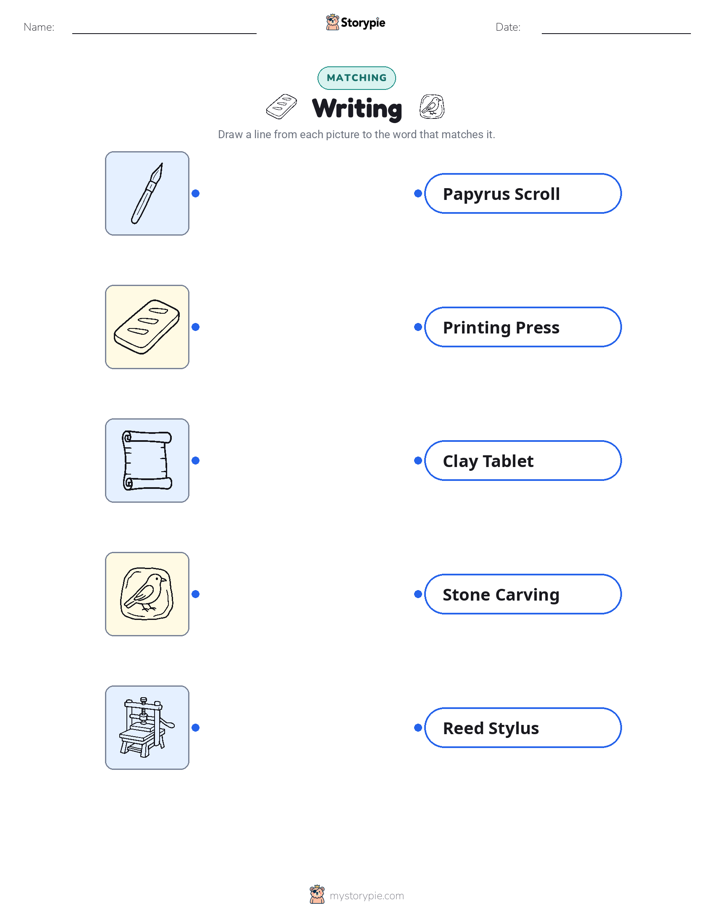
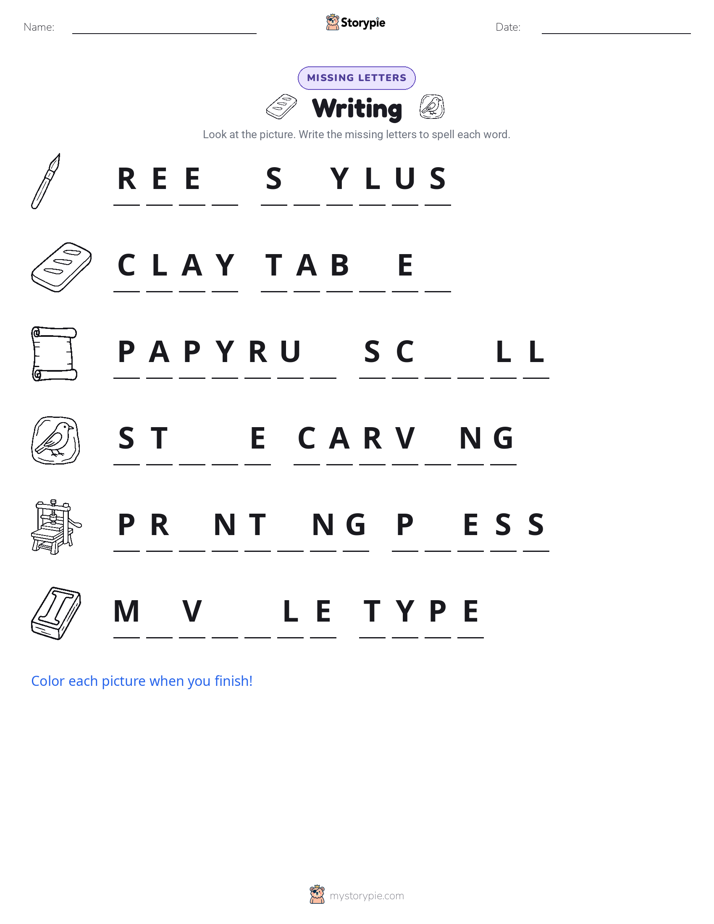
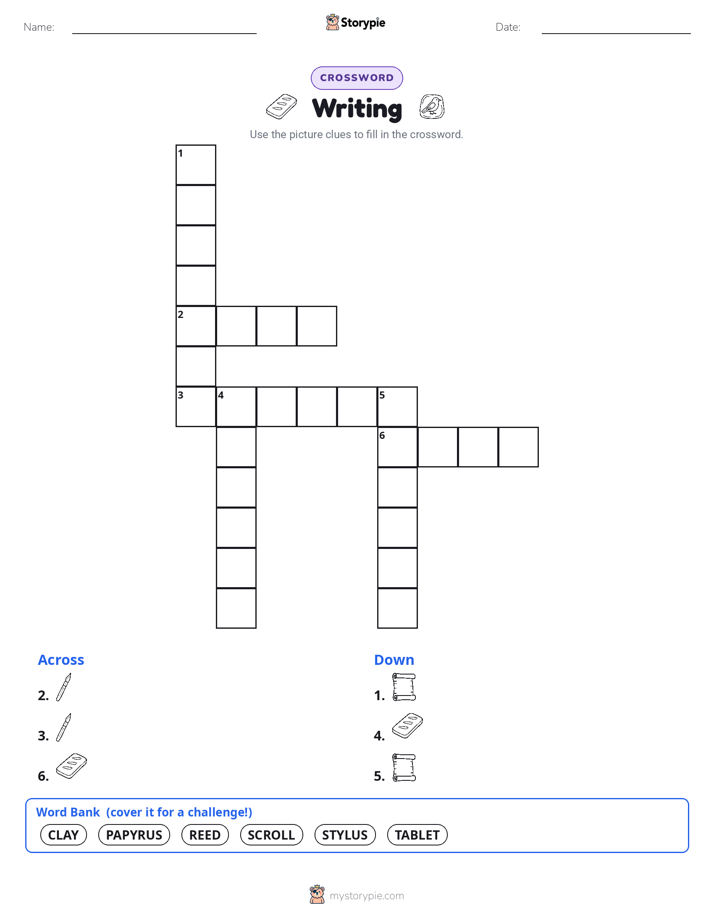
Print & create
Answer keys·No prep·Free with an account
28 worksheets · answer keys · full story · quiz · Ages 10-12 · CEFR B2
Plus adds 244,000+ more stories in 27 languages, audio for every one, and printables for all of them.
Just want Writing?
Before I was born, the world was a place of whispers and fleeting thoughts. I am Writing, and my story begins in the silence before words could be held in your hand. In those ancient days, a story, a law, or the memory of a great leader existed only as long as someone could remember to speak it. Knowledge was as fragile as a breath on a cold day. If a storyteller forgot a line, or a traveler passed away, their wisdom vanished with them. There was no way to send a message to a distant city without a messenger to memorize it, and no way to speak to the future. Humanity needed a memory that would not fade, a voice that would not fall silent. They needed me.
My first stirrings were not words but images, born in the deep, quiet corners of caves over 30,000 years ago. Humans used charcoal and earthy pigments to paint magnificent animals on stone walls. These weren't just decorations; they were the first attempts to make a thought permanent, a visual story of the hunt and the spirit world. But my true childhood began in the sun-baked land of Mesopotamia around 3,400 BCE. The Sumerian people, who lived between the Tigris and Euphrates rivers, were building great cities. They were farmers, traders, and priests, and they had a very practical problem: they needed to keep track of their grain, sheep, and taxes. A person’s memory could fail, but a permanent record could not. So, on soft tablets of wet clay, they began to press marks with a reed stylus. My first true form was born, and they called me Cuneiform, for the wedge-shaped marks I wore. I was a system of symbols, a tool for trade and government, and the world’s first accountant.
I Am Writing
Before I was born, the world was a place of whispers and fleeting thoughts. I am Writing, and my story begins in the silence before words could be held in your hand. In those ancient days, a story, a law, or the memory of a great leader existed only as long as someone could remember to speak it. Knowledge was as fragile as a breath on a cold day. If a storyteller forgot a line, or a traveler passed away, their wisdom vanished with them. There was no way to send a message to a distant city without a messenger to memorize it, and no way to speak to the future. Humanity needed a memory that would not fade, a voice that would not fall silent. They needed me.
My first stirrings were not words but images, born in the deep, quiet corners of caves over 30,000 years ago. Humans used charcoal and earthy pigments to paint magnificent animals on stone walls. These weren't just decorations; they were the first attempts to make a thought permanent, a visual story of the hunt and the spirit world. But my true childhood began in the sun-baked land of Mesopotamia around 3,400 BCE. The Sumerian people, who lived between the Tigris and Euphrates rivers, were building great cities. They were farmers, traders, and priests, and they had a very practical problem: they needed to keep track of their grain, sheep, and taxes. A person’s memory could fail, but a permanent record could not. So, on soft tablets of wet clay, they began to press marks with a reed stylus. My first true form was born, and they called me Cuneiform, for the wedge-shaped marks I wore. I was a system of symbols, a tool for trade and government, and the world’s first accountant.
At first, the marks I wore were simple pictures of the things they represented, which you might call pictograms. A drawing of a fish meant ‘fish,’ and a picture of a head meant ‘head.’ This worked well for tangible objects, but how would you draw ‘love’ or ‘sadness’ or ‘belief’? I needed to grow. My creators, the clever scribes of Mesopotamia and later Egypt, realized I could do more than just represent things; I could represent sounds. This was a monumental leap. A symbol no longer had to look like a thing, it could stand for the sound made when someone spoke its name. This new power was called a phonogram, and it allowed people to write down almost any word they could speak. Around the same time, around 3,200 BCE, my beautiful cousin was born along the Nile River. The Egyptians developed Hieroglyphs, a stunning system of sacred carvings. They used elegant pictures for sounds and ideas, carving histories onto temple walls that would last for millennia and writing on lightweight papyrus scrolls about medicine, poetry, and daily life. I was becoming both an art form and a powerful tool for building civilizations.
My next chapter was an adventure in simplicity. While thousands of symbols like Cuneiform and Hieroglyphs were powerful, they took a lifetime to master. Around 1,200 BCE, a group of brilliant sea traders called the Phoenicians needed a faster, more efficient way to communicate and keep records for their vast trade network across the Mediterranean. They created a revolutionary system: an alphabet. Instead of a symbol for every word or syllable, they had just 22 simple symbols, each one representing a consonant sound. It was easy to learn, adaptable, and incredibly effective. This idea traveled with their ships to new lands. Around the 8th century BCE, the Greeks adopted the Phoenician system and made a crucial improvement. They added symbols for vowels, the open sounds that connect consonants. For the first time, I could capture the sound of spoken language with near-perfect clarity. This Greek alphabet became the foundation for science, philosophy, and democracy. Later, the mighty Romans adapted the Greek letters to their own language, Latin, creating the very alphabet you are using to read my story right now.
With a simple alphabet, my power grew exponentially. But for centuries, I was still copied by hand, a slow and painstaking process. Then, in the 1440s, a man named Johannes Gutenberg invented the printing press in Germany. Suddenly, I could be duplicated hundreds, then thousands of times. Books, which had been precious treasures for the wealthy, could now spread knowledge to everyone. I carried the ideas of the Renaissance and the Scientific Revolution across the globe. I have allowed laws to be written down, giving people rights and justice. I have preserved the grandest poems, the most profound scientific discoveries, and the most intimate personal letters. Today, you see me everywhere—in the books on your shelf, on the screen of your computer, and in the messages on your phone. My form has changed from clay tablets to glowing pixels, but my purpose remains the same. I am the memory of humanity, the bridge between minds, and the vessel that carries our greatest ideas forward through time.
Wow facts
About
Writing is a system of human communication that involves the representation of a language with symbols. Early writing systems began as simple pictures and evolved into more complex symbols, allowing people to record history, share ideas, and communicate across time and distance.
Take a Quiz
Question 1 of 5
Summarize the main stages of Writing's evolution as described in the story, from its earliest form to the alphabet we use today.
Explore next


Want to do even more?
Go beyond exploring. Unlock tools that turn every story into real learning.

Storypie Plus for families
Full stories, quizzes, and printables. Nights and car rides, sorted.
- Unlimited audio stories
- Create Mode: your child stars in the story
- Offline downloads
- Printable worksheets & coloring pages

Why Storypie for Schools
Students engaged. Prep in seconds. Evenings back to you.
- Worksheets & Quizzes
- Classroom Management
- Formative Assessment
- Custom Curriculum & Lesson Plans
- 27 Languages

Why Storypie for Homeschool
Curriculum done. They'll ask for more. Hours back in your day.
- Worksheet Generator
- First-Person Audio Stories
- Built-in Comprehension Quizzes
- Custom Curriculum & Lesson Plans
- Print & Go Activities