English

Writing
Writing is a system of human communication that involves the representation of a language with symbols.
Reads at Grades 3–5 Listens at Grades 1–5
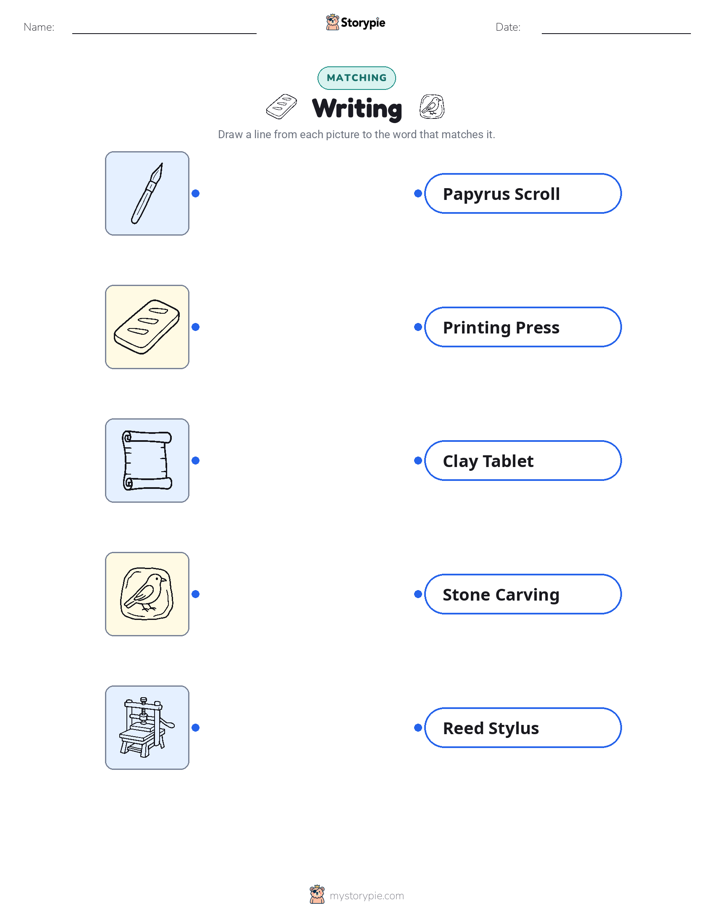
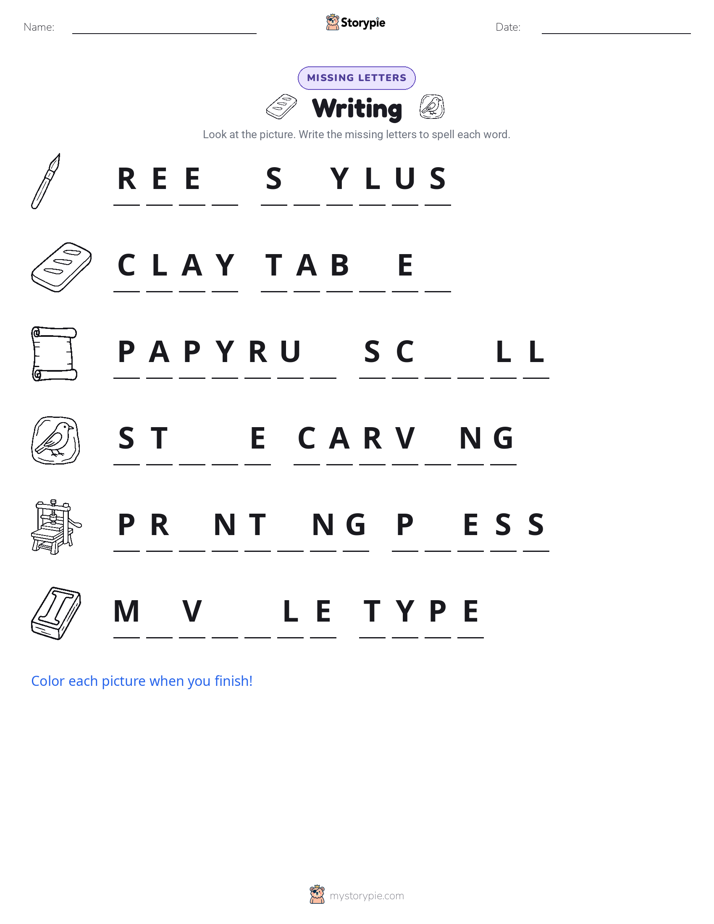
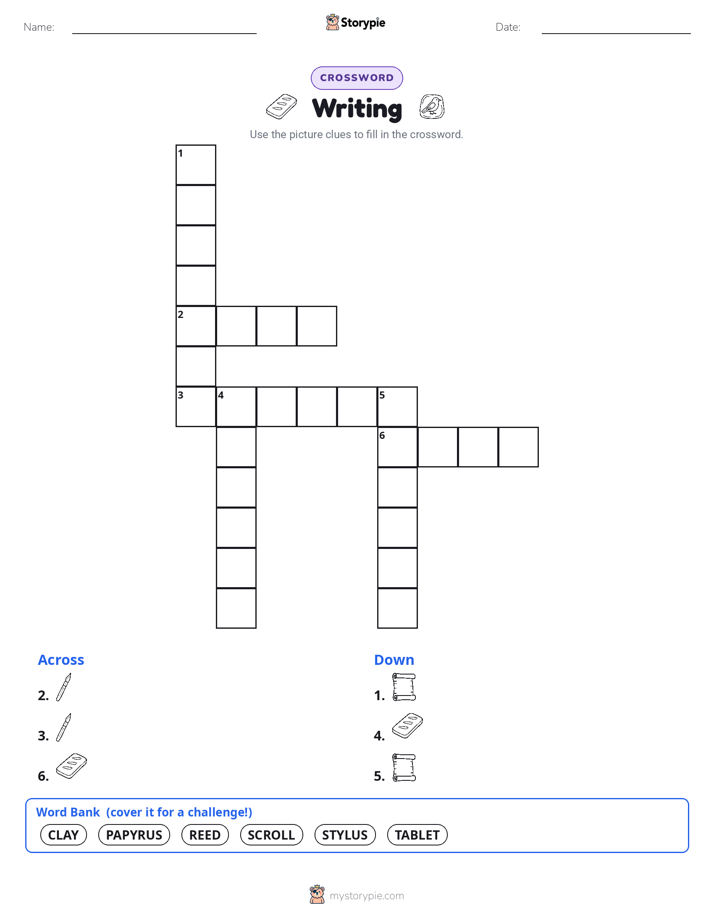
Print & create
Answer keys·No prep·Free with an account
28 worksheets · answer keys · full story · quiz · Ages 8-10 · CEFR B1
Plus adds 244,000+ more stories in 27 languages, audio for every one, and printables for all of them.
Just want Writing?
Hello, I am Writing. Before I existed, the world was filled with sounds and stories that vanished like puffs of wind. Imagine trying to remember every rule, every story, and every promise your family ever made. It was a heavy burden for human memory. If someone forgot, that piece of knowledge could be lost forever. But then, in a warm land called Sumer, in a place known as Mesopotamia, I was born around 3500 BCE. I wasn’t made of letters like you know me today. My first form was simple pictures, called pictographs. The clever Sumerians needed a way to keep track of their goods, like jars of grain and herds of sheep. They took a soft, damp tablet of clay and a sharp reed, and they drew me. A simple drawing of a head of barley meant barley. A sketch of a wavy line meant water. I was a memory keeper, a silent helper who made sure nothing important was forgotten.
Drawing a picture for every single thing was hard work and took a very long time. If you had a hundred jars of oil, you had to draw a hundred little oil jar pictures. The Sumerians knew there had to be a better way. So, around 3000 BCE, they helped me evolve. They simplified my pictures into a system of wedge-shaped marks. This new version of me was called cuneiform. Instead of drawing a whole picture, a scribe could just press the end of a reed into the clay to make different patterns of wedges. This was a huge leap. It meant I could stand for sounds and ideas, not just things. At the same time, in another amazing place, my cousin, the beautiful hieroglyphs of Egypt, came to life around 3200 BCE. They used elegant pictures of animals, objects, and symbols. For the first time, humans could use me to write down their laws, their histories, and even their poems. I was no longer just for counting sheep; I was for sharing the deepest thoughts of the human heart.
The Story of Writing
Hello, I am Writing. Before I existed, the world was filled with sounds and stories that vanished like puffs of wind. Imagine trying to remember every rule, every story, and every promise your family ever made. It was a heavy burden for human memory. If someone forgot, that piece of knowledge could be lost forever. But then, in a warm land called Sumer, in a place known as Mesopotamia, I was born around 3500 BCE. I wasn’t made of letters like you know me today. My first form was simple pictures, called pictographs. The clever Sumerians needed a way to keep track of their goods, like jars of grain and herds of sheep. They took a soft, damp tablet of clay and a sharp reed, and they drew me. A simple drawing of a head of barley meant barley. A sketch of a wavy line meant water. I was a memory keeper, a silent helper who made sure nothing important was forgotten.
Drawing a picture for every single thing was hard work and took a very long time. If you had a hundred jars of oil, you had to draw a hundred little oil jar pictures. The Sumerians knew there had to be a better way. So, around 3000 BCE, they helped me evolve. They simplified my pictures into a system of wedge-shaped marks. This new version of me was called cuneiform. Instead of drawing a whole picture, a scribe could just press the end of a reed into the clay to make different patterns of wedges. This was a huge leap. It meant I could stand for sounds and ideas, not just things. At the same time, in another amazing place, my cousin, the beautiful hieroglyphs of Egypt, came to life around 3200 BCE. They used elegant pictures of animals, objects, and symbols. For the first time, humans could use me to write down their laws, their histories, and even their poems. I was no longer just for counting sheep; I was for sharing the deepest thoughts of the human heart.
Even with cuneiform and hieroglyphs, I was still quite complicated. It took many years of special training to become a scribe who could read and use me. My next big adventure made me much more user-friendly. It happened with the Phoenicians, who were fantastic sailors and traders. Around 1200 BCE, they developed a system where each of my symbols represented a single sound. This was the beginning of the alphabet. It was a simple, brilliant code that was much easier to learn and use. Because the Phoenicians traveled all over the Mediterranean Sea, they shared their amazing idea with many other people. Around 800 BCE, the Greeks adopted this new system but added something incredibly important: vowels. With letters for sounds like 'a,' 'e,' 'i,' 'o,' and 'u,' I was complete. I became a tool that almost anyone could learn, not just powerful scribes or kings. I was finally ready to belong to everyone.
My journey has been a long one, from a humble mark on a clay tablet to the words filling your books and lighting up your screens. I travel instantly across the world in emails and text messages. I hold the wisdom of ancient thinkers and the newest scientific discoveries. I am in the street signs that guide you home and in the recipes that help you bake a cake. I have grown from a tool for counting grain into the voice of humanity. And now, I belong to you. I am the tool you use to share your thoughts, your dreams, and your unique stories. With me, you can make your own mark on the world, a mark that can be shared and remembered forever.
Wow facts
About
Writing is a system of human communication that involves the representation of a language with symbols. Early writing systems began as simple pictures and evolved into more complex symbols, allowing people to record history, share ideas, and communicate across time and distance.
Take a Quiz
Question 1 of 5
In the story, Writing says its evolution from pictures was a 'huge leap.' What does the phrase 'huge leap' mean in this sentence?
Explore next


Want to do even more?
Go beyond exploring. Unlock tools that turn every story into real learning.

Storypie Plus for families
Full stories, quizzes, and printables. Nights and car rides, sorted.
- Unlimited audio stories
- Create Mode: your child stars in the story
- Offline downloads
- Printable worksheets & coloring pages

Why Storypie for Schools
Students engaged. Prep in seconds. Evenings back to you.
- Worksheets & Quizzes
- Classroom Management
- Formative Assessment
- Custom Curriculum & Lesson Plans
- 27 Languages

Why Storypie for Homeschool
Curriculum done. They'll ask for more. Hours back in your day.
- Worksheet Generator
- First-Person Audio Stories
- Built-in Comprehension Quizzes
- Custom Curriculum & Lesson Plans
- Print & Go Activities