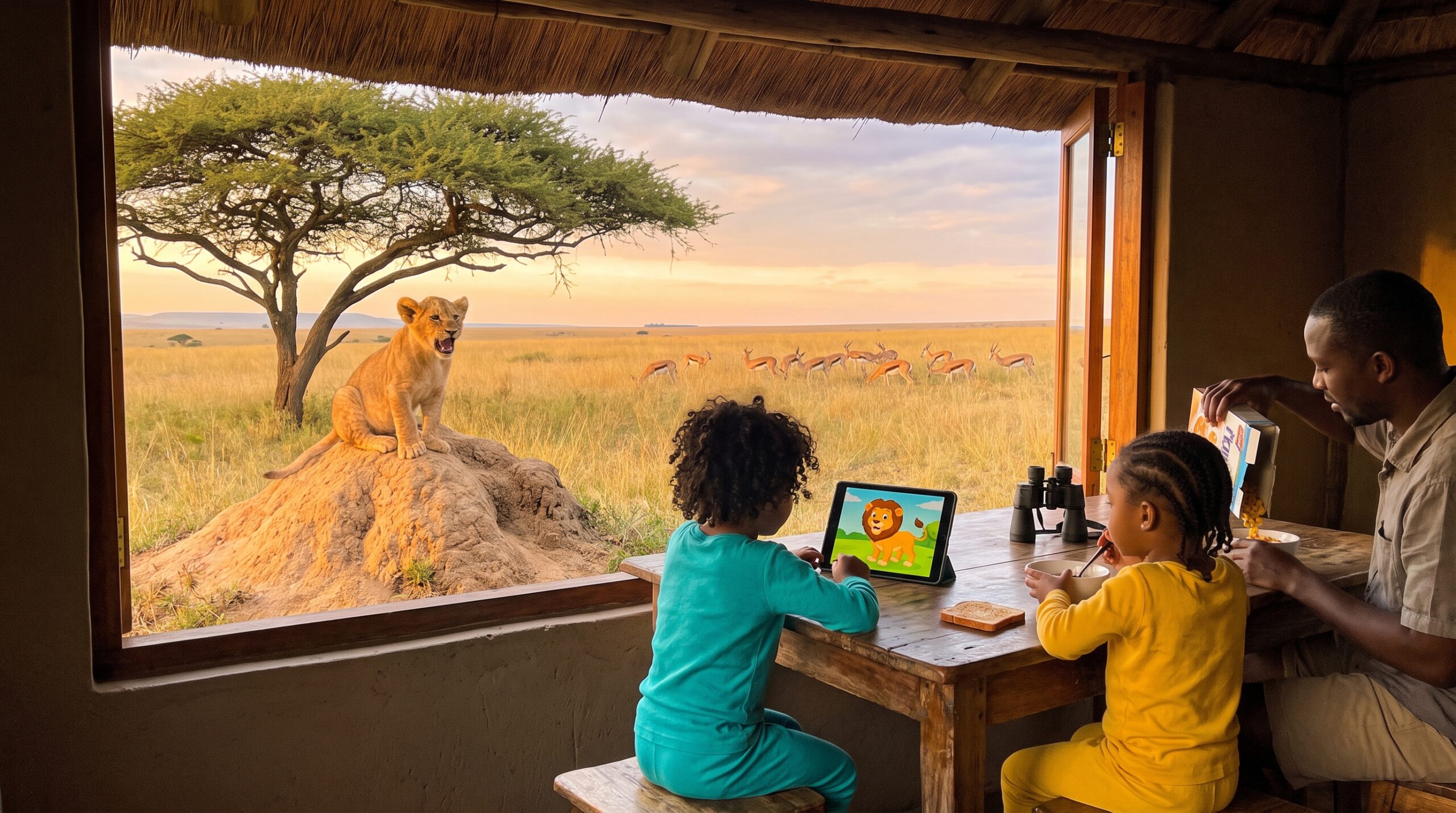
Meet the African lion for kids: a large, social cat that lives in family groups called prides. Meet Leo, an inquisitive cub who practices his roar. Play this on a summer morning to spark simple, joyful questions about nature.
What is an African lion for kids?
The African lion, Panthera leo, lives mainly in sub-Saharan Africa. It prefers savannas, grasslands and open woodlands. Historically lions ranged more widely, but today they live in far fewer places. As of 2023, the African lion’s extant range covers approximately 1,566,529.6 km²—only about 7.4% of its historical range—and this reflects an estimated 36% decline in range since 2002, according to IUCN / African Lion Database.
Physical traits
Adult males often weigh 150 to 225 kg. Females usually weigh 120 to 180 kg. Males grow a mane that can be light or very dark. A darker, fuller mane can signal health and social rank. It may also help protect the neck. Cubs are born with spotted coats that help hide them. Leo’s tiny squeak is utterly delightful and very playful.
Fun size facts
- Male lions can be heavier than many cars weigh, for example small hatchbacks.
- Cubs grow quickly and start to show hunting moves in play.
How lions live together
Lions are the most social of the big cats. A pride often includes related adult females, their cubs and one or a few males. Females do much of the cooperative hunting and raise cubs together. Males defend territory and protect the pride. Territory size depends on prey and habitat. The pride’s teamwork is clever and striking.
Hunting and diet
Lions are carnivores that mainly eat medium and large herbivores. They hunt zebra, wildebeest and antelope. Sometimes they take buffalo or young elephants and giraffes. Hunts rely on stealth, coordination and short bursts of speed up to about 80 km per hour. Females often lead hunts at dawn, dusk or night. Lions also scavenge and sometimes steal kills from other predators.
Growing up
Gestation lasts about 110 days. Litters usually contain one to four cubs. Cubs start eating meat after a few months and are weaned around six or seven months. Play teaches hunting skills. Young lions often leave or are driven out at 18 to 24 months as they become independent. Leo will learn fast and may grow bold in play.
Lifespan and threats
In the wild, male African lions typically live up to 12 years, while lionesses may live up to 16 years, according to Smithsonian’s National Zoo. In well-managed captivity they may reach 20 years or more. Many wild lion populations have declined; the estimated population of adult and subadult lions in Africa in 2023 is between 22,000 and 25,000, having declined from roughly 33,000 in 2006—a reduction of about 30% over 17 years, as reported by IUCN / African Lion Database. Threats include habitat loss, fewer wild prey, conflict with people, illegal killing and disease. Cub mortality can be high from starvation, predation and fights over pride control.
Why lions matter
As top predators, African lions for kids help keep herbivore numbers in balance. This balance protects plants and many other animals. Losing lions can change whole ecosystems. Compared with around 92,000 lions in circa 1970, Africa’s lion population has declined by approximately 75% over the past 50 years, or about 1,400 lions per year, highlighting the urgency for conservation efforts according to Loveridge et al. (2022). Lions also carry cultural meaning and support tourism that can fund conservation. In short, they shape wild places in big ways.
How families can help and learn
Gentle learning builds care. Try these playful ideas together:
- Try a soft roar together. Be silly and be bold.
- Compare a lion’s weight to household items for quick math fun.
- Count spots on cub photos and notice patterns.
- Visit parks responsibly with licensed guides and listen carefully.
Read or listen to a story about African Lion now: For 3-5 year olds, For 3-5 year olds, For 6-8 year olds, For 8-10 year olds, and For 10-12 year olds.
Finally, keep lessons warm and safe. Teach children to respect wild animals and to view them from a distance. For playful prompts and narrated stories, visit Storypie and make a morning listen joyful and bright.