
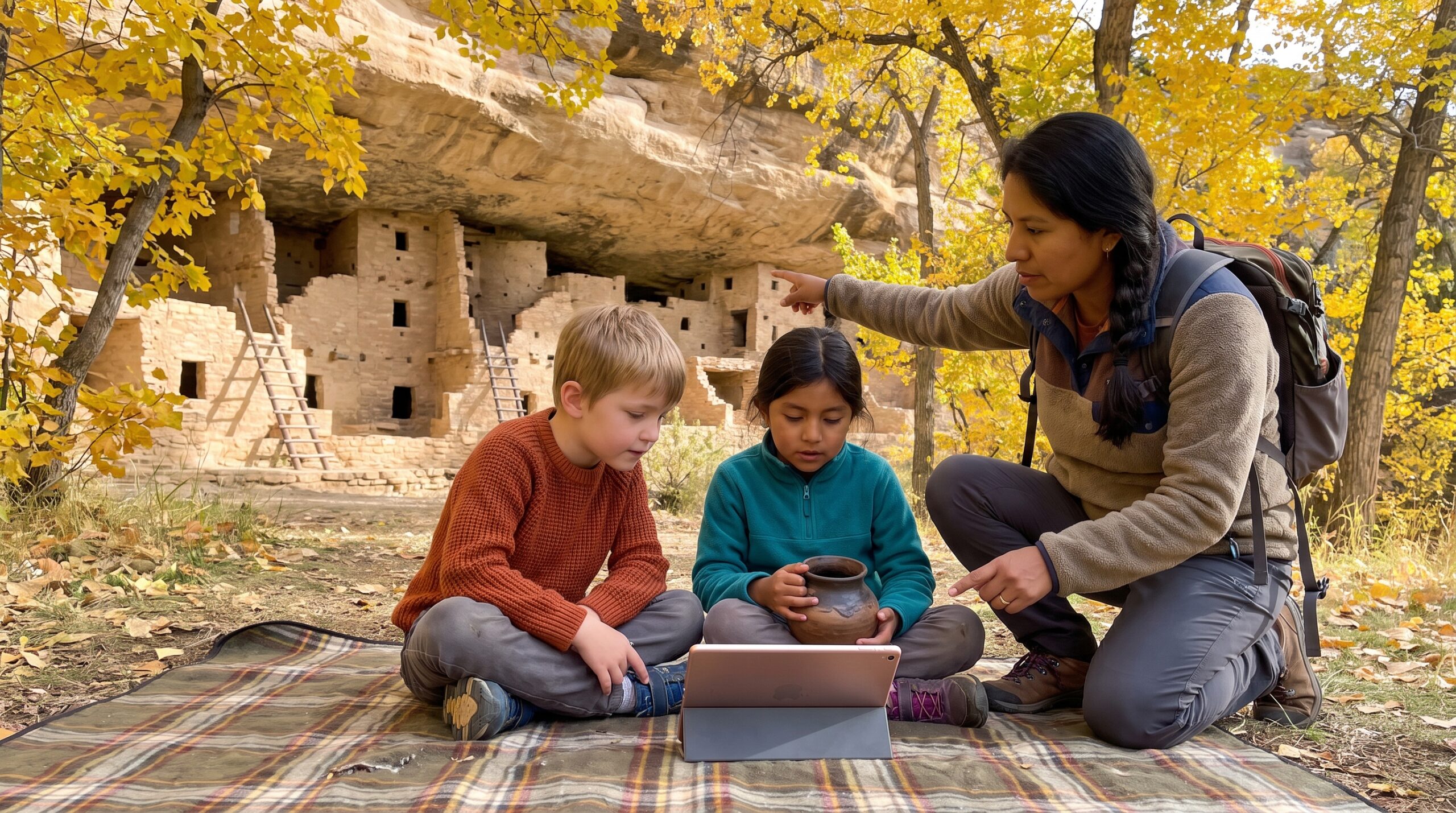
Meet the Ancestral Puebloans (Cliff Dwellers)
Ancestral Puebloans (Cliff Dwellers) lived in the Four Corners region. They built homes in canyon alcoves and on mesa tops. Their story feels inventive and rooted in place. For families, this history offers gentle wonder. The Ancestral Puebloans inhabited the Mesa Verde region from approximately 550 to 1300 CE, during which they constructed over 600 cliff dwellings, showcasing their remarkable architectural skills.
Who they were
They farmed, wove, traded, and built across the Four Corners. Their region sits where Colorado, Utah, Arizona, and New Mexico meet. Archaeologists divide their long history into Basketmaker phases, then Pueblo I through Pueblo III. The famous cliff dwellings date mostly to Pueblo III, about 1150 to 1300 CE. For example, Cliff Palace in Mesa Verde National Park contained 150 rooms, 23 kivas, and housed a population of approximately 100 people, illustrating the scale and complexity of their communities.
Daily life and homes
Families lived in multistory rooms of shaped sandstone and mortar. They used wooden beams for roofs and floors. Some pueblos sat on mesa tops. Others hugged shaded alcoves in canyon walls. Kivas were round, often partly underground. People used them for ceremony and community meetings. For instance, Spruce Tree House, the third-largest cliff dwelling in Mesa Verde, contains about 130 rooms, eight kivas, and housed approximately 60 to 80 people, demonstrating their sophisticated architectural techniques. About 90% of what is visible today is original material, including three-story homes and 700-year-old wooden roofs.
They stored dried maize, beans, and squash in small rooms. Pottery, baskets, sandals, and woven textiles served as tools and art. In short, homes were practical and beautiful.
Farming, water, and clever engineering
They grew the Three Sisters: maize, beans, and squash. Because water was scarce, they used dry farming. Small fields, terraces, check dams, and runoff basins helped trap rain. A check dam is a low stone wall in a wash. It slows water so soil soaks in. These simple systems kept seed beds alive in thin soils.
Trade, Chaco, and long distances
Communities were not isolated. Trade moved turquoise, shells, macaw feathers, and copper across long routes. Chaco Canyon, from about 900 to 1150 CE, acted as a ceremonial and trade hub. It featured great houses and roads. Also, some sites show careful tracking of sun and moon cycles, which hints at thoughtful planning.
Timeline and change
Historians note Basketmaker periods through Pueblo I and II. Cliff dwellings appear mainly around 1150 to 1300 CE. Mesa Verde National Park preserves over 52,000 acres and includes nearly 5,000 archaeological sites, of which 600 are cliff dwellings, as of its April 2026 data, emphasizing the significance of this region in preserving Ancestral Puebloan heritage. From about 1200 to 1300 CE, regional movement and decline occurred. Between 1100 and 1300 CE, the population at Mesa Verde reached several thousand people, concentrated in compact multi-room villages. By the 1280s, the region was almost completely depopulated, likely influenced by the Great Drought of the late 1200s among other factors.
Visiting with respect
When you visit, follow a simple rule: look, listen, and do not touch. Many sites remain sacred to descendant Pueblo peoples. Avoid climbing ruins or taking objects. Follow park rules and listen to tribal guides. Most importantly, use respectful language: Ancestral Puebloans or Pueblo peoples.
Short family ideas
- Make a tiny coil basket from paper strips to learn basket rhythm. Keep it calm and short.
- Plant a pot of corn seeds. Watch a week of sprouts and talk about careful water use.
Cultural sensitivity and glossary
Archaeology helps us learn, and descendant communities remain active and living. Use the names people prefer. Honor requests from tribes about sacred sites.
Glossary
- Kiva — round, often subterranean ceremonial room
- Pueblo — multiroom stone or adobe house
- Alcove — a sheltered cliff recess used for homes
- Maize — corn, a staple crop
Read or listen to a story about Ancestral Puebloans (Cliff Dwellers) now: For 3-5 year olds, For 6-8 year olds, For 8-10 year olds, and For 10-12 year olds.
Quiet closing thought: Ancestral Puebloans lived with careful design in mind. Their legacy stays fragile and alive. Treat it with calm attention and respect.