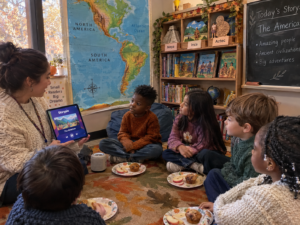
Audio-first routines for imagination make listening the heart of the moment. Parents and teachers will find less screen fuss and more room for big mental pictures.
Why audio-first routines for imagination work
Listening reduces cognitive load. When children do not decode images, their working memory frees up. As a result, they can hold characters, feelings, and little surprises. In fact, a 2024 study published in PLOS ONE found that viewers reported significantly higher cognitive load when watching subtitled videos without sound, highlighting how audio can significantly reduce cognitive load compared to visual-only formats.
Also, a calm voice lowers distractions. For example, removing taps and menus leaves space for story details. In short, less clutter means more headspace for picture-making.
Listening calls the imagination forward
When we do not supply pictures, children supply them. Neuroscience finds listening lights language, sensory, and motor networks. Those same circuits power vivid imagination. Research shows that increasing visual load—adding more images to audio narration—enhances recall performance for content presented with both audio and picture; however, adding images did not benefit content presented in an audio-only format, according to a 2026 study in Cognitive Research: Principles and Implications.
Moreover, oral stories often lead to richer mental images and better recall. Thus, audio-first routines for imagination help with recall and creative play.
Simple ritual ideas
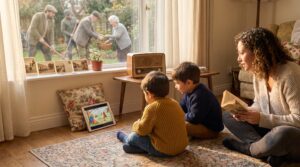
- Dim one lamp and pick a cushion.
- Press play on a short, calm episode.
- Ask one gentle question afterward: What did you picture?
Bedtime, transitions, and calm moments
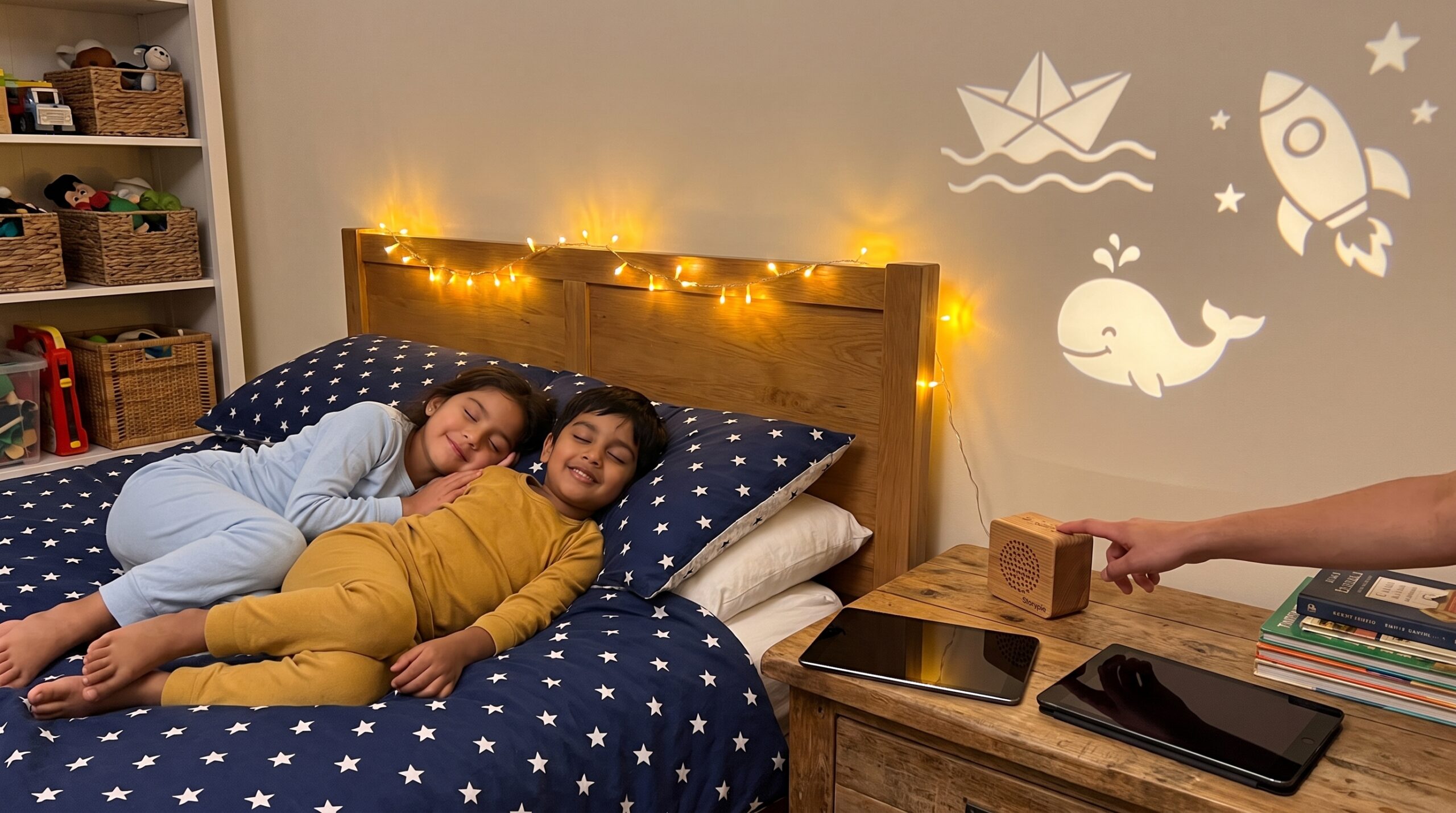
Audio suits winding down. Short sessions of about 10 to 15 minutes lower arousal when the story pace is slow. Replace blue light with a soft speaker, a dim lamp, and a steady voice.
Also, place the device a little distance from the bed. Use offline playback or background play when possible. These small choices keep the moment calm and inviting.
Language, attention, and equity
Hearing stories builds vocabulary and listening stamina. For pre-readers, multilingual families, and children with visual impairment, audio opens access to complex story structures.
Therefore, audio-first routines for imagination act as an inclusive bridge to classroom skills.
A small ritual, big effect
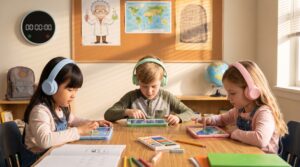
Design a tiny, repeatable moment. One low cushion, one soft light, one tiny basket with headphones and a bookmark does the trick. Rotate episodes like a curated shelf.
Try a simple rotation: a hero pick, a calm pick for bedtime, and a short adventure to stretch imagination. Curation beats clutter every time.
Practical notes
- Keep volume moderate and pace gentle.
- Avoid intense plots near sleep.
- Caregiver involvement helps: ask one short question afterward.
Finally, balance matters. Mix listening with shared reading and active play. Avoid constant background sound or overstimulating tracks.
For a gentle start, try a 10 to 15 minute Storypie episode before bed. Learn more about the Storypie app and curated episodes at Storypie app and browse our picks on Storypie episodes.
Late summer evenings, car rides, and quiet corners make great times to go audio-first. Open a private gallery of internal pictures for your child with audio-first routines for imagination.