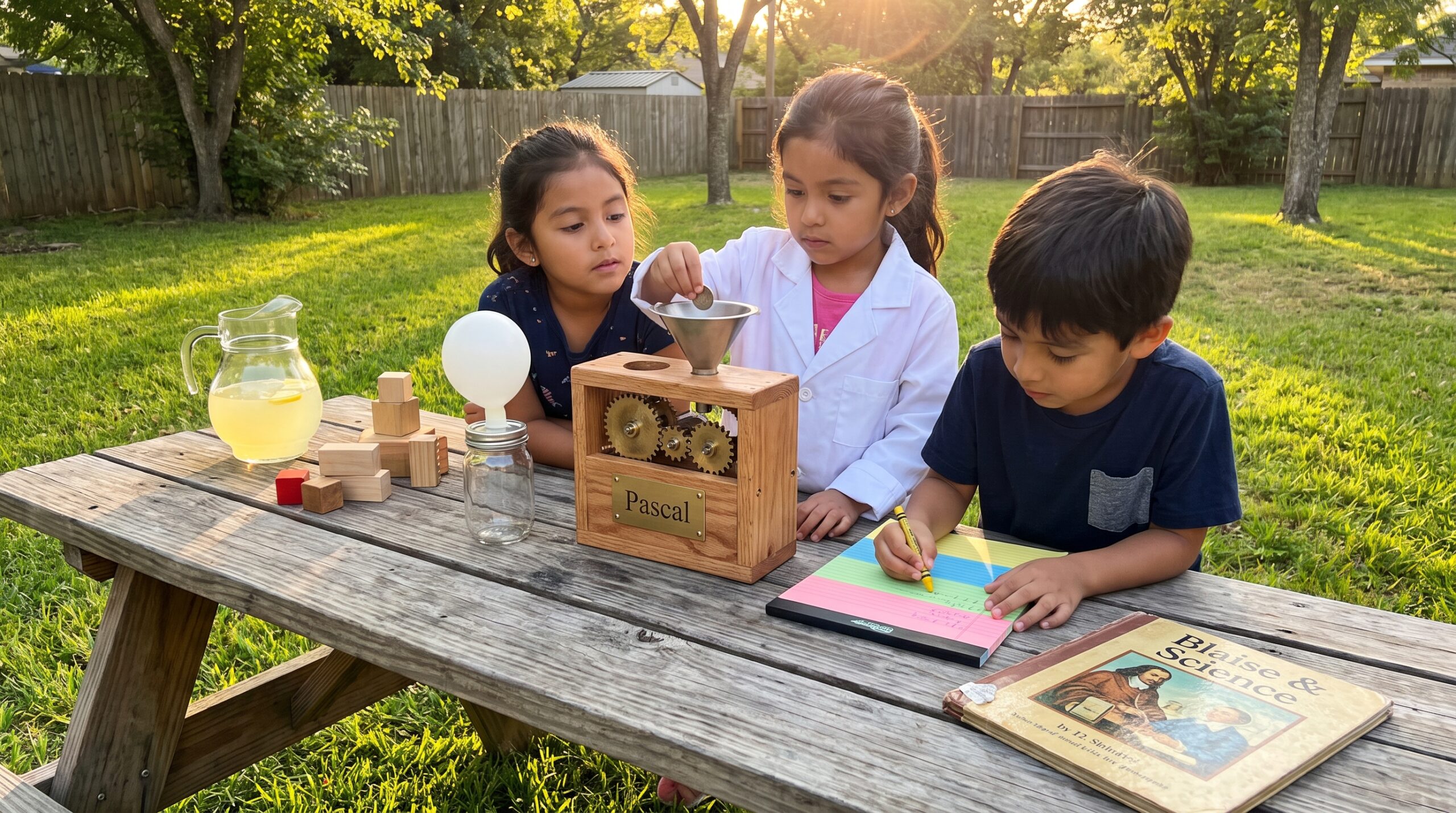
Imagine a boy taking apart a clock to see how it ticked. He grinned with delight. This Blaise Pascal biography for kids begins with that small moment. It shows how curiosity grows into invention and big ideas.
Early spark in the Blaise Pascal biography for kids
Blaise Pascal was born on June 19, 1623, in Clermont-Ferrand, France, and died on August 19, 1662, in Paris, France, living to the age of 39. His father, Étienne, taught him at home. Consequently, young Pascal learned by doing. At the age of 16, in 1640, he produced his first serious mathematical work—Essay pour les coniques—formulating Pascal’s Theorem regarding conic sections. As a teen, he built a mechanical adding machine called the Pascaline. Also, his Pascaline used geared wheels to add and subtract. Today, a few original Pascalines sit in museums as tiny wonders.
Inventions, experiments, and clever questions
Pascal loved experiments and clear thinking. For example, he helped show that air has weight by comparing barometer readings at different heights. Then he explained how pressure in a confined fluid spreads evenly. That idea became known as Pascal’s law. As a result, engineers use it in hydraulic lifts and presses.
Also, Pascal worked with Pierre de Fermat on probability. Their letters solved gambling puzzles. Those exchanges helped start modern probability theory. In addition, Pascal studied the arithmetical triangle that now bears his name, Pascal’s Triangle. These are big ideas born from small experiments and bold questions.
Simple timeline
- 1623 born in Clermont-Ferrand
- 1640 produced his first serious mathematical work
- 1642 built the Pascaline
- Mid 1600s did atmospheric experiments
- 1654 wrote with Fermat about probability
- 1656 to 1657 wrote Lettres provinciales
- 1662 died in Paris at age 39
Two tiny activities inspired by Pascal
These short activities echo Pascal’s hands-on spirit. Try them together for a fun afternoon.
- Coin prediction game. Flip a coin ten times. Have your child guess how many heads will appear. Record the results. Talk about chance and surprise.
- Air pressure demo. With adult supervision, trap a marshmallow in a jar and change the lid seal slowly. Or warm then cool a sealed plastic bottle to watch it crumple. Safety first.
What he wrote and why his name matters
Pascal wrote essays, letters, and short reflections. The Pensées collects his thoughts about belief and reason. Also, Pascal’s Wager is a famous idea about faith and logic. He experienced a powerful religious turn in 1654 and later wrote about Jansenism. Despite health struggles, his name lives on in science and learning. For instance, the SI unit of pressure is called the pascal. A programming language also uses his name.
Read or listen to a story about Blaise Pascal now: For 3-5 year olds, For 6-8 year olds, For 8-10 year olds, and For 10-12 year olds.
Also, visit Storypie for more short audio biographies and kid-friendly science stories. In short, Pascal shows how asking questions and trying experiments leads to discovery. Tonight, try a coin game or a tiny pressure demo. Celebrate curiosity. It is the best kind of learning.