Christopher Columbus biography for kids: Christopher Columbus was an Italian navigator from Genoa. He lived around 1451 to 1506. First, he sailed for Spain in 1492 hoping to reach Asia by going west. That journey changed maps and the world, in ways both exciting and very sad.
Christopher Columbus biography for kids: the voyages
In August 1492 he left Spain from Palos de la Frontera with three ships: the smaller Niña and Pinta, and the larger Santa María, which had a total crew of about 90 members. Ferdinand and Isabella of Spain sponsored the trip. They also gave Columbus titles such as Admiral of the Ocean Sea. On October 12, 1492, the fleet found land in the Americas on an island the Lucayan people called Guanahani, which he renamed San Salvador. This date marks a pivotal moment in history, often regarded as the beginning of European exploration of the Americas, according to the Library of Congress.
Ships, navigation, and maps
Columbus sailed again and made four transatlantic voyages between 1492 and 1504: 1492–1493, 1493–1496, 1498–1500, and 1502–1504. Sailors used a compass, an astrolabe or quadrant, charts, and dead reckoning. Navigation mixed careful observation with bold guesswork. Life at sea was cramped and risky. For example, caravels held about 50 to 60 tons and small crews. Sailors slept in tight quarters and relied on stored food and the weather.
The tools and the map changes
Maps and navigation changed fast after those voyages. Mapmakers updated charts as news arrived. As a result, trade routes and global imagination shifted. Columbus showed Europeans that lands lay west of Europe. That discovery began big changes for people around the world.
Columbian Exchange and the complex legacy
The Columbian Exchange followed Columbus’s voyages, which led to the widespread exchange of plants, animals, and cultures between the Eastern and Western Hemispheres. Foods like maize, potatoes, tomatoes, cacao, and tobacco traveled from the Americas to Europe, Africa, and Asia. Also, horses, cattle, wheat, rice, and diseases such as smallpox went to the Americas. Tragically, these diseases devastated many Indigenous communities who had no immunity, according to National Geographic.
Columbus also governed in Hispaniola. His rule drew criticism for harsh treatment. In 1500 he faced arrest and returned to Spain in chains. Later, he regained some favor. Today, people remember Columbus in different ways. Some celebrate him. Others point to the harm that followed. Many communities now mark Indigenous Peoples Day. I say both the curiosity and the hard questions out loud. That honest balance is the real lesson.
Quick facts
- Born around 1451 in Genoa, Italy.
- First voyage sailed in 1492 for Spain.
- Sailed with Niña, Pinta, and Santa María.
- Made four voyages between 1492 and 1504.
Read or listen to a story about Christopher Columbus now: For 3-5 year olds, For 6-8 year olds, For 8-10 year olds, and For 10-12 year olds.
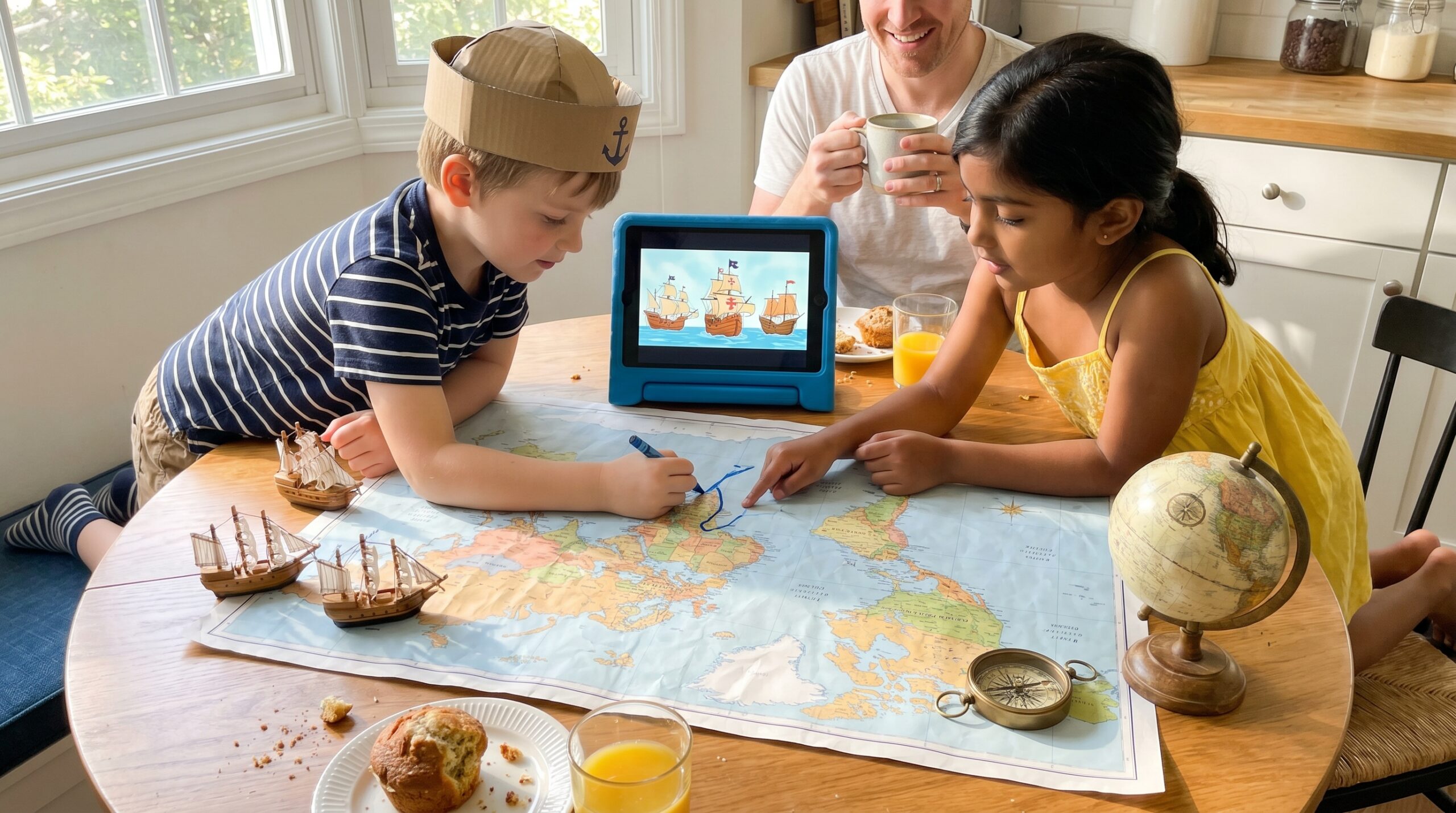
Also, you can visit Storypie for more family stories and activities. For a tiny history adventure, try drawing Columbus’s route westward on a big sheet of paper. Then, ask older kids to write a one day sailor journal and imagine life for a Taino child that same day. These gentle activities help families explore both curiosity and care.