
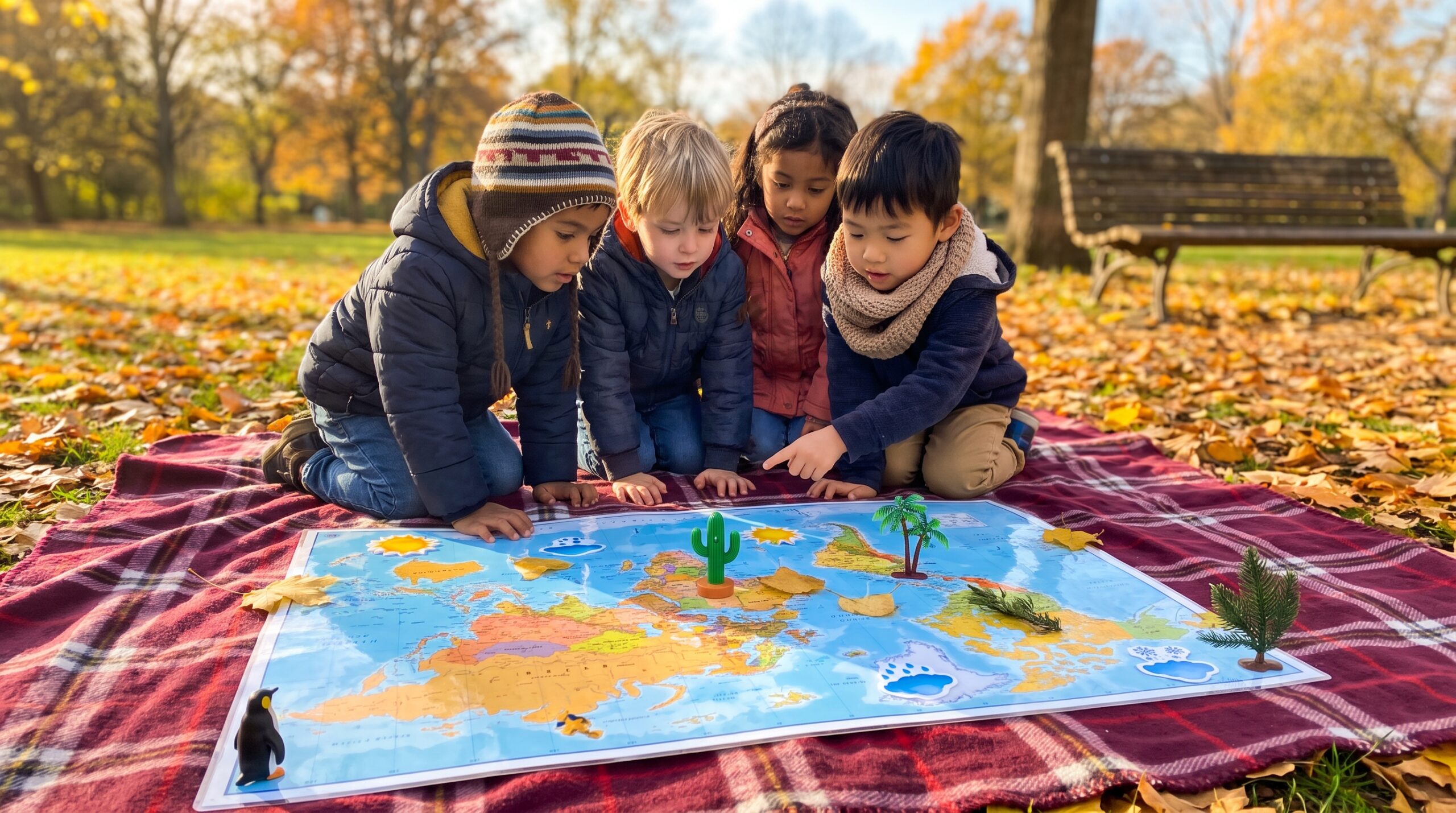
Climate zones of the world are large regions with similar long-term patterns of temperature and rainfall. This idea helps families see why some places feel hot and others stay icy. Try a one-minute map game by pointing to your country. It is quick, fun, and a little magical.
Climate zones of the world: a simple idea
A climate zone is like a big weather neighborhood. It describes long-term patterns of temperature and precipitation. Scientists often map these regions to compare places and plan food, homes, and gardens. According to a 2024 publication in the International Journal of Climatology, the Köppen-Geiger classification shows that Arid (B) climates cover 31.9% of global land area, while Cold (D) climates encompass 22.5%, Tropical (A) at 18.5%, Temperate (C) at 15.0%, and Polar (E) at 12.0%. This breakdown provides essential insight into climate distribution across the planet.
Who named the main map?
The most famous climate map uses the Köppen system. Wladimir Köppen created it and Rudolf Geiger refined it later. Köppen uses letters: A tropical, B dry, C temperate, D continental, E polar, and H highland. For example, Af means tropical rainforest while BWh means hot desert. The codes help people talk clearly about climates.
What shapes climate zones?
Many factors decide which climate sits where. Latitude matters a lot because sunlight varies with distance from the equator. Also, altitude changes temperature quickly. In addition, distance from the ocean affects how mild or extreme seasons become. Ocean currents like the Gulf Stream can warm coastlines. Finally, mountains can block moisture and create rain shadows that form deserts.
How climate zones shape life
Climate zones affect plants, food, and daily life. Rice thrives in wet tropical zones. Grapes love Mediterranean summers. Wheat grows well in temperate and continental belts. Meanwhile, tundra supports low shrubs and mosses. In short, climate zones help explain why people build different homes and celebrate different holidays.
Everyday examples
- The United Kingdom is mostly oceanic temperate.
- The southeastern United States is humid subtropical.
- Australia has a large arid interior and varied coastal climates.
Fun family activities about climate zones
Turn this topic into a playful lesson. Small activities make big learning moments. Try at-home experiments and map games that spark curiosity.
- Find your town on a Köppen map and note the code. Then describe typical seasons across the year.
- Compare a coastal town with an inland town at the same latitude and ask why they differ.
- Measure temperatures in sun, shade, and wrapped jars to see how shelter and shade matter.
- Track daily temperature and rainfall for a month and compare with historical averages from your national weather service.
Climate zones are moving
Climate zones are not fixed. As the planet warms, zones shift poleward and up mountains. Consequently, growing seasons and wildlife ranges are changing. Families can respond with small, hopeful actions. For example, plant native trees, reduce household waste, walk short trips, and watch local changes like little science detectives.
Read or listen to a story about Climate Zones of the World now: For 3-5 year olds, For 6-8 year olds, For 8-10 year olds, and For 10-12 year olds. Also, explore more family stories and activities at Storypie.
Final thought
A one-minute map game can spark curiosity and questions that lead to learning. Explore, listen, and make climate learning simple and delightful on Storypie. Happy exploring!