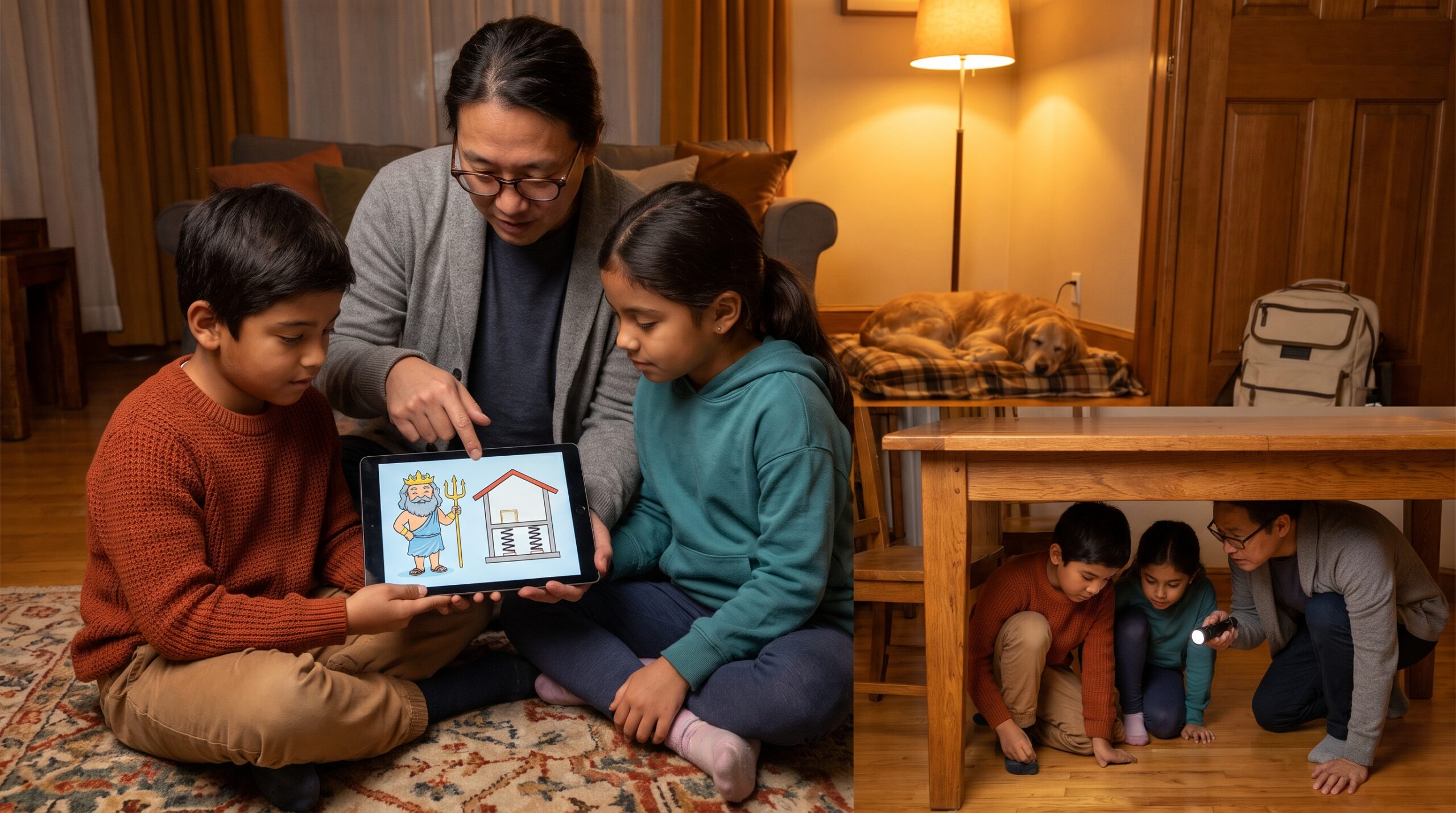
Earthquake safety for families starts with calm facts and simple steps. On an autumn evening Storypie tells a cozy Earth-voice tale. The story mixes old myths and modern Richter readings. This short guide makes science friendly and reassuring.
What is an earthquake?
An earthquake is a sudden shaking of the ground. It happens when Earth’s crust releases stored energy. Most quakes occur as tectonic plates move along faults. Also, volcanic activity can release stress and trigger shaking. In 2023, the United States Geological Survey (USGS) recorded 7,651 earthquakes worldwide, illustrating the frequency of seismic activity.
The spot inside Earth where the slip starts is the hypocenter or focus. The point on the surface above it is the epicenter. Seismic waves carry energy outward. First arrive P-waves that compress the ground. Then S-waves follow and shake more strongly. Finally surface waves usually cause the most damage. In fact, in 2023, there were 19 earthquakes worldwide with a magnitude of 7.0 or higher, which can have devastating effects and highlight the need for preparedness.
How scientists measure earthquakes
Scientists measure size by magnitude and shaking by intensity. Today they often use the moment magnitude, or Mw. Older reports may still mention the Richter scale. For intensity, experts use scales like the Modified Mercalli scale.
Seismographs record P-waves and S-waves. Therefore scientists can learn quake size and depth. This helps communities prepare better and stay safer. The U.S. Geological Survey’s National Earthquake Information Center now locates about 20,000 earthquakes per year globally, averaging about 55 earthquakes per day, reinforcing the ongoing need for awareness.
Read or listen
Read or listen to a story about Earthquake now: Read or listen to a story about Earthquake now: For 3-5 year olds, For 6-8 year olds, For 8-10 year olds, and For 10-12 year olds.
Earthquake safety for families: Quick drill
Practice Drop, Cover, Hold On as a family. First, everyone drops to the ground. Then take cover under a sturdy table or against an interior wall. Next hold on until the shaking stops. If no table is nearby, bend to protect head and neck. Also move away from windows and tall furniture.
Try a calm script during practice, for example: “Drop, Cover, Hold On together. Count to 60 while we stay safe.” Repeat twice so the drill lasts about two minutes. Practicing helps children respond with confidence.
After the shaking stops
After the quake, check for injuries and hazards. For example look for gas smells, sparks, or damaged wiring. Expect aftershocks and move carefully. If you are outdoors, stay away from buildings, trees, and power lines. In a vehicle, stop safely and remain inside until the shaking ends.
Preparedness at home
Preparedness at home is simple and powerful. Keep three days of food and water. Also have a flashlight, batteries, first aid supplies, and needed medications. Store copies of important documents and a whistle. A battery-powered or hand-crank radio helps when power is out.
Identify safe spots in each room and choose a meeting place outside. Make a family communication plan and include an out-of-area contact. These steps make families calmer and more ready.
How science and engineering reduce risk
Strong building codes and seismic retrofitting help structures survive shaking. Base isolation systems and flexible utility connections also reduce damage. Early warning systems detect first P-waves and send advance notice. Therefore people get precious seconds to Drop, Cover, Hold On or pause critical operations. The deadliest earthquake of 2023 was a magnitude 7.8 earthquake in Turkey on February 6, resulting in 59,488 to 62,013 deaths, highlighting the critical importance of effective safety measures.
Final thought
Earthquakes can feel mysterious and a little scary. Yet learning how they work makes them less so. Tell a short, gentle story with your child about the ground’s tiny but mighty rumble. Then practice your two-minute drill. Curious and prepared families are calmer families.
Explore more quiet, playful science with Storypie at Storypie. Also enjoy more Earth-themed stories and activities on our learning pages.