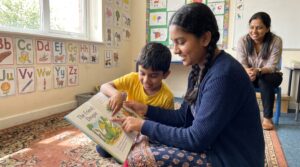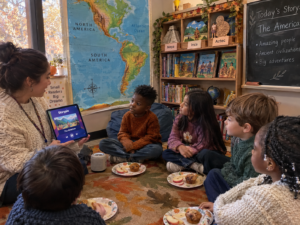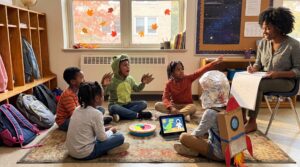
Education through storytelling ages 3-12 turns tiny moments into lasting learning. Families and teachers used stories long before schools existed. Today, stories remain joyful and memorable.
Why stories stick
Stories organize ideas into tidy, memorable chunks. Characters, plots, and cause and effect build clear memory trails. As a result, children recall events more easily than isolated facts. In fact, a 2023 study found that children retained 70% of information when taught through storytelling, compared to just 10% retention when taught through traditional methods.
Also, stories spark mental images. Those images strengthen memory. In addition, short repeats help new words settle in the mind. A 2025 meta-analysis of 25 interactive/shared reading experiments found a moderate positive effect on narrative ability for children aged 4–5 years, with the largest effect specifically observed in 4–5-year-olds.
How narrative fits each age
Ages 3 to 5
Preschoolers love sound, rhythm, and repetition. Keep episodes short. Aim for roughly eight to twelve minutes. This length matches their attention span. Also, lively sounds help build vocabulary and listening stamina. Analysis of data from the 2020–2021 U.S. National Survey of Children’s Health found that among children ages 3–5, 35% of those who were read to, told stories to, or sung to every day met all four school-readiness domains, compared to just 19% of children who had these activities only 0–3 days per week.
Ages 6 to 8
Early elementary children follow longer plots. They begin to infer motives and sequence events. Repeated episodes reveal new words and plot twists each time they listen.
Ages 9 to 12
Older children enjoy multi-episode arcs and subtler themes. They practice perspective taking and deeper moral thinking. Moreover, they can apply a character’s choices to real-life problems. A 2025 randomized controlled trial demonstrated that kindergarten learners receiving a mother-tongue–based dialogic storytelling intervention achieved 15.2% greater gains in vocabulary acquisition and 11.1% greater gains in listening comprehension compared to a control group.
What research shows
Research links narrative to memory, language, attention, and social growth. Shared reading boosts vocabulary and comprehension. Also, hearing characters’ thoughts supports theory of mind. A 2026 study published in npj Science of Learning measured first-grade-age children learning novel object functions via storytelling; they achieved a mean score of 6.1 ± 1.6—significantly above chance—and the effect size was large, illustrating the effectiveness of storytelling in teaching complex concepts.
Embedding math, science, or history inside a story helps children use abstract ideas in new ways. Repetition and exposure across home and school strengthen retention.
Audio storytelling and modern delivery
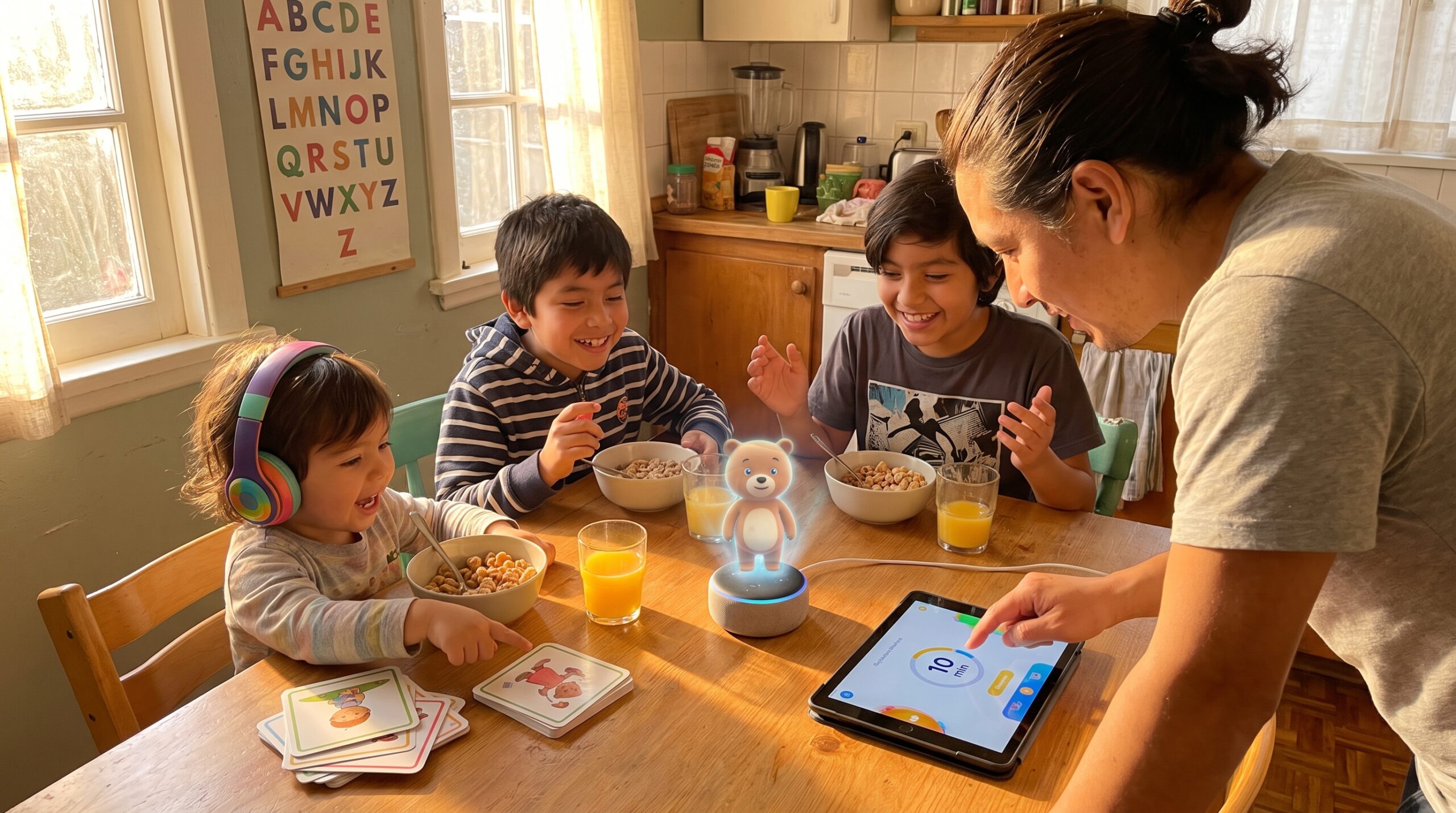
Audio episodes work well in busy homes. Play a short Storypie episode during breakfast or a car ride. Audio adds structured language exposure without screens.
For more episodes and organized audio, try the Storypie audio library. To make it simple, get the Storypie app and queue a morning episode.
Quick ways to use a Storypie episode
- Play a ten-minute episode at breakfast to introduce new words.
- Pause once and ask one prediction question: “What will the squirrel do next?”
- Invite a brief retell at line time. Three sentences is plenty.
Classroom-friendly activity
Try this three-step loop.
- Play a short episode.
- Ask students to draw the main event.
- Have partners tell one thing the character learned.
This short loop boosts recall and social talk. It is simple, playful, and effective.
Final thought
Education through storytelling ages 3-12 makes small moments meaningful. A quick morning episode, a repeated bedtime favorite, or a short classroom retell builds vocabulary, attention, and empathy.
For a gentle start tomorrow, play a short Storypie episode before breakfast or get the app. Happy listening.