
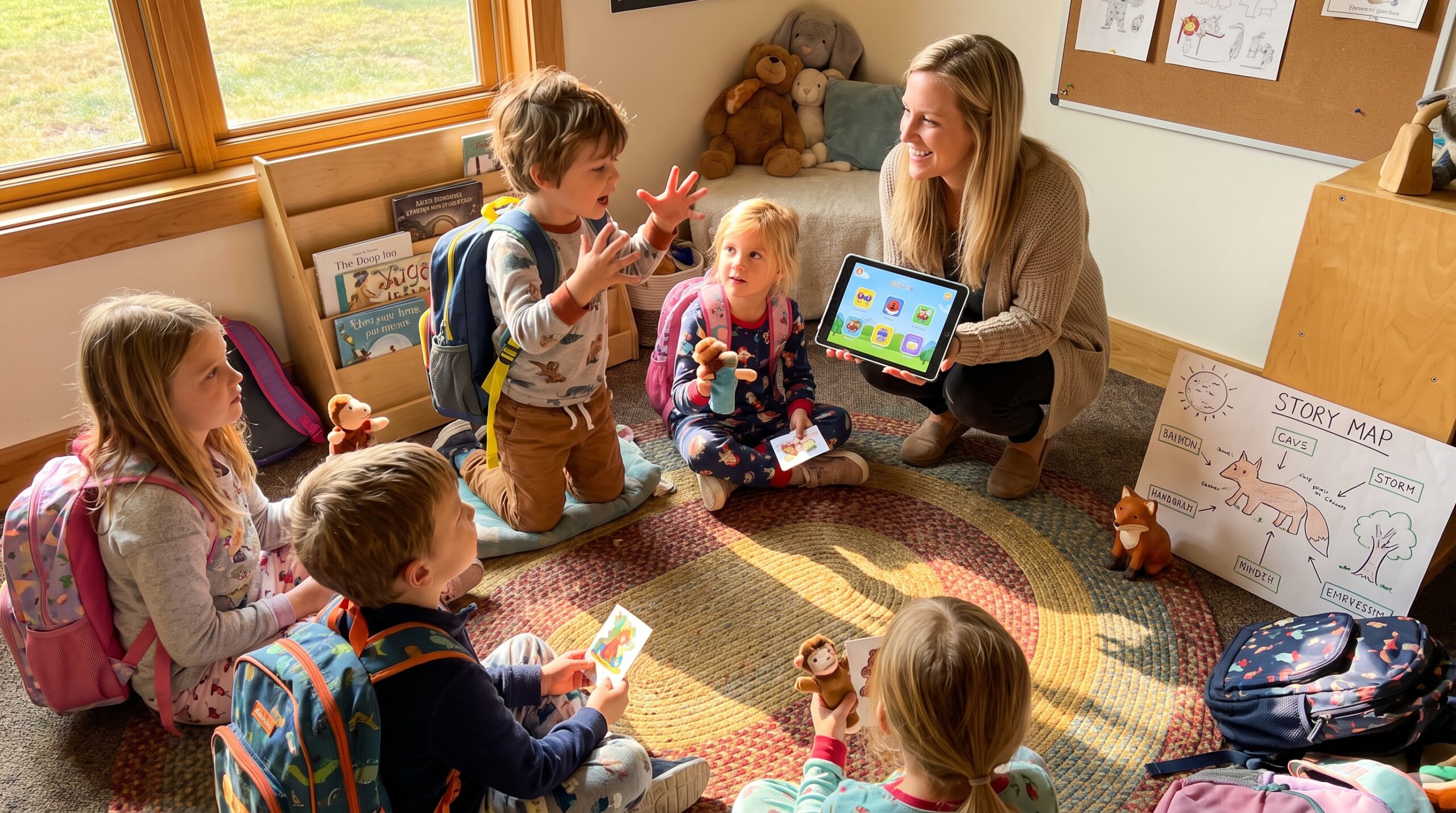
Education through storytelling ages 3-12 helps children learn facts, feelings and rules in a memorable shape. Stories give information form, and that shape fits how young minds remember. Parents and teachers find narrative easy, playful and surprisingly effective.
Why stories stick for ages 3-12
Stories create characters, goals and causes. Because of that structure, details travel together. Neuroscience shows episodic memory favors story-like events. Psychology shows causal chains and imagery help kids link ideas. In short, narrative makes learning stick. A 2023 systematic review found that storytelling-based interventions improved narrative production with effect sizes of **d = 0.51** and comprehension with **d = 0.54** in group-design studies, demonstrating the effectiveness of storytelling interventions in enhancing children’s narrative skills.
How the shape of a story helps memory
First, characters give focus. Next, goals add direction. Finally, events give sequence. These parts match how children sort experience. Therefore, a tidy story helps them keep facts and vocabulary. Furthermore, a 2020 experimental study found that live oral storytelling produced the largest gains in receptive vocabulary and story comprehension, highlighting how this method can significantly enhance early literacy development.
Simple tips for daily practice
Make a tiny ritual. After a short story, ask your child to retell one scene. Keep the task small. Two sentences work. A thumbs-up at the end helps. This ritual boosts language and recall fast. Research indicates that children whose families engage in reading, singing, or storytelling most days are more likely to be healthy and ready to learn; specifically, **55%** of preschool children in the U.S. had these experiences 4-6 days a week, compared to only **37%** among those with fewer experiences.
Quick routines that really work
- Tell a morning micro-story from the Create Story tab on Storypie.
- Ask one bright question at the end.
- Encourage a short retelling the next day.
What to expect by age group
Education through storytelling ages 3-12 looks different at each stage. Tailor the story to the child.
Ages 3 to 5
Young children like clear shapes and repetition. Use one hero and one problem. Keep language vivid and concrete. Rhythm and rhyme help too. A meta-analysis of 16 dialogic reading intervention studies found an overall effect size of **g = 0.62** for improving narrative skills, emphasizing the importance of storytelling in these early years.
Ages 6 to 8
Kids begin to infer motives. Ask what a character wanted and why. They enjoy longer chains of events and cause and effect. Integrating oral storytelling into classrooms has been shown to enhance teacher language input and support children’s narrative skills, as demonstrated in a 2023 classroom-based study.
Ages 9 to 12
Older children hold multiple points of view. They can follow layered plots and explore moral gray areas. Offer alternate endings and ask them to imagine outcomes.
Research and real results
Scholars like Jerome Bruner argued narrative is central to human meaning. Research links shared story time to larger vocabularies and stronger early reading. Studies show retelling scenes raises recall and language output. These findings support education through storytelling ages 3-12 in real classrooms and homes.
Beyond facts: feelings and social learning
Stories teach emotions and social rules. For example, discussing a character’s choice builds empathy. Fables and simple parables package kindness and fairness in memorable ways.
Formats that help
Oral telling, picture books, audio and apps each add value. Pictures invite imagery. Audio trains listening. Interactive apps can add gentle prompts. If you want a quick start, try a morning micro-story from Storypie’s Create Story tab or browse short reads in Learn & Explore. A single hero and one end question work best.
Try a tiny test
Tell a short tale about a puddle that holds the sky. The next morning ask your child to tell the best line. If they say it back, learning happened. If not, shorten the plot and try again. Small, joyful practice wins.
Education through storytelling ages 3-12 gives parents and teachers a playful, reliable tool. Try a warm voice, a short ritual and a bright question. For gentle ideas and story starters visit Storypie.










