
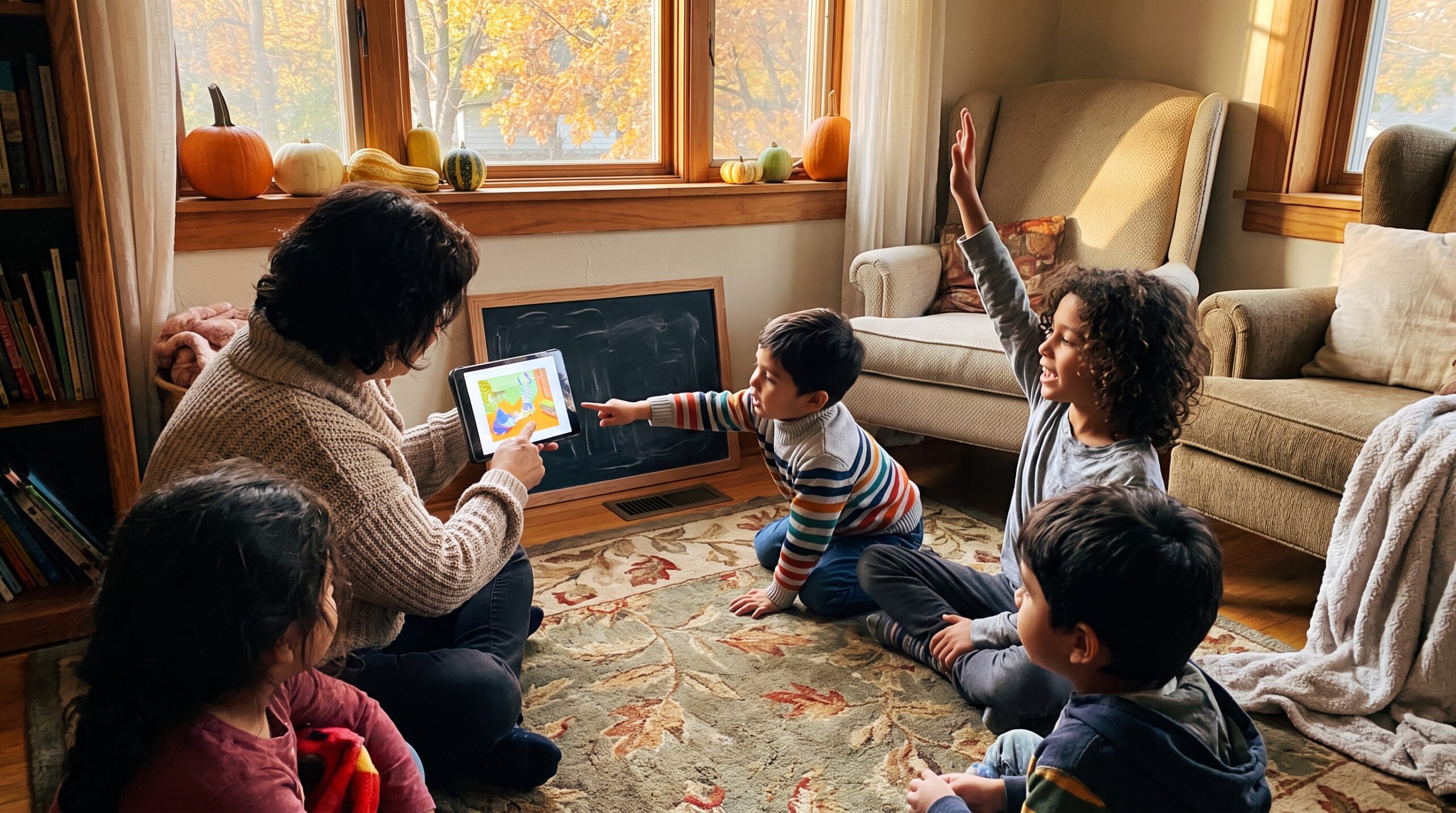
On a cozy autumn evening, education through storytelling ages 3-12 comes alive. Parents and teachers tell a short scene. Children gasp, predict, and lean forward. Stories, whether told, read, or played on a tablet, teach facts, language, values, and ways of thinking. In fact, a 2023 study found that children who learned through storytelling retained 70% of the information, compared to just 10% when taught via traditional methods.
Why narrative works
Stories give structure. A clear beginning, middle, and end helps children see cause and effect. Neuroscience shows coherent narrative lights up memory systems. Also, emotionally vivid moments create strong memory hooks. Characters with goals make abstract ideas concrete. Repeated motifs act like anchors. Children hum a chorus or rhyme later. That memory magic matters. Additionally, a 2024 longitudinal study found that storytelling-connectedness in children aged 5–8 predicted improvements in phonological awareness and reading comprehension measured 3–4 months later.
How this shows up in real life
For example, I once told a tale about a fox who forgot his hat. My four year old guessed the fox would lose it. Then the child suggested three clever ways to find the hat. By the third telling, the child used words like search, clue, and solve. No drill practice needed. That is the quiet, delightful power of story.
Education through storytelling ages 3-12: What children learn
Stories support different skills at each age. Below are quick, easy snapshots.
- Ages 3 to 5: Rapid vocabulary growth and pretend play. Stories teach new words and emotion labels. They also boost early perspective taking.
- Ages 6 to 8: Growing inference skills and longer attention spans. Kids follow multi-step plots and learn causal chains. Retelling predicts later reading success. A 2025 meta-analysis evaluating teacher-designed e-storybooks for young children showed that the experimental group’s mean narrative-competence score rose from 17.9 (pre-test) to 31.4 (post-test), a gain of 13.5 points, yielding a very large effect size (Cohen’s d = 1.87).
- Ages 9 to 12: Stronger abstract thinking and moral reasoning. Older children handle complex motives, dilemmas, and links between facts and narrative meaning.
Social and emotional gains
Stories let kids practice empathy and social problem solving inside a safe space. When a character faces a choice, listeners rehearse responses. They label feelings and imagine outcomes. As a result, real-life choices feel less scary. In short, narrative builds emotional muscles. A March 2026 study in npj Science of Learning found that scaffolding—encouraging children to tell the story—led to improved learning outcomes and higher neural synchrony between teacher and child, compared to passive listening; however, these benefits vanished in remote learning environments.
Multimodal storytelling and easy prompts
Storytelling is not only oral. Picture books, audio narration, shows, and apps carry narrative. Digital formats expand access and let families revisit favorites. For hands-on story creation, try the Create Story flow in Storypie. Also visit the Storypie home for ideas.
Research-backed tip to boost recall
Research finds a single retrieval or prediction prompt after a story boosts recall. For example, ask one prediction question after reading. Ask: What might happen next time? That short prompt deepens memory. It also invites the child to think like an author.
Quick classroom or kitchen moves
Try simple steps that fit small windows of time. These moves work at home and in class.
- Model out loud during transitions, then tell a tiny two-line scene.
- Ask one prediction question after each story to boost recall.
- Use Begin, Middle, End to help retell and check understanding.
- Invite drawings or a short audio retell so kids hear themselves.
Finally, stories are cozy and scientifically smart. If you want gentle tools that blend prompts, characters, and audio, try Storypie and the Get App page. Every child has a story to tell. When we tell together, ideas stick longer and feel warmer.