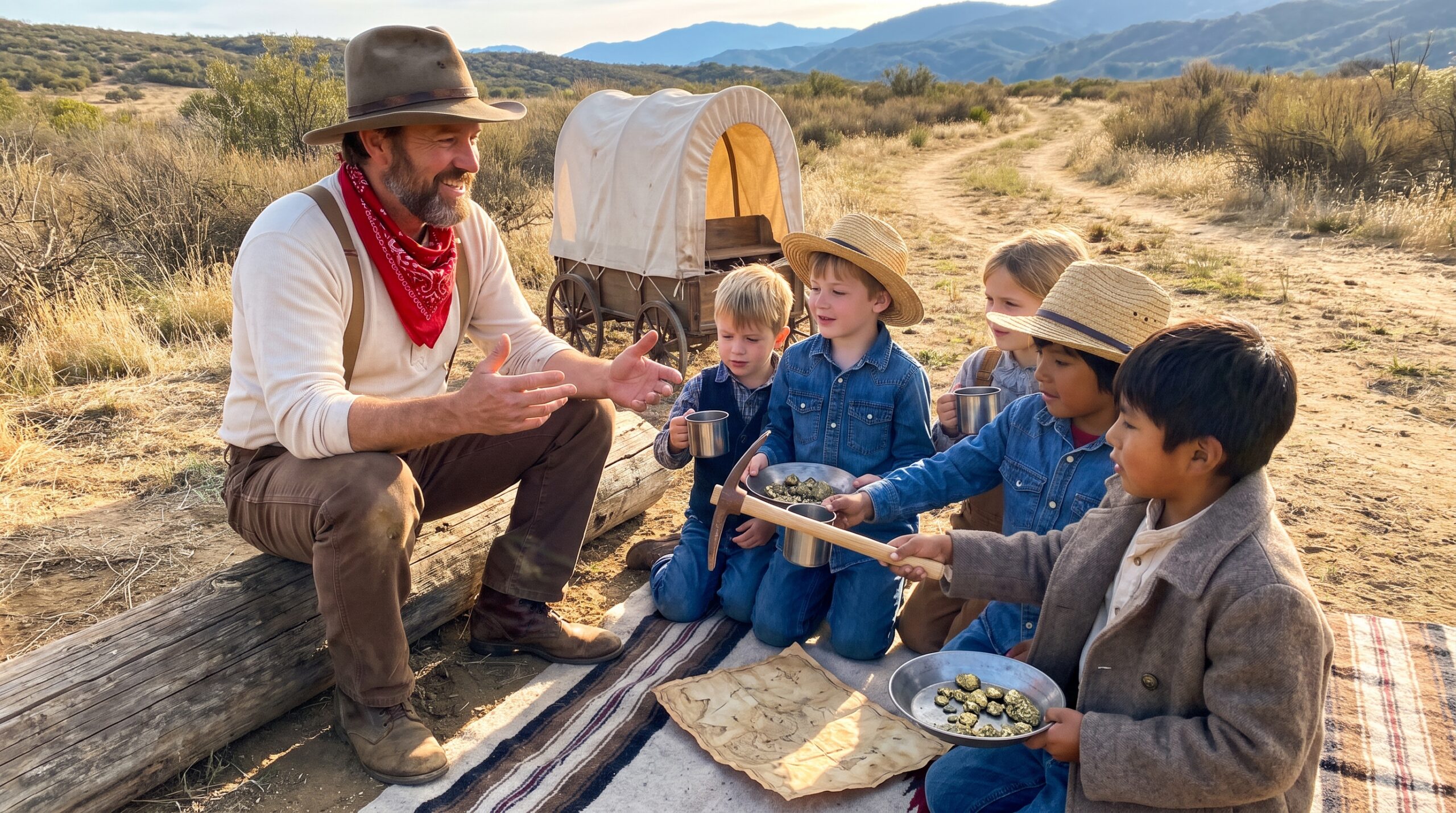
The Gold Rush family story begins with a bright find and a long, hard walk. On January 24, 1848, James W. Marshall found flakes of gold at Sutter’s Mill in Coloma, California. According to California State Parks, this discovery marked the beginning of the California Gold Rush. Word spread quickly and, by 1849, thousands rushed west. Many of them became the hopeful Forty-Niners.
Where the Gold Rush family story began
People came from across the United States and the world. Some traveled overland on the California Trail. Others sailed around Cape Horn or crossed the Isthmus of Panama. Travelers faced illness, hunger, and long days. By the end of 1849, California’s non-Native American population surged from approximately 14,000 to nearly 100,000, and by 1852, it grew to around 250,000, as highlighted by California State Parks. Sadly, many never reached a mine.
Life and work during the Gold Rush
At first, mining looked simple. Men and women panned streams and used sluice boxes to catch shiny flakes. This method is called placer mining. Later, miners followed deeper veins in rock with tunnels and stamp mills. Then hydraulic mining used high pressure water to wash hillsides. It produced more gold, with production in California in 1852 reaching $81,200,000 in value, and about 100,000 miners working that year, according to California Museum Curriculum. However, it also caused huge damage to rivers and farms.
Boomtowns, townsfolk, and daily life
Boomtowns grew overnight. Tents and rough wooden shops became busy towns. Merchants often made steadier money than miners. San Francisco swelled from a sleepy port into a busy city within a few years. Other towns faded into ghost towns once the gold ran out.
Daily life felt gritty. Camps felt makeshift and law felt uneven. Disease spread quickly. Sometimes miners made their own rules. Immigrants arrived from Europe, Latin America, China, Australia, and the Pacific Islands. Native American communities suffered loss, violence, and displacement. Discrimination and taxes targeted many foreign miners, especially Chinese miners.
Impact and legacy of the Gold Rush family story
The Gold Rush changed economies worldwide. Huge quantities of gold flowed into trade and banking. Between 1848 and 1967, California produced more than 106 million troy ounces of gold, accounting for roughly 35% of total U.S. gold production, as noted by California Department of Conservation. New businesses and services grew. The rush helped California become a U.S. state in 1850. Yet the gains had high costs. Rivers choked with silt and valleys flooded. In 1884, the Sawyer decision limited destructive hydraulic mining. Over time, laws and mining codes developed from the chaos.
Today the story survives in place names, museums, and guided panning experiences. Families can visit Marshall Gold Discovery State Historic Park or explore other sites. Recreational panning still attracts curious hands, but rules and permits vary. Always follow local guidance and honor Indigenous histories.
Read or listen to a story about Gold Rush now: For 3-5 year olds, For 3-5 year olds, For 6-8 year olds, For 8-10 year olds, and For 10-12 year olds.
At Storypie, our Gold Rush tale told by a Forty-Niner turns a hard westward journey into lessons about courage, friendship, and other treasures. Tell it with a wink. Let the tale glint like a nugget. Then walk, read, and wonder together with your family.
Explore more family-friendly history at Storypie.