
Education through storytelling ages 3-12 is not fluff. For parents and teachers, it is a practical way to teach language, facts, values, and reasoning.
Education through storytelling ages 3-12: Roots and reach
Storytelling is the oldest classroom. Long before textbooks, people passed skills and social rules through parables, myths, and folk tales. Over the last two centuries, that oral tradition grew into children’s literature and school practice.
Major thinkers like Piaget and Vygotsky explained why stories fit growing minds. Today, reviews and studies back their ideas. Meta-analyses and guidance from education groups show oral language work and shared reading improve vocabulary and comprehension. For example, the What Works Clearinghouse practice guide reported statistically significant average effects of shared-book reading on language (g = 0.20 across 16 studies) and reading- and literacy-related outcomes (g = 0.30 across five studies).
Why narrative sticks
Narrative organizes information in causal chains. Because characters want things, actions follow. Children remember the why and the what more easily in a tale than from a list of facts. A 2021 meta-analysis of narrative texts found an average advantage over expository texts for memory and comprehension (Hedges’ g = 0.55 across 150 comparisons); for participants aged 16 and under, the estimated advantage was g = 0.67.
Cognitive science finds people encode gist and causal links more reliably than isolated facts. Neuroscience shows storytelling lights up memory and social cognition networks. Even better, a shared story can align attention between teller and listener, which boosts understanding and recall. A 2021 meta-analysis of narrative-language interventions also found positive effects on children’s narrative comprehension and production: effect sizes were d = 0.51 for group-design studies and d = 1.24 for single-case-design studies.
Emotion acts like glue. A small, surprising moment in a tale makes the rest of the episode easier to retrieve. So a vivid detail often helps children hold onto facts and ideas.
Ages and outcomes
Stories match development. They meet children where they are and move skills forward.
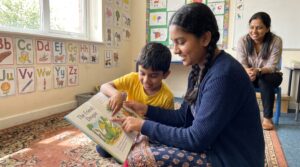
- Preschool, ages 3 to 5: Stories build spoken vocabulary, sentence patterns, and early perspective taking. Short picture books and lively read-alouds work best.
- Ages 6 to 8: Children shift toward concrete reasoning. Stories that show cause and effect deepen causal inference and bridge decoding to comprehension.
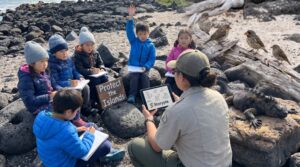
- Ages 9 to 12: Bigger plots invite abstract thinking, moral reflection, and multiple viewpoints. Longer narratives give practice in sustained attention and critical empathy.
Formats, equity, and small actions
Stories work across formats. Shared reading offers rich language exposure, while audio stories and apps expand reach for busy families. However, exposure varies by household. Landmark research highlighted early language gaps and their long-term effects. Digital stories can add a little extra support, too: a 2015 meta-analysis of technology-enhanced storybooks found small additional benefits over traditional story sharing for story comprehension (g = 0.17) and expressive vocabulary (g = 0.20).
Libraries, community programs, and accessible apps can help narrow that gap. At home, keep it short and sensory. For example, rotate three hero stories face-out for a week. Make a tiny ritual: a warm light, a cozy blanket, a whisper at the turning page.
One tiny, delightful trick: pause and ask your child to predict the ending. This simple prompt boosts memory and reasoning. Dialogic prompts like that are easy and powerful. A 2018 meta-analysis of shared storybook reading, covering 38 studies and 2,455 children, identified dialogic reading and story repetition among the factors related to children’s word-comprehension outcomes.
Narrative is efficient teaching. It fits how children think at each stage and ties facts to feeling and purpose. For playful, evidence-based practice, make stories part of the daily habit. At Storypie we offer short stories that stick, cozy and useful on a weekday night or a travel day. Learn more at Storypie.