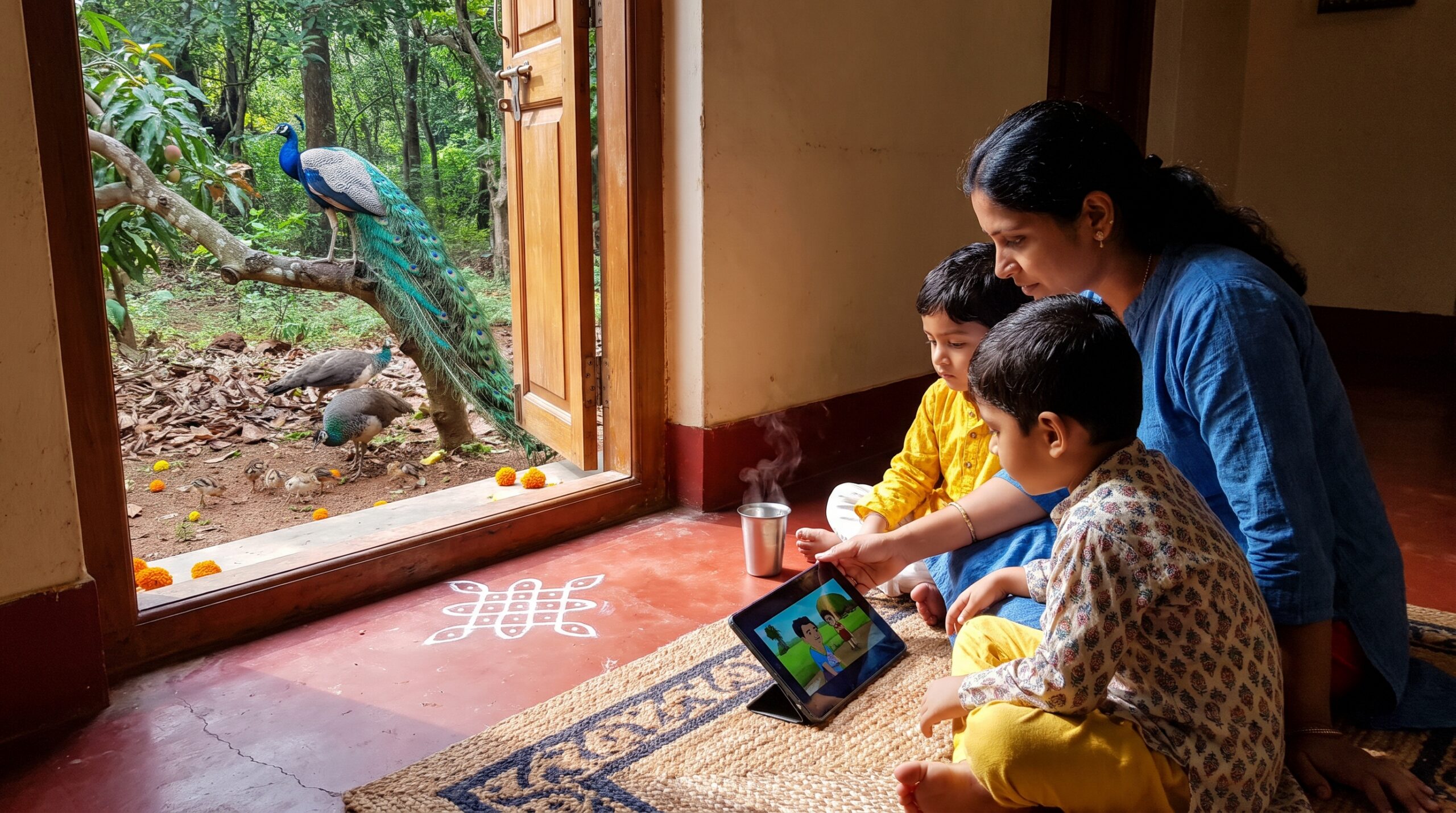
I tell short stories for a living and I love animals that arrive with a built-in wow factor. This Indian peafowl family guide helps parents and teachers share that wow. Say the scientific name slowly with kids: Pavo cristatus. Male peafowl are peacocks. Females are peahens. Babies are peachicks. Say those names out loud. It becomes a fun little game.
Read or listen to a story about Indian Peafowl now: Read or listen to a story about Indian Peafowl now: For 3-5 year olds, For 6-8 year olds, For 8-10 year olds, and For 10-12 year olds.
What I watch for when teaching about Indian peafowl
The male’s train is showy but it is not the true tail. The train comprises approximately 200 elongated upper-tail covert feathers, which can fan out to form a display up to 5 feet high during courtship, making it a spectacular sight. Tiny eye-shaped markings on those feathers are called ocelli. Also, the blues and greens come from structural color. Tiny feather structures reflect light. So the colors shimmer from different angles. Females are mottled brown and green. They are quietly beautiful and built for camouflage. I point these facts out with a smile and a nudge to look closely.
Quick facts families can say out loud
- Size and life: Males may weigh around 4 to 6 kg. Their train can add over a metre. Peachicks are small but fast. In the wild, peafowl often live 15 years or more.
- Where to see them: Native to the Indian subcontinent. They live in open forests, edges, farmland, and village areas. Feral populations exist in other countries. In a recent survey completed in December 2023, an estimated mean population size of approximately 6.1 million Indian Peafowl was recorded in Tamil Nadu, with a population density of 40.45 peafowl/km², showing their prevalence in certain areas according to the Wildlife Institute of India.
- What they eat: Omnivores. Seeds, fruit, insects, and small reptiles and amphibians. They are great little pest controllers, though they can be garden nuisances sometimes.
- Behavior: They roost in trees and forage on the ground. Groups are called a muster or an ostentation. Males fan and shake their train in courtship and call loudly at dawn and dusk.
Breeding and care notes
Peahens nest on the ground in a shallow scrape. Clutches are roughly 3 to 8 eggs; in a captive breeding study conducted in Bangladesh during July–September 2023, the average clutch size of Indian Peafowl was found to be 5.1 eggs, with a range of 3 to 7 eggs according to a recent study. Incubation is about 28 days. Chicks are precocial and follow their mother soon after hatching.
Simple parenting micro-template
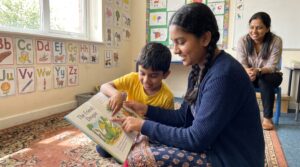
- I listen with my child. We count eyespots.
- I ask one open question: What color surprised you most?
- I give a tiny task: Draw a peafowl with three eyespots.
- We save the drawing and tell one quick story together. Do this tonight and share a tiny victory.
Cultural note: The Indian peafowl was declared the national bird of India on February 1, 1963, and appears in art and stories across South Asia. That status helps protect it. For safety, watch quietly, keep distance, do not chase or touch, and never take feathers from wild birds.
Want a cozy listen or a short read? Try the Storypie stories linked above for a simple family moment together.