
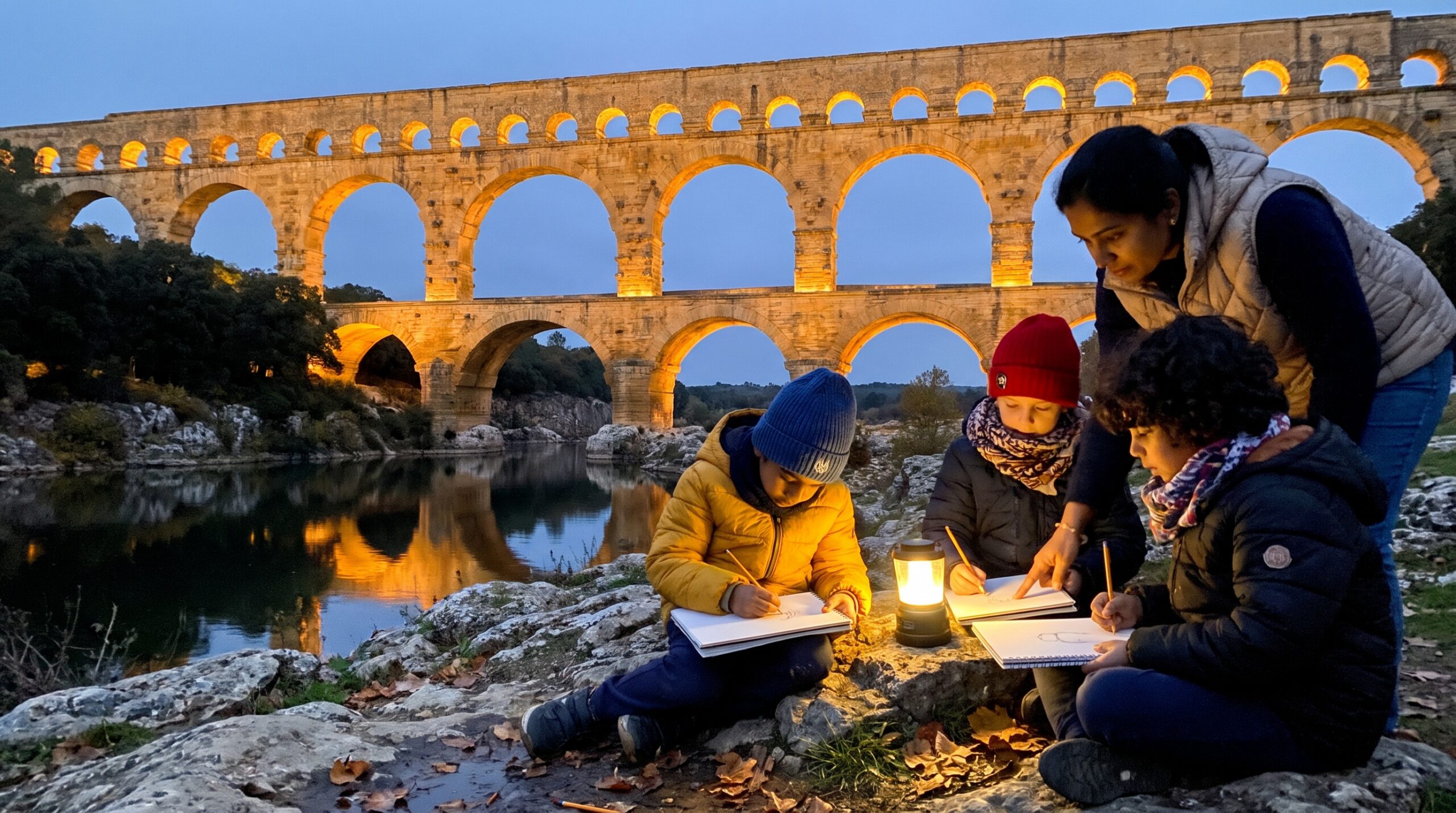
I love taking my kid to places that turn a small fact into a big idea. The Pont du Gard aqueduct impresses right away. It shows why Romans built water highways and why careful planning mattered more than raw muscle.
Read or listen to a story about Pont du Gard now: Read or listen to a story about Pont du Gard now: For 3-5 year olds, For 6-8 year olds, For 8-10 year olds, and For 10-12 year olds.
Pont du Gard aqueduct in a sentence
Pont du Gard is a Roman aqueduct bridge in southern France near Nîmes. Archaeological evidence dates construction of the Nîmes aqueduct to between 40 and 80 AD, according to the Occitanie Regional Heritage Inventory. The bridge was part of a 50.02-kilometer aqueduct that carried water from the Eure spring near Uzès to Nîmes, as the UNESCO World Heritage Centre explains. The structure stands nearly 48.77 meters high—about 160 feet—and spans about 275 meters across the Gardon valley.
Why I tell my kid this first
The bridge answers a straightforward problem: people needed water. Roman engineers solved it with a three-tiered arch bridge that held the aqueduct channel, the specus. At full flow, the aqueduct could carry up to 40,000 cubic meters of water per day, according to the Occitanie Regional Heritage Inventory—a helpful reminder that this beautiful bridge was also practical infrastructure. The lowest tier has six large arches. The middle tier has eleven. The top tier has thirty-five smaller arches. Many guides describe the whole structure as fifty-two arches in total. It makes a neat counting game for curious kids.
Quick facts to share
- Built: archaeological evidence places construction between 40 and 80 AD.
- Function: carried fresh spring water from the Eure spring near Uzès to Nîmes.
- Size: about 48.77 meters high and 275 meters long; part of a 50.02-kilometer aqueduct.
Three striking things to point out on a visit
- Arches are clever. They move weight into the pillars so the bridge stays tall and light. Ask your child to count arches per tier. It feels like math and magic at once.
- Very slight slope. Roman engineers kept the aqueduct almost flat, dropping an average of about 24.8 centimeters per kilometer so gravity could move the water along. According to Pont du Gard’s technical guide, that remarkably gentle gradient reflects careful planning. Because of the small slope, water flowed gently without rushing.
- Stonework that lasts. Builders used local limestone cut precisely so many blocks fit with little mortar. Some blocks used metal clamps. That precision helped the Pont du Gard survive floods and heavy use for centuries.
Later life and a simple family activity
After Rome, people still crossed the bridge and sometimes took stones from it. Later, engineers repaired and stabilized the structure. Today it is a UNESCO World Heritage Site and a wonderful outdoor classroom about hydraulics and planning.
Visiting tips: the site offers a visitor center, a museum, and kid-friendly walking paths. Also watch for flood warnings and follow conservation rules. For a fun activity, timebox ten minutes. Have your child tell the story in the first person, “I was a builder who needed water,” and save that recording. Small acts like this turn a monument into a memory and a tiny engineer into a confident explorer.