Galápagos Islands for kids often begin with a volcanic story. Picture islands rising from hot lava about 560 miles west of Ecuador. The archipelago includes about 19 major islands, six smaller islands, and more than 100 islets and rocks. The land covers roughly 8,000 square kilometers. The surrounding marine area is much larger and richly protected.
Volcanic beginnings and living landscapes
Volcanic origins shape everything you see. The islands formed over a hotspot beneath the Nazca Plate, so younger islands show fresh lava flows while older islands look rounded and eroded. Some volcanoes remain active, especially on Isabela and Fernandina. Consequently the landscape stays alive and keeps changing.
Meet the animals, up close and wonderfully quirky. Many Galápagos animals live nowhere else on Earth. Try these kid-friendly facts:
- Giant tortoises can live more than 100 years. Their shells match island plants.
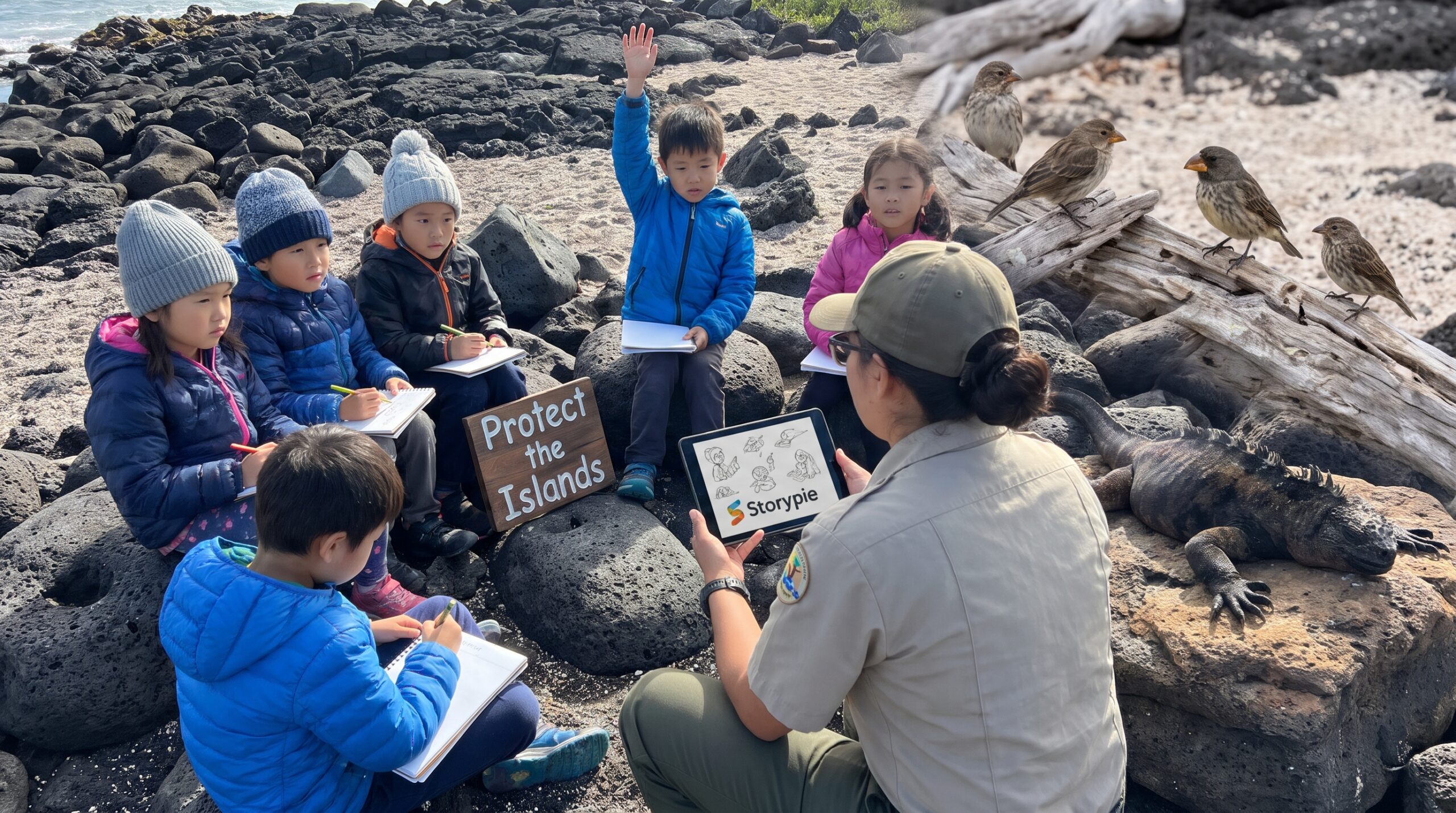
- Charles Darwin’s finches have diverse beaks. Each beak fits a particular food.
- Marine iguanas dive to eat algae. Then they bask in the sun to warm up.
- Galápagos penguins live north of the equator. The flightless cormorant cannot fly but is a superb swimmer.
- Blue-footed boobies show bright feet in a funny courtship dance.
History, people, and conservation
Charles Darwin visited in 1835 aboard HMS Beagle. Observing differences between islands helped him shape ideas about natural selection. Those ideas later fed On the Origin of Species. Today the islands act as a working laboratory for evolution.
People arrived later. The name Galápagos comes from an old word for tortoise. Today a small human population lives mainly on Santa Cruz, San Cristóbal, and Isabela. Towns like Puerto Ayora and Puerto Baquerizo Moreno welcome visitors and support conservation and research.
Protection matters a great deal. Approximately 97% of the Galápagos Islands’ land area, totaling 7,665,100 hectares, was declared a National Park in 1959, according to UNESCO. The Galápagos Marine Reserve was established in 1986 with an initial area of 70,000 km², and was expanded in 1998 to its current size of 133,000 km², making it one of the largest marine reserves in the world (UNESCO). The Charles Darwin Research Station opened in the 1960s. UNESCO listed the islands in 1978. However, threats remain, including invasive species, overfishing, tourism pressure, and climate variability like El Niño. Research shows that a 2024 Digital Dashboard by the Charles Darwin Foundation reports that at least 1,639 species have been introduced to the Galápagos Islands, of which 4% are classified as invasive. These events can cause food shortages for wildlife.
Visiting with family and simple activities
If you plan a family visit, follow biosecurity rules. Expect luggage and footwear checks. Do not bring fresh food. Stay on marked trails and never touch or feed animals. Best times to visit are December to May for warmer, greener islands and breeding activity. Alternatively, visit June to November for cooler water and excellent snorkeling. Practical facts: people speak Spanish and the U.S. dollar is used. Flights leave from Quito or Guayaquil.
Simple activities bring the islands home. For example, play a beak game with tweezers, chopsticks, or spoons. Let kids pick up different foods and discover which tool works best. Explain adaptation in plain language. Then ask one open why question and let kids guess. Curiosity leads to conversation and fresh ideas.
Read or listen to a story about Galápagos Islands now: For 3-5 year olds, For 3-5 year olds, For 6-8 year olds, For 8-10 year olds, and For 10-12 year olds.
At Storypie we bring the Galápagos Islands to life: volcanic birth, curious finches, Darwin’s discoveries, and conservation today. For a cozy activity, play this story on a fall afternoon and ask one why question to spark curiosity. A 2026 report by the Galápagos Conservancy states there are an estimated 17,200 to 24,200 Galápagos sea lions and 14,000 to 19,000 Galápagos fur seals across the archipelago, based on surveys conducted over the past decade, highlighting the ongoing monitoring and conservation efforts. Try our app.