Education through storytelling ages 3 to 12 helps facts stick by wrapping them in feeling. Parents and teachers see children hush, imagine, and remember. Stories make learning feel cozy, vivid, and joyful.
Why stories matter for young learners
Storytelling organizes information in clear cause and effect. It also adds emotion and characters to care about. Together, structure, feeling, and people create memory hooks that last. In fact, a longitudinal study of 253 children (ages 5–8) published in npj Science of Learning found that measures of oral-narrative “connectedness” predicted phonological awareness, reading comprehension, and word-reading accuracy 3–4 months in advance, emphasizing the educational value of storytelling.
How the brain responds
Neuroscience shows why education through storytelling ages 3 to 12 works so well. Narrative engagement lights up language areas and memory networks. A 2025 neuroimaging study tested 51 children (ages 6–12) and found that listening to a chapter of *Alice’s Adventures in Wonderland* activated brain regions associated with social cognition, indicating that narrative listening engages important cognitive networks. It also activates social thinking and emotion. As a result, stories prime attention and create many retrieval cues for later recall.
What changes with age
Children grow in their ability to follow and use stories. Tailoring complexity helps learning and keeps interest high.
- Ages 3 to 5: Keep tales short, repetitive, and vivid.
- Ages 6 to 8: Add reasons, motivation, and new vocabulary in context.
- Ages 9 to 12: Layer viewpoints, motives, and longer arcs.
Formats that support learning
Different formats meet different needs. Live oral stories build connection. Picture books pair image and text to boost comprehension. Audio stories support busy families and listening skills. Well-designed apps combine image, sound, and prompts. Each format can widen access and deepen learning.
Active engagement makes a difference
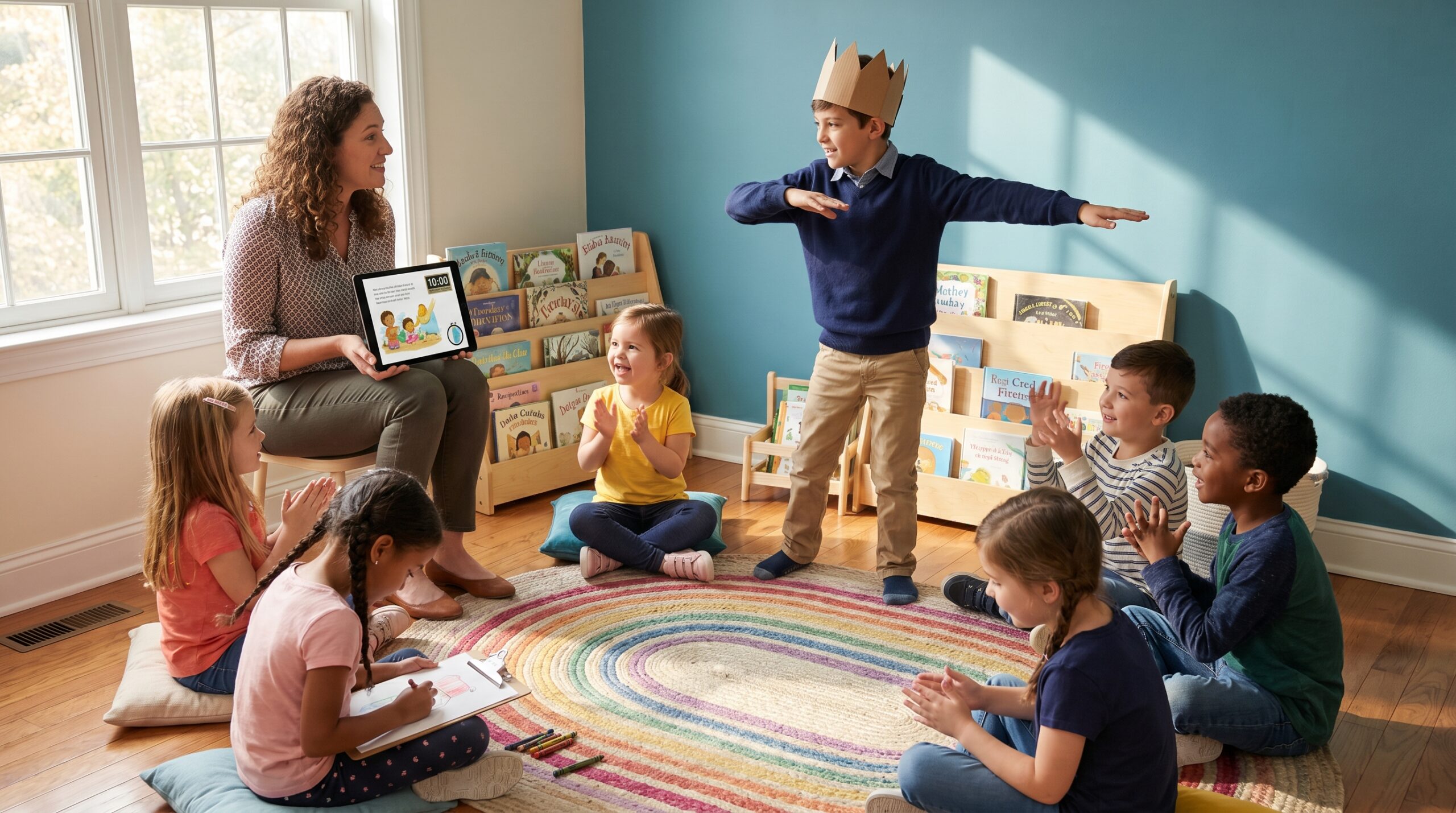
Passive listening helps, but active follow-up cements learning. Retelling, prediction questions, and playful reenactment turn listening into long-term memory work. For example, short retells strengthen sequencing and language skills.
Evidence you can trust
Research shows that shared reading and repeated narrative exposure improve vocabulary and later reading comprehension. A 2025 study found that substituting standard language instruction with teacher read-aloud for just one hour a day significantly enhanced children’s intelligence. Narrative fiction also links to gains in empathy and perspective taking. Research indicates that storytelling contributes 68.2% to the improvement of early childhood empathy skills, especially at the age of 5–6 years. Retrieval practice, like asking a child to recall a scene, strengthens long-term memory. In a 12-week randomized trial of shared storybook reading plus mentalizing discussions published in July 2024, children in the lowest baseline quartile for prosocial behavior increased their mean prosocial scores significantly after the intervention, demonstrating how storytelling can enhance social behaviors in children.
Quick tip: the 10-minute retell
Try this tiny ritual. After a 10-minute tale, ask a child to retell one vivid scene. This takes a minute. It reactivates memory and boosts language. Try it now and watch details bloom.
Classroom and home ideas
Use short retells during transitions. Ask prediction questions and praise details. Try puppets, drawings, or a quick audio recording to extend a favorite scene. Diverse and culturally relevant stories help identity and belonging, which increases attention.
Stories are powerful, but they are not automatic. Quality, developmental fit, and active involvement determine impact. Digital formats multiply reach, but avoid distracting bells and whistles.
Want tools that make storytelling easy and joyful? Explore Storypie for flexible prompts, delightful characters, and simple audio narration. Try the Storypie app for a family-friendly way to bring education through storytelling ages 3 to 12 into everyday moments: Try Storypie.