
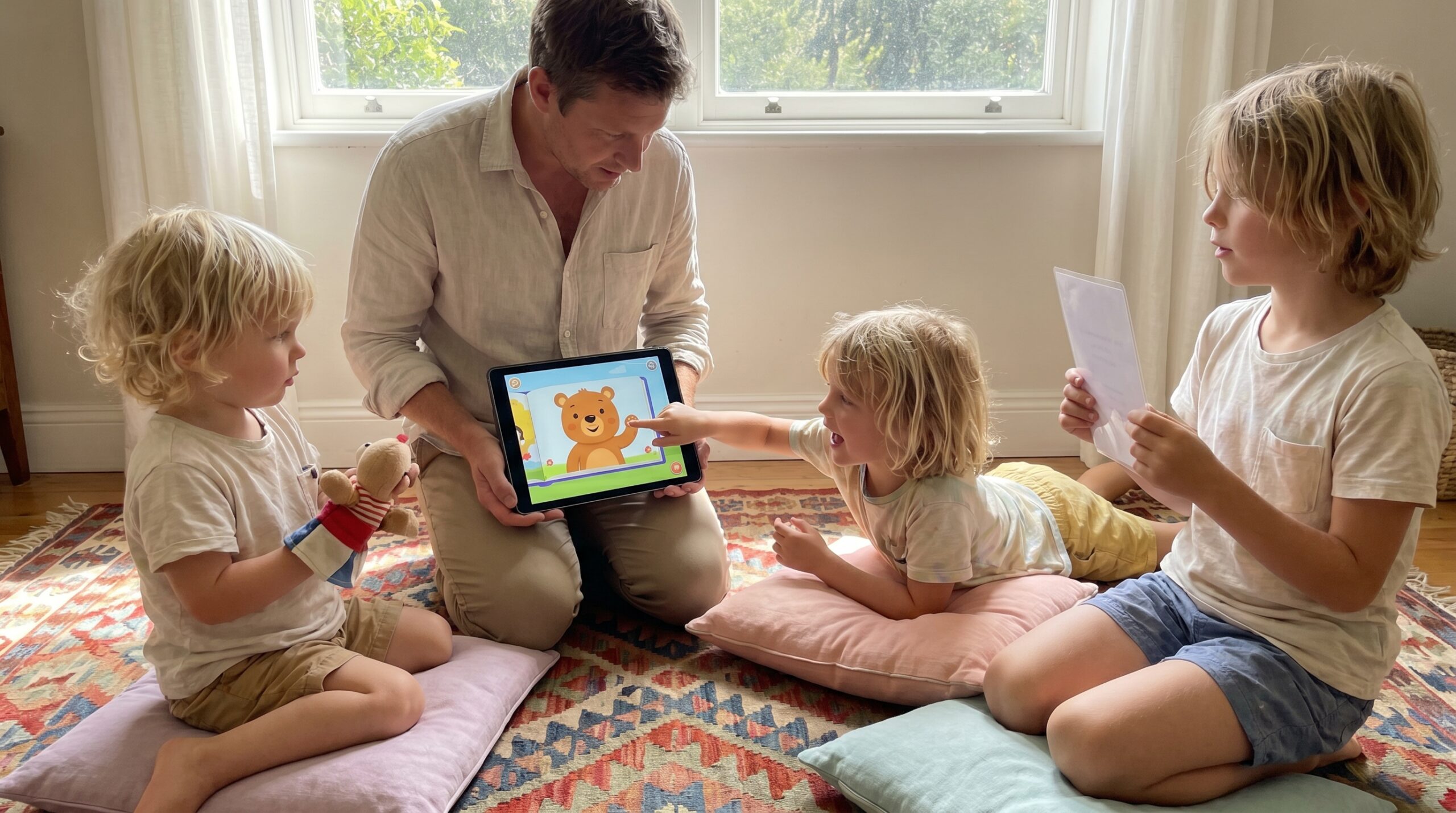
Education through storytelling ages 3 to 12 turns facts into scenes that children can remember. At Storypie we prefer short, character-driven microstories. For busy families, a tiny daily story can add lasting language and background knowledge. Research indicates that children who learned through storytelling retained 70% of the information, compared to just 10% when taught through traditional methods.
How education through storytelling ages 3 to 12 shapes learning
Education through storytelling ages 3 to 12 uses narrative structure to organize ideas. Stories create goals, actions, and consequences. Because events have shape, children form stronger memories. Researchers have long noted narrative power. Jerome Bruner argued people think in stories. Hart and Risley linked early language input to later vocabulary. Also, studies show shared stories synchronize listener and speaker brains. Therefore stories boost attention and retention.
What the research shows
Meta-analyses tie regular read alouds to better listening comprehension and later reading skill. For example, dialogic reading research finds interactive reads lift expressive vocabulary. Similarly, fiction exposure correlates with empathy and theory of mind in multiple studies. A longitudinal study published in May 2024 found that storytelling connectedness in children ages 5–8 predicted phonological awareness and reading comprehension measured 3–4 months later.
Short, repeatable tales often yield quick gains. Small, daily doses add up over months. Consequently, children receive concentrated language input and richer background knowledge. A recent study found that children using augmented-reality storybooks produced higher post-test retelling means and story-comprehension means compared with printed books, with very large effect sizes, highlighting the effectiveness of innovative storytelling methods in enhancing children’s comprehension skills (Frontiers in Psychology, 2024).
How narrative helps at different ages
Ages 3 to 5
At this stage, children gain fast vocabulary. They favor simple plots and clear character goals. Repetition and strong images anchor new words. In short, microstories accelerate early language growth.
Ages 6 to 8
Between six and eight, comprehension expands. Stories supply background knowledge needed for classroom topics. Characters and events illustrate cause and effect. As a result, narrative exposure supports decoding and understanding. A randomized controlled field trial reported that the intervention increased daily shared reading, producing standardized receptive-vocabulary treatment effect sizes that demonstrate the effectiveness of shared reading interventions in improving vocabulary, crucial for early literacy (Journal of Research on Educational Effectiveness).
Ages 9 to 12
Older children reason more abstractly. Longer narratives invite nuance and moral reflection. At this age, stories promote inference, debate, and richer discussion. They also strengthen sustained attention.
Core characteristics of education through storytelling
- Character-driven plots that focus attention.
- Clear causal chains for easier recall.
- Repeatable language that builds vocabulary.
- Age-appropriate complexity from simple to subtle.
Because the format is compact, it fits into busy routines. Short stories still deliver deep benefits. They are friendly to families, classrooms, and mixed-age settings.
Evidence and practical impact
Multiple studies link daily read alouds to measurable gains. For instance, one classroom study found improved vocabulary in eight weeks. Also, broader reviews show sustained benefits for reading and social understanding. An October 2024 evidence review reported that children in the Reach Out and Read (ROR) group scored 11.7 percentage points higher on receptive vocabulary after a 6-month intervention compared to the control group (Vanderbilt University).
In sum, education through storytelling ages 3 to 12 acts as memory scaffolding. It brings language, knowledge, and social insight together in one accessible format.
About Storypie and quiet story moments
Storypie creates short, character-focused stories that align with this research. Our microstories aim to deliver concentrated language and background knowledge. For gentle exploration, try the Storypie app or explore Storypie stories for examples.
Small daily habits matter. Over weeks, brief stories stack into real learning gains. Above all, stories help children remember, care, and grow.