
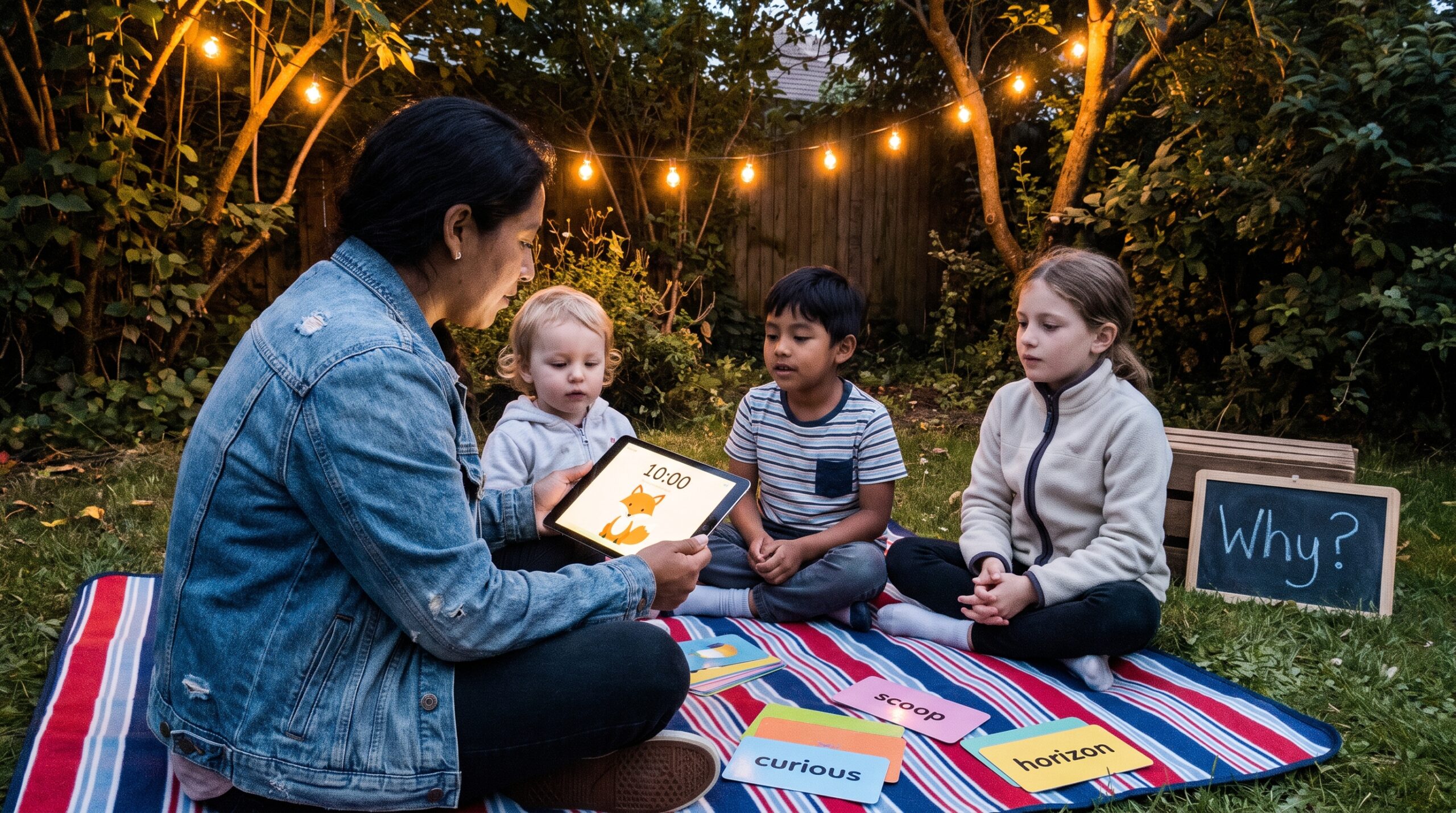
Education through storytelling for ages 3-12 organizes facts into people, goals, problems, and outcomes. In short, narrative gives children a shape to remember. For parents and teachers, this idea feels simple and powerful.
Why narrative sticks: education through storytelling for ages 3-12
Stories act as natural memory scaffolds. First, they present a beginning, middle, and end. Next, cause and effect tie events together. Because of this order, children recall whole chains of events better than isolated facts.
Emotion also helps. When a character feels joy, fear, or cleverness, those feelings tag the facts. Therefore new words and ideas arrive wrapped in meaning. That makes vocabulary and grammar easier to learn.
Development across ages 3 to 12
Young children, ages 3 to 5, follow simple picture-book plots. They love refrains and repetition. Simple, predictable text builds listening skills and new words.
Between about 6 and 8, children begin to infer motives and track consequences. Short chapters help them see how one choice leads to another.
By 9 to 12, children can hold multiple viewpoints and subtler themes. They notice irony, weigh motives, and discuss morals. Longer narratives deepen vocabulary and comprehension.
Cognitive and language benefits
Stories bundle new words into clear context. As a result children get three cues at once: situation, repetition, and emotion. Shared reading boosts spoken vocabulary and later reading comprehension.
Decades of research tie regular story exposure to stronger classroom reading outcomes. For instance, a 2024 meta-analysis covering 30 empirical studies with over 5,300 students found that narrative learning materials produced a significant positive effect on student performance, with an average effect size of 0.16 (95% CI: 0.03–0.30, p < .05). This highlights the effectiveness of narrative learning in improving educational outcomes for children, making it a strong argument for using storytelling in education. For children who fall behind, stories offer a low-cost, high-impact way to close word-exposure gaps.
Memory, attention, and rhythm
Narratives improve attention because they promise a payoff. Causal links keep children hunting for the next event. Also, repetition makes new terms stick.
Short, regular sessions tend to work better than rare marathons. Moreover, small rituals often support focus and comfort during reading time.
Social-emotional and cultural learning
Stories act as safe practice fields for empathy. Hearing about choices trains perspective taking and classroom behaviour. Across cultures, tales pass on values and identity.
Diverse characters help children see themselves and others. That inclusion matters for social learning and belonging.
Formats, delivery, and curriculum fit
Formats change with age, and each format has different strengths. Picture books suit ages 3 to 7. Illustrated early readers fit 6 to 9. Middle-grade novels serve 9 to 12.
Live, shared reading shows the strongest language gains. Good audio and well-designed apps can help when books or adults are scarce. For age-suitable picks, try a Storypie collection or the Storypie app as a friendly resource.
Equity and classroom alignment
Education through storytelling connects well with early years curricula. It supports listening skills, sequence, and narrative language. For many classrooms, storytelling is an equitable way to boost readiness.
Small libraries of rotating titles often provide steady exposure. Above all, stories teach children how to hold ideas and share them. They make learning feel like joyful, reliable magic.
Explore age-suitable stories in the Storypie collection or check the Storypie app for gentle, curated choices.